

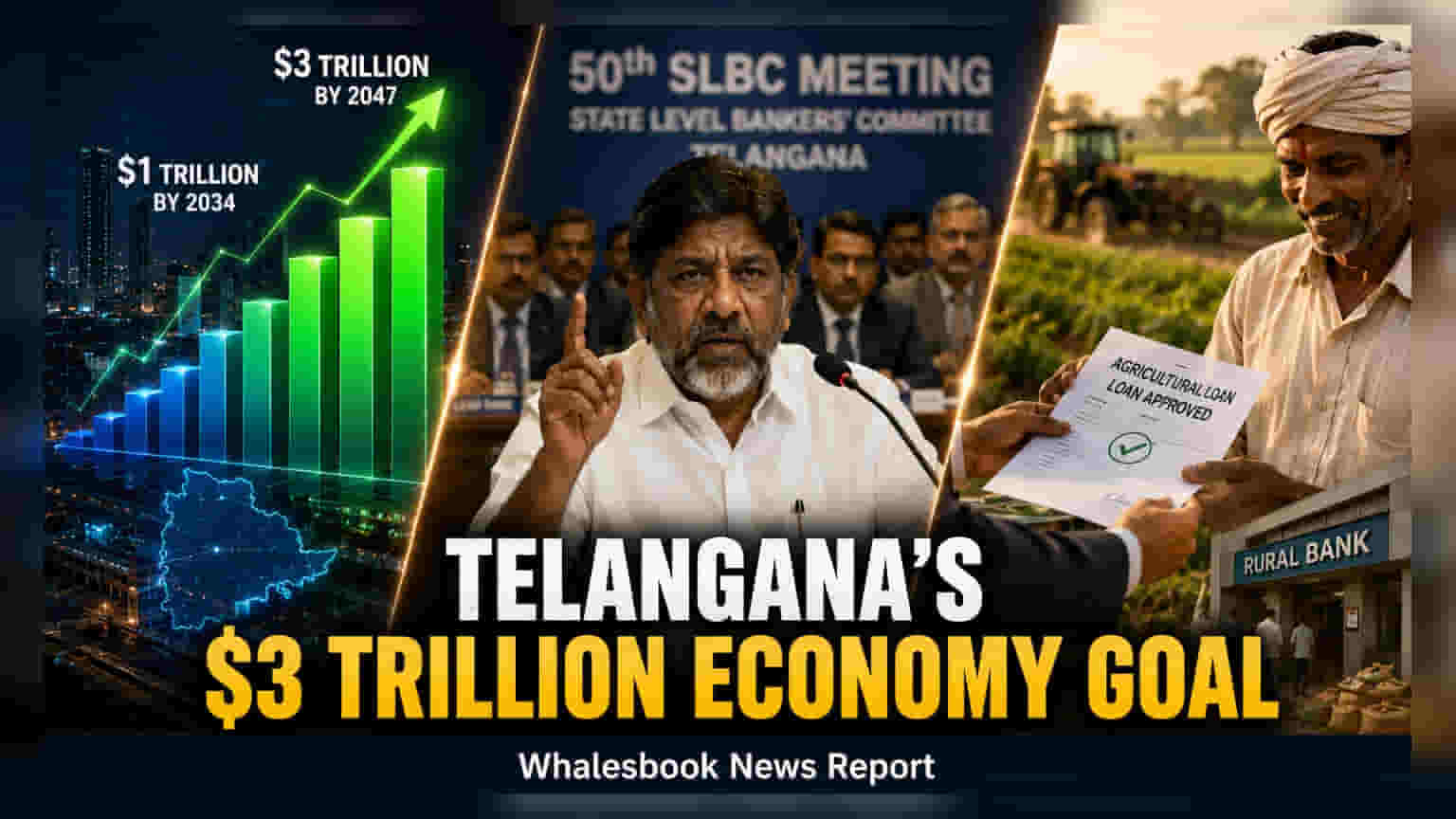
Deputy CM Bhatti Vikramarka has called for a new banking roadmap to help Telangana reach a $1 trillion economy by 2034 and $3 trillion by 2047. The plan emphasizes increasing credit flow to agriculture and small businesses. For investors, the state’s high credit-deposit ratio and inflation trends remain key areas to watch as banks align with these ambitious targets.
Telangana Deputy Chief Minister Bhatti Vikramarka has urged the banking sector to step up its support to help the state reach significant economic milestones. At the 50th State Level Bankers’ Committee (SLBC) meeting held this week, the Deputy CM outlined a vision to turn Telangana into a $1 trillion economy by 2034, eventually aiming for $3 trillion by 2047. To achieve this, the government has requested banks to draft a 'Telangana Rising 2047 Banking Roadmap.'
Developing a Banking Roadmap for 2047
The proposed roadmap is intended to move beyond general lending by setting specific annual targets across various economic sectors. The Deputy CM emphasized that the banking system needs to be more proactive, particularly in rural areas. For instance, he noted that farmers should not have to seek out banks; instead, the system should ensure credit reaches them efficiently. This aligns with the state’s focus on the 'CURE-PURE-RARE' spatial development model, which aims to balance growth between urban hubs and rural agricultural regions.
There is also a strong push to support Micro, Small and Medium Enterprises (MSMEs). These businesses are seen as the backbone of the state’s future economic growth. While the state has already seen significant agricultural loan disbursements—reaching ₹52,337 crore as of June 2026—the government is looking for even faster access to funds for entrepreneurs to ensure project timelines are met.
Navigating Risks and Credit Demand
While the push for growth is ambitious, the state’s banking sector operates under a unique financial environment. As of May 2026, Telangana reported a Credit-Deposit Ratio (CDR) of approximately 130.78%. This figure indicates that banks in the state are currently lending more than the total deposits collected locally, often relying on funds from outside the state to meet credit demand. While this shows high economic activity and credit appetite, a persistently high CDR requires banks to manage liquidity and asset quality carefully.
Another factor investors and analysts are tracking is inflation. With inflation rates in the state recorded at 6.32% in July 2026—higher than the national average—there is pressure on consumer purchasing power and the costs of implementing large-scale infrastructure projects. Successfully meeting the 2047 economic targets will depend on how effectively the banking sector can balance this high demand for credit with the risks posed by inflationary pressure and the need for prudent lending standards.
Furthermore, the government highlighted a gap in financial inclusion. Despite having many Jan Dhan accounts, about 19.13 lakh accounts in the state currently have zero balances. The government is pushing for these accounts to be utilized for saving, insurance, and credit access, which could deepen the banking penetration required to support a $3 trillion economy.
The next steps for the market will involve monitoring how the SLBC structures the new roadmap and whether credit disbursal to MSMEs and agriculture accelerates in the coming quarters without compromising the stability of local bank balance sheets.