

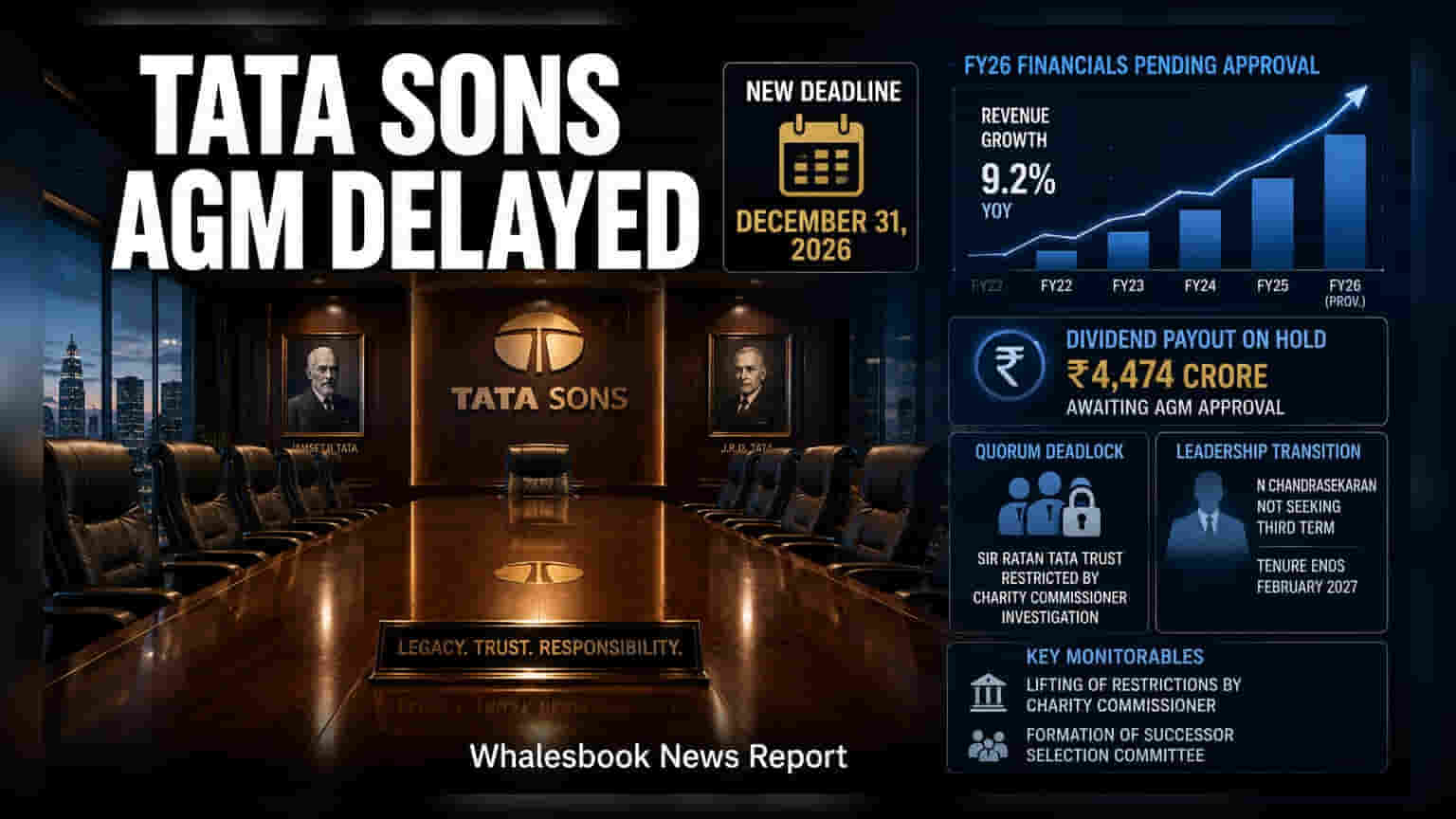
The Registrar of Companies has granted Tata Sons an extension until December 31, 2026, to hold its Annual General Meeting after a quorum failure stalled proceedings in August. The delay, caused by regulatory restrictions on the Sir Ratan Tata Trust, has temporarily held up the approval of fiscal accounts and a ₹4,474 crore dividend. Investors are monitoring the situation due to its potential impact on succession planning.
Tata Sons has secured an extension from the Registrar of Companies (RoC) to conduct its Annual General Meeting (AGM), moving the new deadline to December 31, 2026. This move follows an unusual event on August 18, 2026, when the company was forced to adjourn its AGM because it could not meet the mandatory quorum requirements set out in its Articles of Association.
The Source of the Gridlock
The quorum failure stems from a governance deadlock involving the Sir Ratan Tata Trust, a key shareholder. Under the company’s rules, board meetings require the joint participation of representatives from both the Sir Ratan Tata Trust and the Sir Dorabji Tata Trust. Currently, the Sir Ratan Tata Trust is unable to appoint or send a representative to these meetings due to restrictions imposed by the Maharashtra Charity Commissioner. This regulator is conducting an ongoing investigation into the trust’s governance structure, which has resulted in a temporary freeze on its ability to participate in formal business activities.
Financial and Strategic Consequences
This administrative standstill has immediate practical effects for the conglomerate. The delay prevents the formal approval of the fiscal 2026 financial accounts, which is a standard procedure at an AGM. Consequently, the distribution of a ₹4,474 crore dividend payout to shareholders is currently on hold until the meeting can be reconvened.
Beyond the financials, the situation creates uncertainty regarding the company’s long-term leadership. Tata Sons is currently preparing for a major transition, as N Chandrasekaran has announced he will not seek a third term as Chairman, with his current tenure set to conclude in February 2027. The inability to hold the AGM complicates the formalization of the selection committee responsible for identifying his successor, creating a layer of governance uncertainty that market watchers are tracking.
Investor Monitorables
The core issue remains the regulatory inquiry into the Sir Ratan Tata Trust. For the conglomerate, the resolution of this matter is critical to resuming normal governance processes. Investors will be looking for updates on two main fronts: the lifting of restrictions by the Charity Commissioner, which would allow the trust to resume participation in Tata Sons' business, and any subsequent announcements regarding the formation of the successor selection committee. As Tata Sons is the holding company for the broader Tata Group, stability at the top is a key point of interest for shareholders across the conglomerate’s listed entities.