

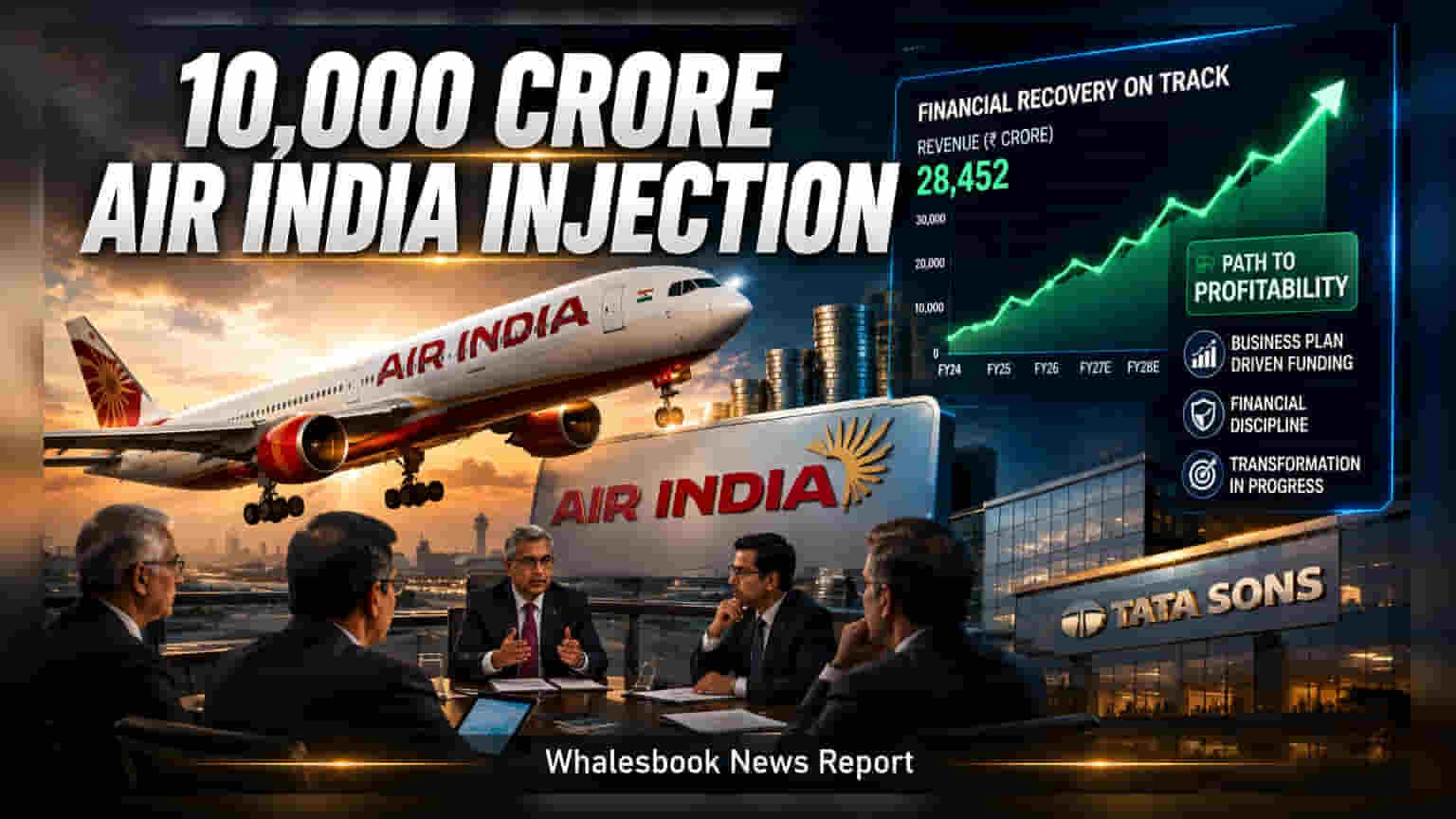
Tata Sons has cleared a ₹10,000 crore capital boost for Air India, contingent on strict performance targets. This move follows an FY26 loss of ₹22,238 crore, signaling a shift toward financial discipline at the airline and highlighting the parent company’s own regulatory constraints.
The board of Tata Sons has approved a fresh capital infusion of over ₹10,000 crore into Air India. While this is a significant commitment to support the airline's ongoing transformation, the funding is not unconditional. The parent company has mandated that future releases of these funds will depend on Air India’s management submitting detailed business plans for each tranche, marking a clear move toward tighter fiscal accountability.
This capital injection comes after a challenging year for the airline. In the financial year 2026, Air India reported a net loss of ₹22,238 crore, which was more than double the ₹10,859 crore loss reported in the previous year. This widening gap has pressured the conglomerate to move away from open-ended support toward a model that demands better efficiency and clearer paths to profitability.
Regulatory and Financial Hurdles
The funding strategy is also being shaped by regulatory realities. Tata Sons is currently navigating the Reserve Bank of India’s framework for Core Investment Companies. As a large entity under the 'Upper Layer' of non-banking financial regulations, the parent company faces strict rules that limit its ability to provide financial guarantees or letters of comfort for its subsidiaries. This means Tata Sons cannot easily use its own balance sheet to back the airline's debt, necessitating more direct and conditional cash support.
Air India currently carries an estimated debt of ₹40,000 crore across 11 lenders. State Bank of India holds the largest exposure at ₹18,500 crore, followed by Bank of Baroda at ₹5,938 crore. These lenders and the airline’s broader financial health will be central to how the parent company manages its capital allocation in the coming quarters.
Leadership and Strategic Transition
The airline's turnaround plan coincides with a major leadership transition at the parent company. Tata Sons Chairman N. Chandrasekaran is scheduled to step down in February 2027 following a lack of board consensus on his reappointment. This timeline creates an environment of uncertainty regarding the long-term strategy for major group investments. Investors and stakeholders are closely tracking how the airline meets its business targets under these conditions. The key monitorable for the coming months will be whether the airline can stabilize its operations and prove it can use the new capital effectively to narrow its losses, while satisfying both the parent company’s new disciplined approach and the concerns of its lenders.