 Whalesbook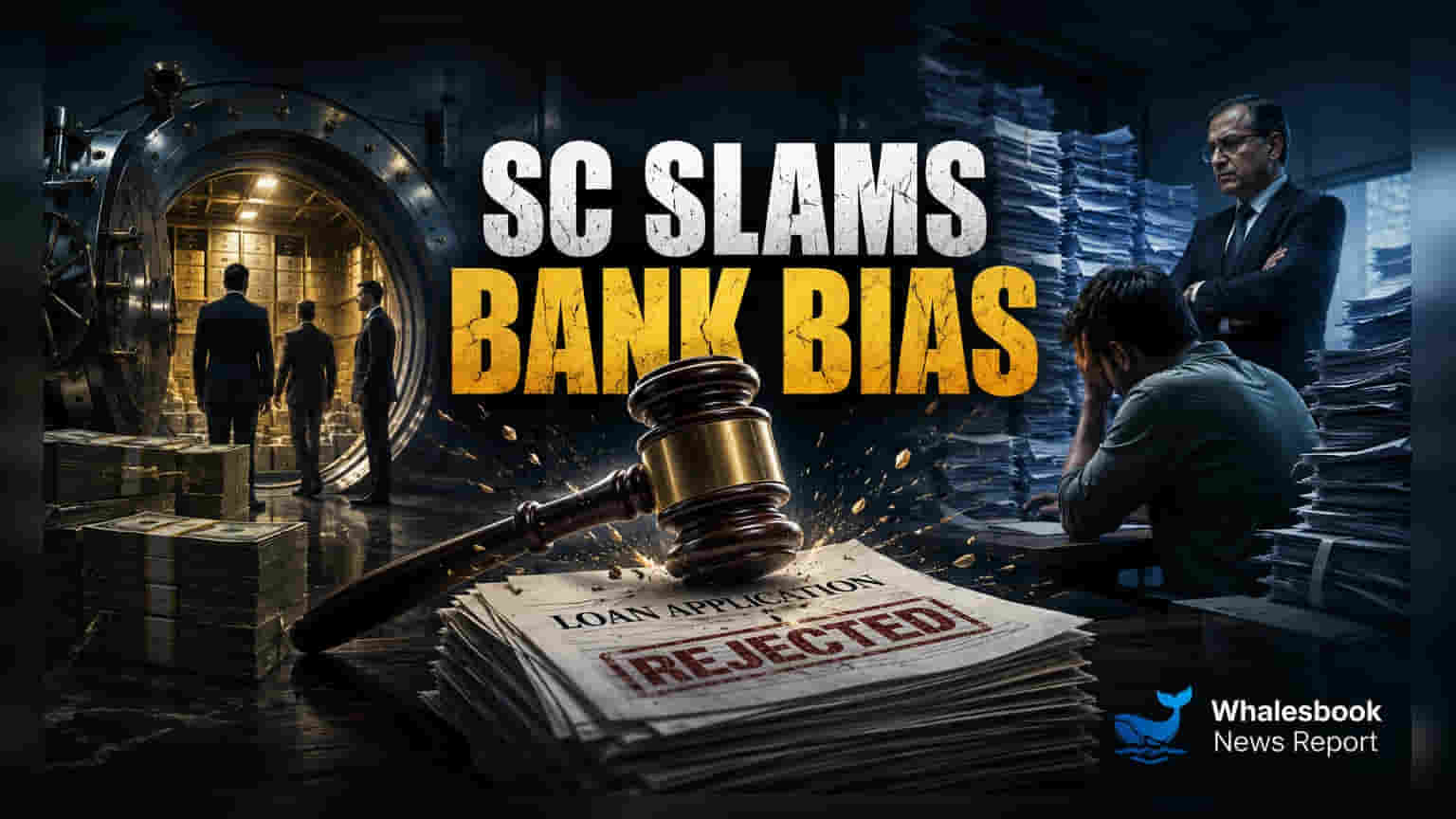


Court Highlights Lending Disparities
The Supreme Court has pointed out a significant difference in how banks handle large corporate loans compared to smaller individual borrowings. Justices Ahsanuddin Amanullah and R. Mahadevan noted that banks are notably "casual" when approving substantial credit for major corporations. This approach starkly contrasts with the "stringent conditions and tedious process," which the court described as "borderline harassment," faced by individuals seeking personal loans. The court considers this a "troubling trend" indicating systemic bias.
Call for Equitable Loan Access Policies
In response, the apex court has recommended that the government explore policy options to improve loan accessibility for the general public, especially those from lower-income backgrounds. The court emphasized that this does not mean weakening fundamental lending rules, which remain under the Reserve Bank of India's and banks' authority. The main goal is to make loan application and recovery processes fairer and more streamlined.
Case Study: SBI and Bhaskar International
The Supreme Court's comments arose during a case involving Bhaskar International and the State Bank of India (SBI). The matter concerned the recovery of a loan of over ₹8 crore granted by SBI in 2019. The court found "negligence" by SBI officials in approving this loan, noting that the borrower could not start repayment and the account quickly became a Non-Performing Asset (NPA). While the court denied Bhaskar International's request to halt SBI's property seizure, it used the case to highlight its wider concerns about banking practices.
Examining Systemic Issues and Recovery Methods
The Supreme Court's recent remarks shed light on ongoing discussions about Indian banks' lending and recovery practices. Retail lending in India has grown, accounting for 35% of assets under management by 2025, up from 28% in fiscal year 2018. Conversely, corporate lending has decreased from 50% to 38% in the same period. This shift coincides with a rise in personal loan NPAs, which increased to 1.6% from 0.9% in fiscal year 2022, suggesting potential stress in retail lending. The Supreme Court's critique of SBI's loan assessment for Bhaskar International, where a large loan was approved despite immediate default, points to potential weaknesses in due diligence for major corporate loans. Recovery processes in India involve general methods and legal actions like the SARFAESI Act and Debts Recovery Tribunals (DRTs). The court's call for fairer recovery suggests that while legal frameworks exist, their practical application needs improvement to prevent undue hardship.
Concerns Over Inconsistent Diligence and Recovery Challenges
A key issue highlighted by the Supreme Court's remarks is the apparent inconsistency in due diligence standards between corporate and individual lending. The "negligence" noted in SBI's approval of a significant corporate loan contrasts with the rigorous, and sometimes described as harassing, procedures for smaller loans. This raises questions about the thoroughness of risk assessment for large loans, especially when immediate defaults occur. The recovery process for corporate defaults can become lengthy, as seen in the Bhaskar International case where the borrower sought relief. Moreover, the increase in personal loan NPAs indicates that recovery remains challenging even with strict individual lending processes. SBI's internal reports detail various recovery strategies, but the court's observations imply that the effectiveness and fairness of these processes, particularly when compared to loan sanctioning, need closer examination.