 Whalesbook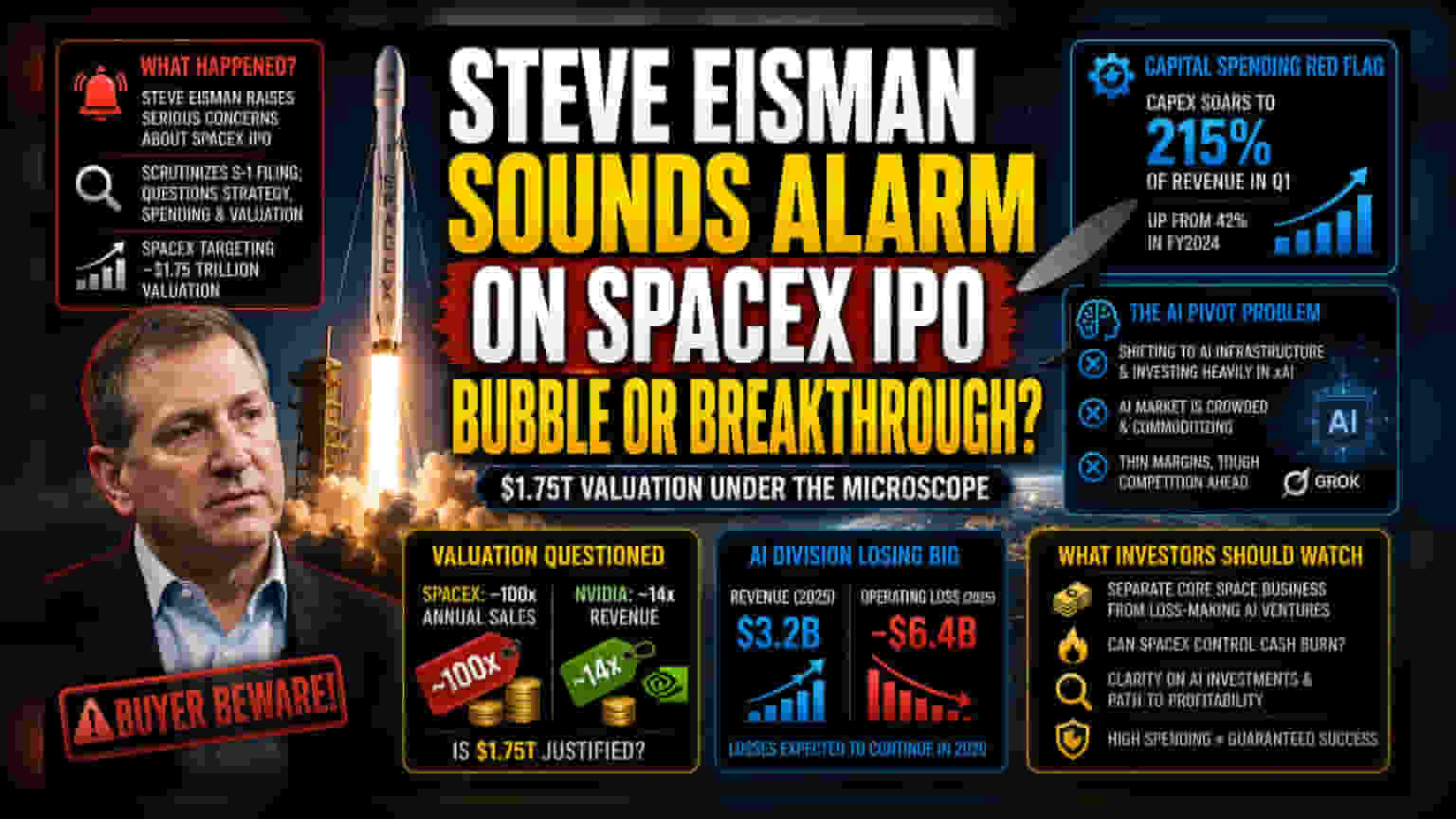


Famous investor Steve Eisman has raised concerns about the upcoming SpaceX IPO, pointing to massive spending on AI infrastructure and questions about the company's high valuation.
What Happened
Steve Eisman, the investor well-known for correctly predicting the 2008 housing market crash, has voiced significant reservations about the upcoming public listing (IPO) of SpaceX. In his analysis of the company's S-1 regulatory filing, Eisman pointed to several areas of concern, particularly regarding the company's shifting business strategy and its heavy spending on new technology. The company is reportedly aiming for a valuation near $1.75 trillion, a figure that Eisman and other market watchers are examining closely as potential investors prepare for the offering.
The Capital Spending Concern
One of the primary red flags raised by Eisman involves how much money SpaceX is spending. He highlighted that the business has become extremely capital-intensive, meaning it is pouring a massive amount of cash into infrastructure and expansion. Data cited from the filing shows that capital expenditure, or the money spent on equipment and infrastructure, rose to 215% of revenue in the first quarter, up from 42% in the previous fiscal year. While high spending is common for growing tech firms, Eisman argues that this scale of spending requires a deep look at whether the company is over-leveraging its resources.
The AI Pivot and Competitive Reality
Eisman’s critique is largely driven by what he describes as SpaceX’s move to position itself as an AI infrastructure provider rather than just a company focused on space exploration and satellite internet. This shift has led to significant investment in Elon Musk’s AI firm, xAI, and its chatbot, Grok. However, Eisman expressed skepticism about the company's ability to compete in the crowded AI market. He argues that AI products, including large language models, are becoming commoditized. This means that when many companies offer similar products, it becomes difficult for any single player to maintain a unique advantage or charge premium prices, potentially leading to thinner profit margins.
The Valuation Question
Eisman also questioned the valuation requested by the company, which he suggests is around 100 times annual sales. He compared this to industry leaders like NVIDIA, which trades at roughly 14 times its revenue despite also showing strong growth. The financial data released in the prospectus shows that the AI division brought in approximately $3.2 billion in revenue in 2025 but recorded an operating loss of $6.4 billion. With losses projected to continue into 2026, Eisman suggested that investors should approach the financial narrative in the filing with caution, noting that some of the company’s stated ambitions feel more like science fiction than grounded business plans.
How Investors May Read This
For those watching the IPO, the key takeaway is the need to distinguish between the company’s core space business and its newer, loss-making AI ventures. When a company pivots to a new, capital-heavy area like AI, investors often look for proof that this spending will lead to actual profit. Eisman’s warnings highlight that high spending alone does not guarantee success, especially in a sector where competition is fierce and products can quickly become similar. Investors may track whether the company can control its cash burn and provide more clarity on how its AI investments will generate sustainable returns compared to its established operations.