

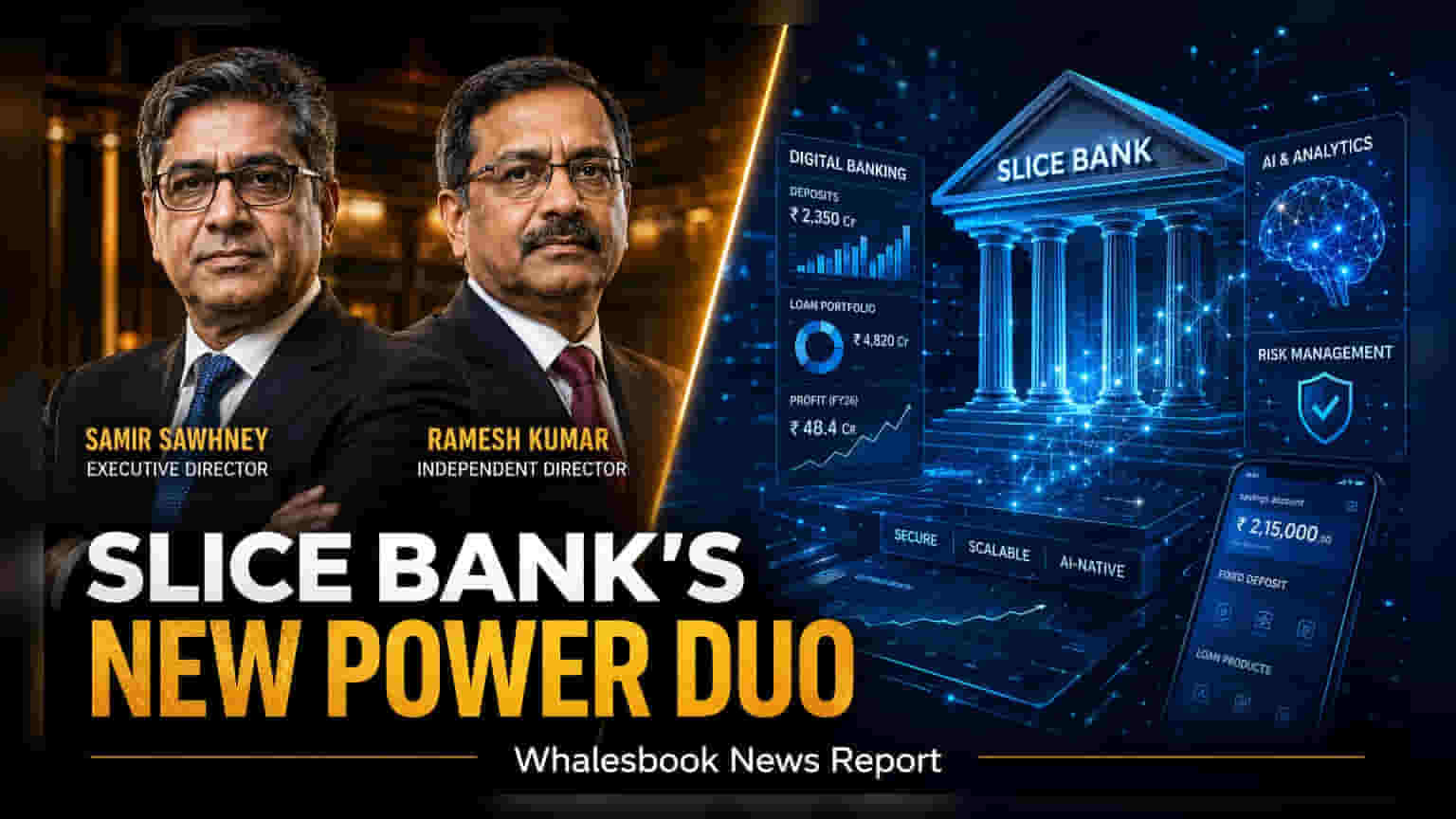
Slice Small Finance Bank has appointed senior executives from SBI and ICICI Bank to its board to bolster its digital banking strategy. As an unlisted entity, this leadership change highlights the bank's professional shift following its transition to a full-stack financial institution. Investors should note the company's recent move into profitability while navigating intense competition in the digital banking space.
Slice Small Finance Bank has strengthened its leadership team by appointing former State Bank of India (SBI) and ICICI Bank executives to its board. Samir Sawhney, who brings over three decades of banking experience, has been named Executive Director, while Ramesh Kumar joins as an Independent Director. These appointments have received necessary approvals from the board and the Reserve Bank of India (RBI).
The strategic focus of these additions is to deepen the bank’s digital and AI-native capabilities. Samir Sawhney is well-regarded for his extensive tenure at SBI, where he managed large-scale treasury operations. Ramesh Kumar, with his deep background in technology management from his two decades at ICICI Bank, is expected to help the bank navigate the complex requirements of building a secure and scalable digital infrastructure. This professional expertise is a significant pivot as the company matures from its roots as a payments-focused app into a regulated, full-stack bank.
Financial performance has been a central part of this transition. For the financial year 2026, the company reported a maiden annual profit of ₹48.4 crore. This momentum continued into the new fiscal year, with the bank posting a profit of ₹50.9 crore for the quarter ended June 30, 2026. These numbers mark a notable change for a business model that previously relied heavily on consumer credit and payments, now evolving into a broader institution offering savings accounts, fixed deposits, and varied loan products.
Strategic Transition and Risks
It is important for market observers to understand that Slice is an unlisted public company. While its recent profit growth is positive, the transition from a niche technology player to a licensed bank carries significant execution risks. The banking sector in India is highly competitive, and the company must now manage traditional banking challenges, such as stringent regulatory compliance and the need for disciplined underwriting, alongside its digital ambitions.
The merger with North East Small Finance Bank, finalized in October 2024, provided the banking license required to offer a full suite of services. However, this expansion requires the bank to successfully manage a more diverse loan book. Moving away from a pure unsecured lending model to a broader mix of products involves maintaining asset quality, especially when interest rates or economic conditions change. Unlike traditional lenders, the bank must prove that it can maintain its digital efficiency while managing the credit risk that comes with a growing customer base.
Moving forward, the primary monitorables for stakeholders will be the bank's ability to maintain its profit margins while scaling its deposit base and diversifying its loan portfolio. The integration of its legacy tech systems with the requirements of a traditional regulated bank will remain a critical area of focus for the newly appointed leadership.