

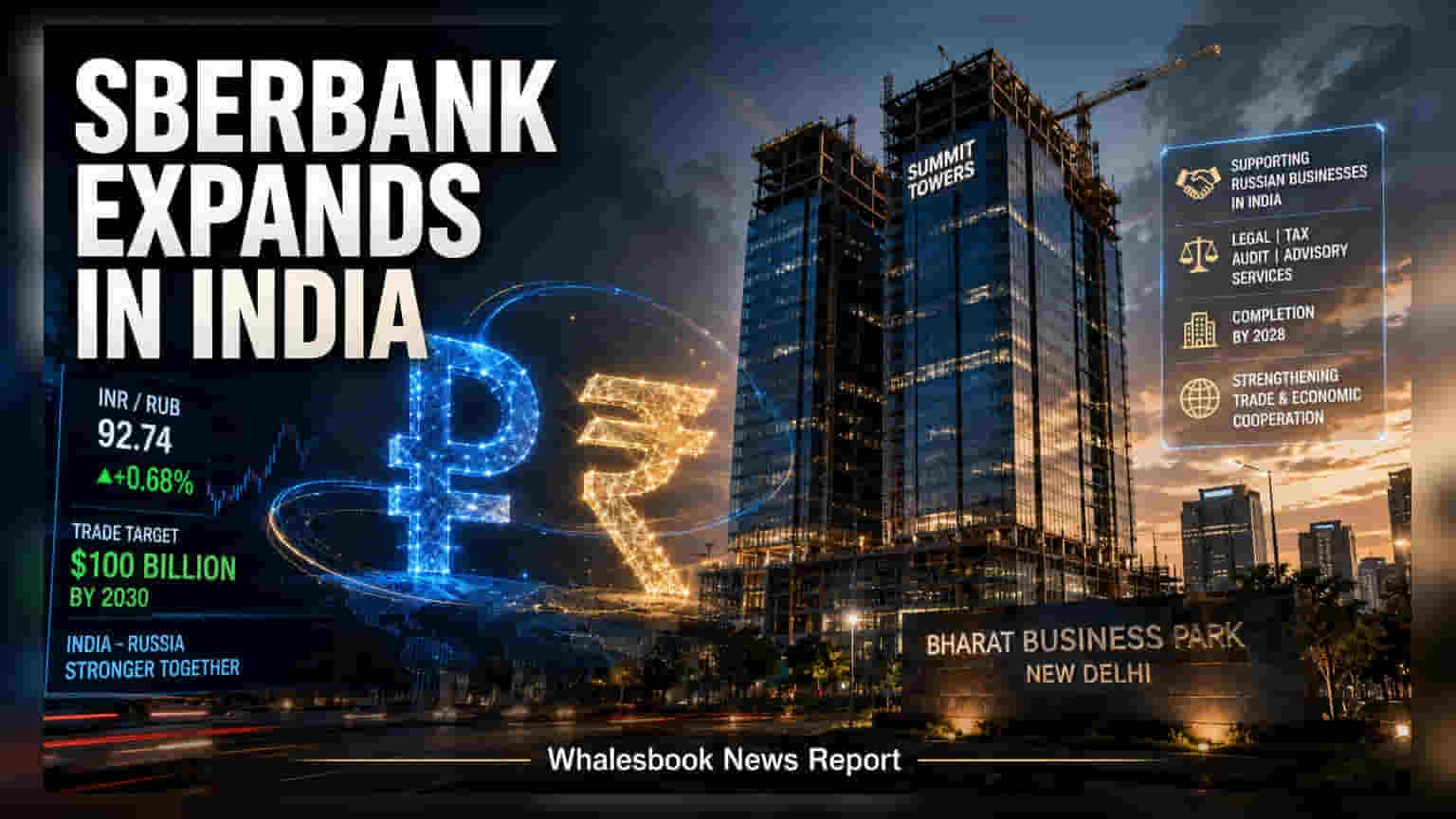
Russian lender Sberbank has acquired two under-construction office towers in New Delhi’s Bharat Business Park to establish a new trade and support center. The project is expected to be completed by 2028, aiming to help companies meet the $100 billion India-Russia annual trade target by 2030. Sberbank is not listed on Indian stock exchanges, but the investment marks a significant step in expanding its physical infrastructure in the country.
Sberbank, the largest financial institution in Russia, has acquired two under-construction office buildings in New Delhi to create a dedicated hub for trade and economic cooperation. Known as 'Summit Towers' and located in the Bharat Business Park, the properties are scheduled for completion by 2028. This long-term real estate investment is designed to provide Russian businesses with essential support services, including legal, tax, and audit assistance, to help them navigate the Indian market.
For market participants, it is important to note that Sberbank is not a listed company on the National Stock Exchange (NSE) or the Bombay Stock Exchange (BSE). Consequently, this development does not provide a direct opportunity for stock market investment. However, the project is significant for the broader trade ecosystem between the two nations.
The strategic focus behind this infrastructure project is the $100 billion annual trade target set by India and Russia to be reached by 2030. To achieve this goal, financial institutions are working to improve payment mechanisms and streamline cross-border transactions. By expanding its physical footprint, Sberbank aims to integrate itself further into the local corporate services market, acting as a facilitator for Russian companies looking to establish or expand their operations in India.
The bank is building on a presence that spans over 15 years in India. It currently operates offices in New Delhi and Mumbai, alongside a specialized information technology hub in Bengaluru. This move is a continuation of its strategy to support trade flows through more localized services.
From a risk perspective, this investment involves the typical challenges associated with long-term real estate projects in foreign markets, such as construction timelines and regulatory compliance. Furthermore, the success of such an initiative relies on the continued stability and development of bilateral payment mechanisms between India and Russia. The ability of the new center to effectively support trade will depend on how successfully these cross-border settlement systems evolve over the next few years. Those tracking the broader trade sector may monitor how such infrastructure projects contribute to the targeted growth in bilateral economic activity.