

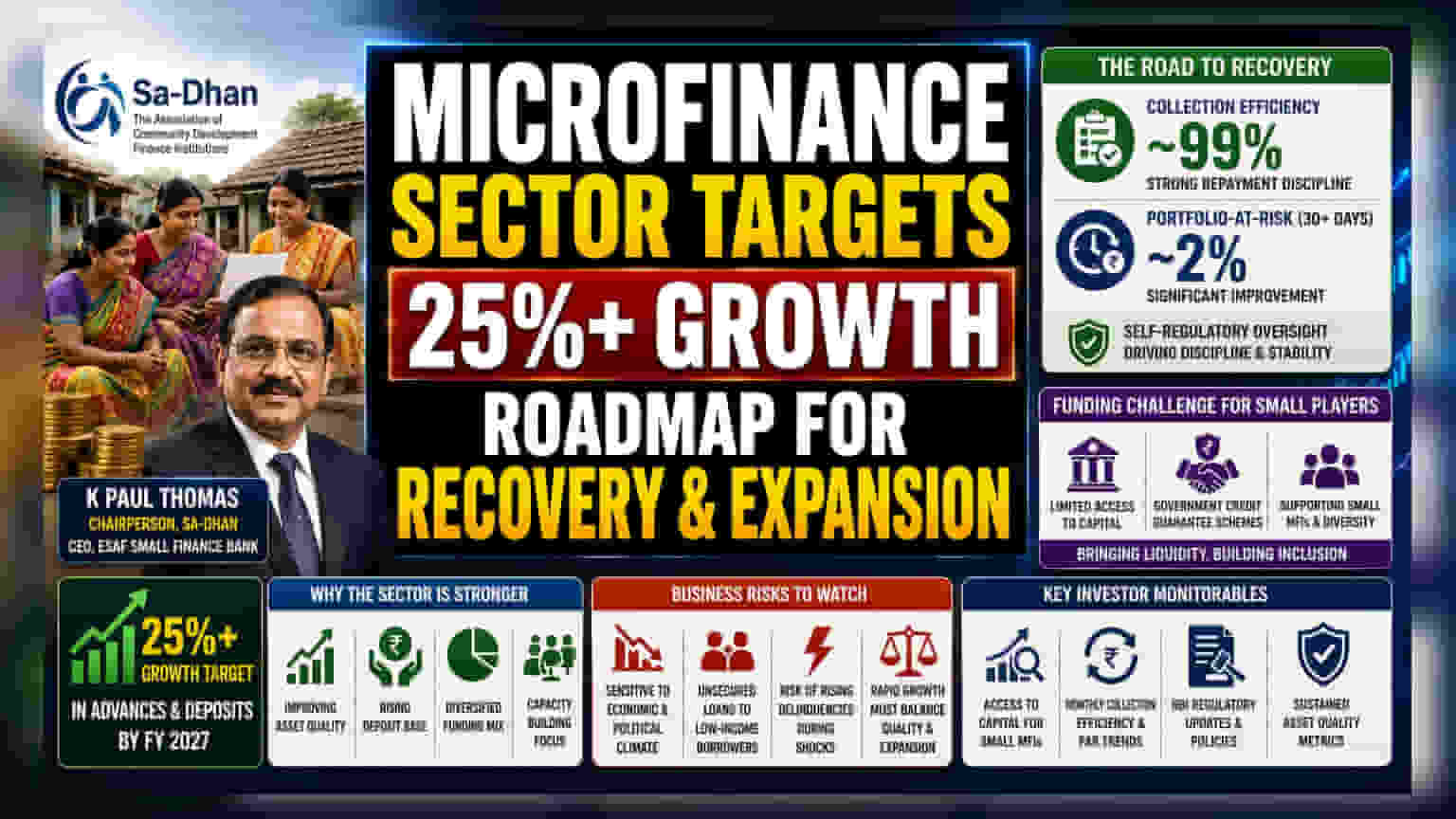
Sa-Dhan’s new chairperson, K Paul Thomas, has set a goal of over 25% annual growth for India's microfinance sector by FY27. While asset quality shows improvement, the focus is shifting toward securing capital for smaller institutions. For investors, this indicates a push to stabilize the sector's ecosystem and improve funding access for smaller players.
What Happened
The microfinance sector in India is entering a phase of expansion and stabilization, according to K Paul Thomas, the newly appointed chairperson of Sa-Dhan, the industry body for microfinance institutions (MFIs). Thomas, who also serves as the CEO of ESAF Small Finance Bank, outlined a clear roadmap for the industry, setting a target of over 25% growth in both advances and deposits by fiscal year 2027. The industry is currently recovering from a challenging period marked by higher credit risks and funding constraints, and is now focusing on both scaling operations and institutional capacity building.
Why The Sector Is Recovering
The optimism regarding the 25% growth target is rooted in recent operational data. According to the industry body, collection efficiencies—the rate at which loans are repaid by borrowers—have reached approximately 99%. Additionally, the portfolio-at-risk (a measure of how many loans are overdue by 30 days) is currently hovering around 2%. This represents a significant improvement from previous years when the sector struggled with higher delinquency rates. This performance is supported by stricter oversight through the industry's self-regulatory organization framework, which has helped bring more discipline to how loans are issued and collected.
The Funding Challenge For Small Players
While the sector as a whole is recovering, a key priority for Sa-Dhan is addressing the funding gap faced by smaller microfinance institutions. Smaller players often find it difficult to secure capital from banks and other traditional sources due to perceived risks. Thomas highlighted that the government’s credit guarantee schemes are expected to play a major role in providing liquidity and supporting these smaller entities. By improving funding access, the industry body hopes to prevent a situation where only large players dominate the market, thereby ensuring a more diverse financial ecosystem for underserved populations.
Business Risks And Market Sensitivity
While the industry targets high growth, investors should consider the inherent risks associated with microfinance. The sector is highly sensitive to the broader economy and political climate. Because these loans are typically given to low-income borrowers without traditional collateral, even small economic shocks or local issues can lead to a sudden spike in bad loans. Additionally, as the industry grows at a rapid 25% rate, maintaining asset quality remains a balancing act. Rapid expansion can sometimes lead to lower underwriting standards if not managed with proper oversight.
What Investors Should Track Next
The key monitorable for investors and stakeholders in the microfinance space will be how effectively smaller institutions manage to raise capital through the government’s support schemes. Investors should also watch the monthly and quarterly collection data, as any meaningful decline in the 99% collection efficiency or a rise in the 30-day overdue portfolio could signal renewed stress. Furthermore, updates on regulatory changes from the Reserve Bank of India regarding lending practices will remain critical, as these rules directly dictate the operating margins and growth capacity of both large and small MFIs.