 Whalesbook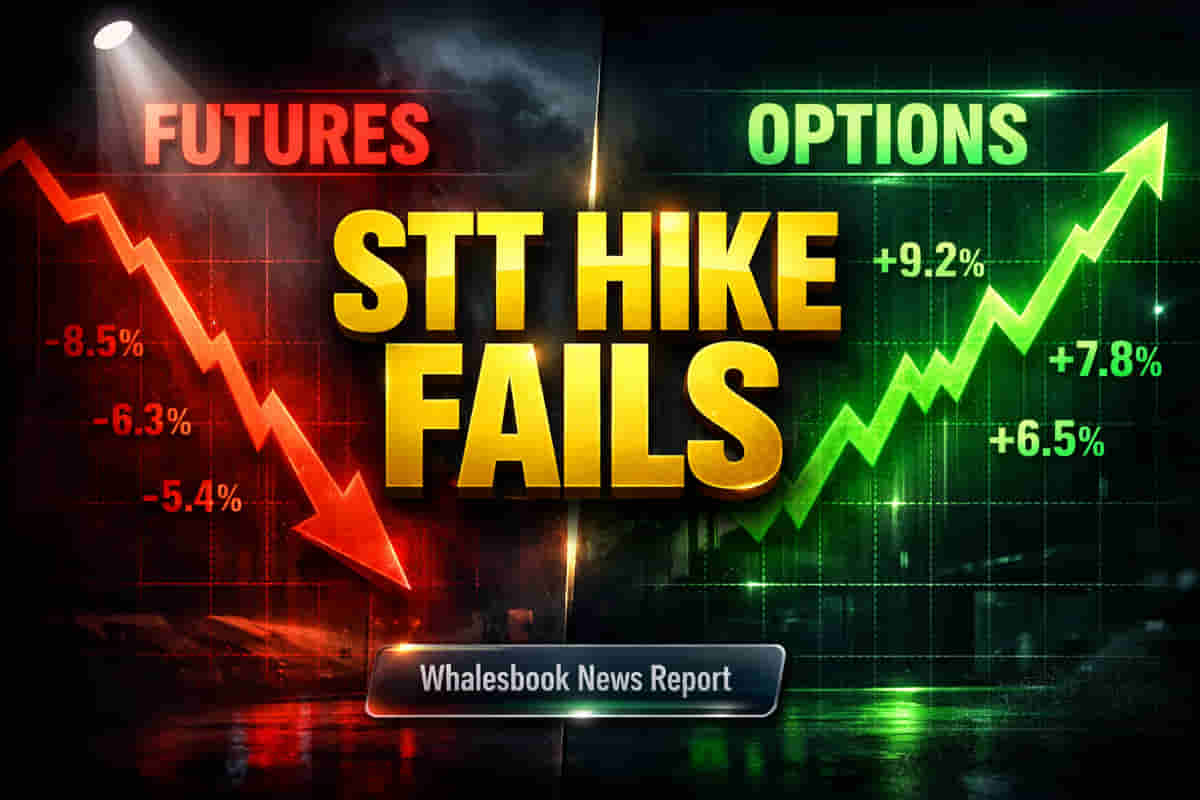
The STT Surge: A Tool or a Deterrent?
The recent Union Budget 2026 has introduced a significant increase in the Securities Transaction Tax (STT) levied on derivatives trading, a move that has drawn sharp criticism from industry participants like Nithin Kamath, founder and CEO of Zerodha. While the government states its intent is to manage systemic risks and curb speculative activity in India's derivatives markets [12, 19], Kamath contends that the tax hike will be ineffective in achieving its primary goal [3, 6, 8]. Instead, he predicts it will disproportionately affect futures trading, pushing already dominant speculative activity further into options [3, 8]. This tax adjustment, set to take effect from April 1, 2026, raises STT on futures from 0.02% to 0.05%, and on options premiums from 0.1% to 0.15% [2, 4, 5, 11]. The market reacted swiftly to the announcement, with benchmark indices experiencing a sharp sell-off on Budget Day [18, 27].
Valuation and Market Dynamics Under Pressure
Kamath's core argument centers on the structure of the tax increase. He highlights that with options already comprising approximately 95% of F&O trading volumes, a tax hike that impacts futures more acutely is unlikely to deter the bulk of speculative behavior [3, 8]. Instead, it could simply skew market participation further towards options. The cumulative effect of rising transaction costs is a significant concern, with Kamath warning that sustained STT increases risk making trading unviable and materially impacting overall trading volumes [3, 6]. For firms like Zerodha, STT collections already exceed their brokerage revenue, illustrating the substantial tax burden placed on active traders [6]. The sentiment among some analysts suggests this move is a regulatory step to slow speculative activity and augment government revenue, potentially denting near-term sentiment and impacting trading volumes, particularly for market makers and high-frequency trading firms [13].
Historical Precedents and Alternative Strategies
The STT structure has historically played a significant role in shaping trading patterns in India. A notable shift occurred in 2008 when STT on options was moved from being levied on contract value to the premium amount, making options substantially cheaper to trade than futures and contributing to their rapid growth [3]. This historical precedent suggests that STT adjustments have a direct influence on trader preference and market composition. Kamath proposes that rather than relying on incremental STT hikes, a more effective approach would be to implement product suitability norms, determining which traders are eligible for complex derivatives [3, 6, 10]. Such a move, he argues, would reduce uncertainty for brokers and traders alike, offering a more targeted solution than what he describes as "death by a thousand STT hikes" [3, 6, 10]. He also suggests that lowering STT for cash equities and futures, coupled with increased intraday leverage, could help rebalance market activity, promoting growth in cash and futures segments over solely trying to curtail options volumes [3].
Sector-Wide Implications and Future Outlook
Beyond the immediate impact on traders, the STT hike has broader implications for the broking and exchange ecosystem. Brokerages and exchanges that derive a significant portion of their revenue from F&O trading face potential headwinds from declining volumes [13]. Companies like BSE and Angel One, which rely heavily on derivatives trading for revenue, are seen as particularly vulnerable [13]. While the government's stated intention is to manage systemic risk and curb speculation [12, 19], the long-term effect on market liquidity and global competitiveness remains a point of concern [27]. The government's expectation to collect an increased amount from STT, projected at Rs 73,700 crore for FY27, underscores the scale of trading activity it aims to influence [7, 14]. However, market participants will be closely watching whether the higher transaction costs lead to a sustained slowdown in activity or if traders adapt, potentially shifting strategies or absorbing the increased costs. The government's focus appears to be on moderating high-frequency and short-term derivatives trading, distinct from long-term equity investing, signalling a nuanced approach to market regulation [19].