

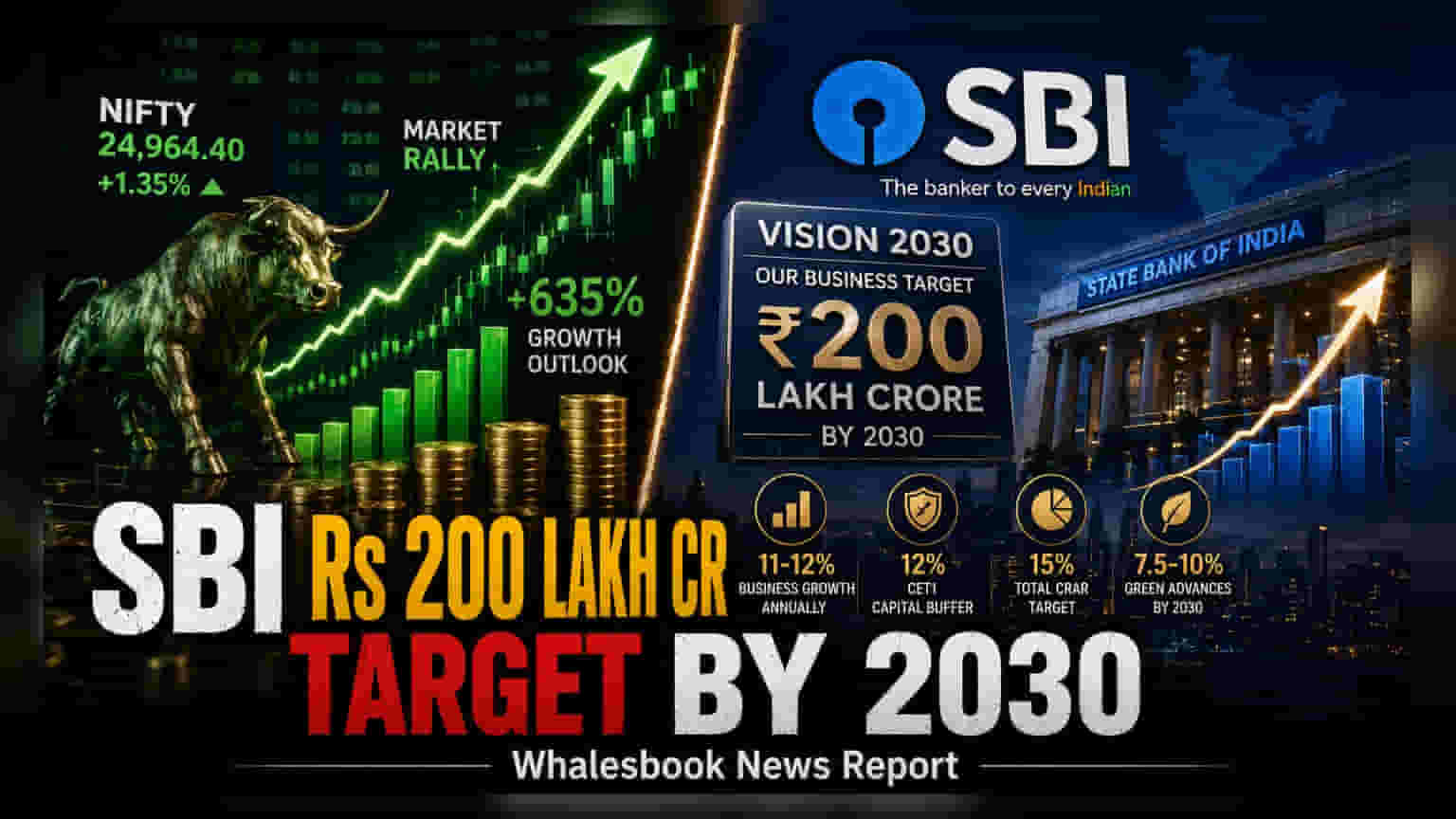
State Bank of India aims to double its total business to Rs 200 lakh crore by 2030 under its 'Vision 2030' plan. The strategy links growth to India's economic performance and digital upgrades. Investors are watching the bank's capital buffers and upcoming changes to how it accounts for bad loans as key future monitorables.
State Bank of India (SBI) has unveiled its 'Vision 2030' strategy, aiming to scale its total business to approximately Rs 200 lakh crore by 2030, which will also mark the bank’s platinum jubilee. Chairman C S Setty shared that this goal is tied to the broader growth of the Indian economy. If the country maintains an annual economic growth rate of 7-8%, the bank expects its balance sheet to expand at an annual rate of 11-12%, effectively doubling its size every six years.
Connecting Business Growth to India's Economy
For investors, the strategy highlights that SBI’s expansion is directly linked to national growth trends. The bank plans to support this scale by keeping its core capital buffer—known as the Common Equity Tier 1 (CET1) capital ratio—at around 12% and its total capital-to-risk-weighted assets ratio (CRAR) near 15%. Maintaining these buffers is essential to support continued lending across sectors like agriculture and MSMEs without compromising financial stability.
In its recent Q1 FY27 performance, the bank demonstrated solid financial health, reporting a standalone net profit of ₹21,121 crore, a 10% increase compared to the previous year. This performance has been supported by resilient domestic net interest margins—the difference between interest earned from loans and interest paid on deposits—which have remained steady above 3%.
Strategic Focus: Digital Efficiency and Green Finance
Beyond scale, SBI’s 'Vision 2030' prioritizes efficiency and modernization. The bank is focusing on upgrading its digital platform, YONO 2.0, to improve customer service and operational productivity. By simplifying internal processes and using data-driven approaches, the bank aims to lower its cost-to-income ratio by 2-3 percentage points.
Green finance is another pillar of this long-term strategy, with the bank planning to expand its green advances portfolio to 7.5–10% of total loans by 2030. This shift reflects the bank’s attempt to align with global sustainability standards and manage long-term climate-related risks in its loan book.
Financial Risks and Monitorables
While the growth outlook is ambitious, investors are keeping an eye on several structural changes and market pressures. A significant shift approaching is the transition to Expected Credit Loss (ECL) provisioning standards, which is set to become effective in FY28. This move will change how the bank calculates and sets aside money for potential bad loans, which could impact profit reporting cycles.
Additionally, the bank faces risks related to the rapid expansion of digital finance and platform lending, which requires robust data security and underwriting capabilities. External factors, including global geopolitical uncertainty and its impact on domestic inflation, remain important monitorables. With the share price recently hovering around the ₹1,048 level, investors will likely track how the bank balances its aggressive growth targets with asset quality and the upcoming accounting transitions over the coming quarters.