

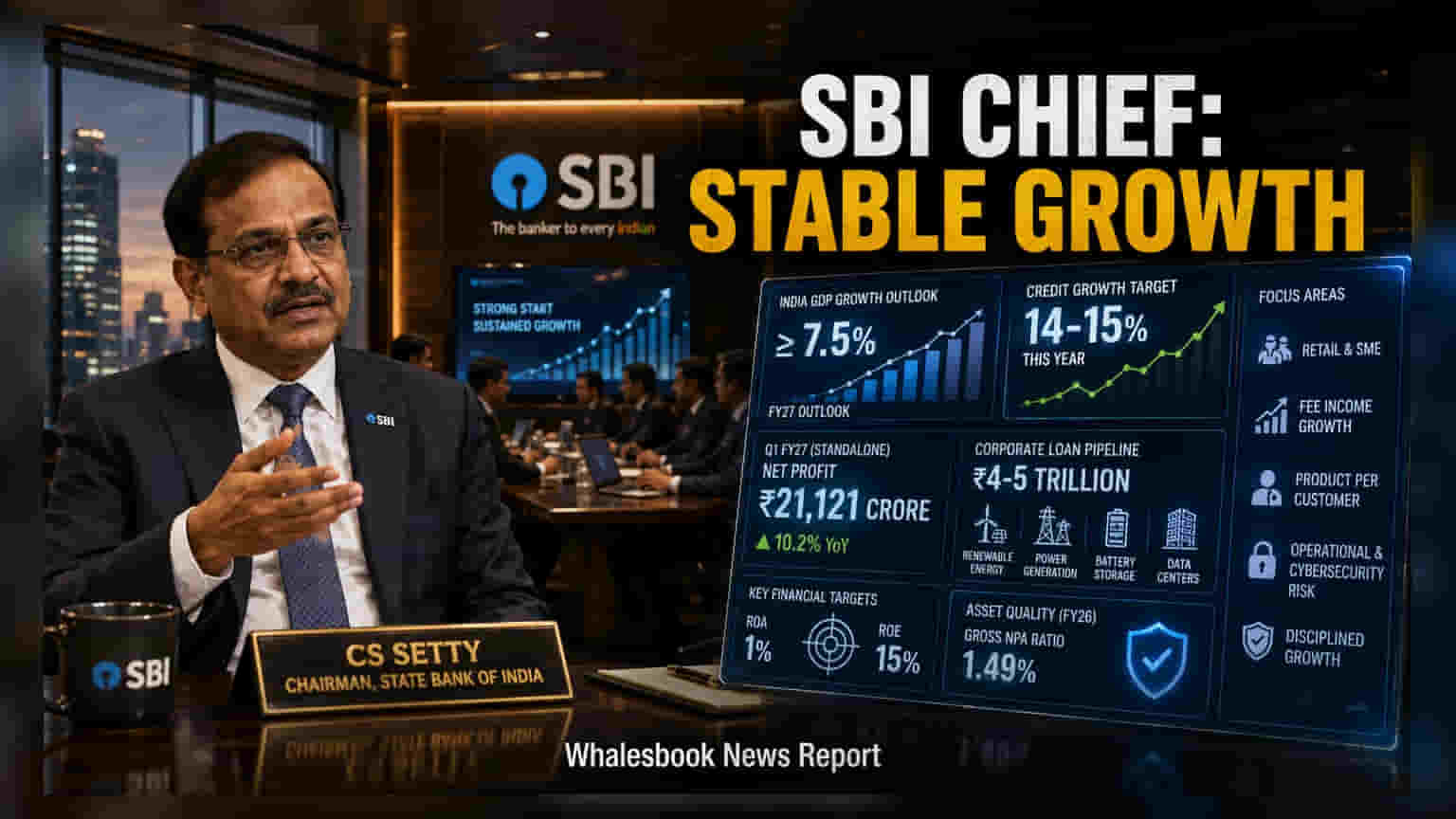
State Bank of India Chairman CS Setty forecasts 7.5% economic growth, with the bank aiming for 14-15% credit expansion this fiscal year. Following a solid first-quarter profit of ₹21,121 crore, the lender is prioritizing retail, SME, and a large corporate loan pipeline. Investors are now watching how the bank maintains its target Return on Assets amid shifting global and domestic economic conditions.
State Bank of India (SBI) is projecting a stable fiscal outlook, with Chairman CS Setty expecting India’s economic growth to reach at least 7.5%. The country’s largest lender has set a goal to achieve 14-15% credit growth this year. This ambition follows a strong start to the fiscal year, with the bank posting a standalone net profit of ₹21,121 crore for the first quarter of FY27, representing a 10.2% increase compared to the same period last year.
Fueling Growth Through Credit and Pipeline
The bank’s strategy for achieving this credit growth involves a multi-pronged approach. While retail and small-to-medium enterprise (SME) lending remain central pillars, the institution is also focusing on a substantial corporate loan pipeline estimated at ₹4-5 trillion. This pipeline includes significant demand from sectors such as renewable energy, power generation, battery storage, and data center infrastructure. By moving beyond traditional lending metrics, SBI is working to act as a primary banker for these large projects, aiming to capture demand early in the infrastructure cycle.
Beyond loan growth, the management is focused on improving its fee income and product-per-customer ratio. The bank aims to achieve a Return on Assets (ROA) of 1% and a Return on Equity (ROE) of 15%. This target is supported by a more stable balance sheet environment, where many corporate borrowers have successfully reduced their debt levels over the past few years.
Balancing Performance and Economic Risks
While the growth outlook is positive, the banking sector faces ongoing challenges. The bank maintains a focus on operational and cybersecurity risks, which are becoming as critical as traditional credit risk assessment. Asset quality has shown improvement, with the Gross NPA ratio standing at 1.49% for FY26, but maintaining this quality requires strict discipline as the loan book expands.
Investors may keep an eye on potential margin pressure. If the cost of funds increases or if interest rates remain volatile, banks may find it harder to maintain their Net Interest Margins (NIMs). Furthermore, the bank’s ability to reach its 15% credit growth target relies heavily on sustained consumer spending and corporate investment. If global geopolitical tensions or supply chain issues worsen, they could create headwinds for the broader economy and, by extension, the banking sector.
As of August 27, 2026, SBI shares were trading around ₹1,043 on the National Stock Exchange. Moving forward, the most important updates for investors will be the bank’s ability to execute its large corporate loan pipeline, management’s commentary on NIM trends in upcoming quarters, and any shifts in asset quality as the loan book grows.