 Whalesbook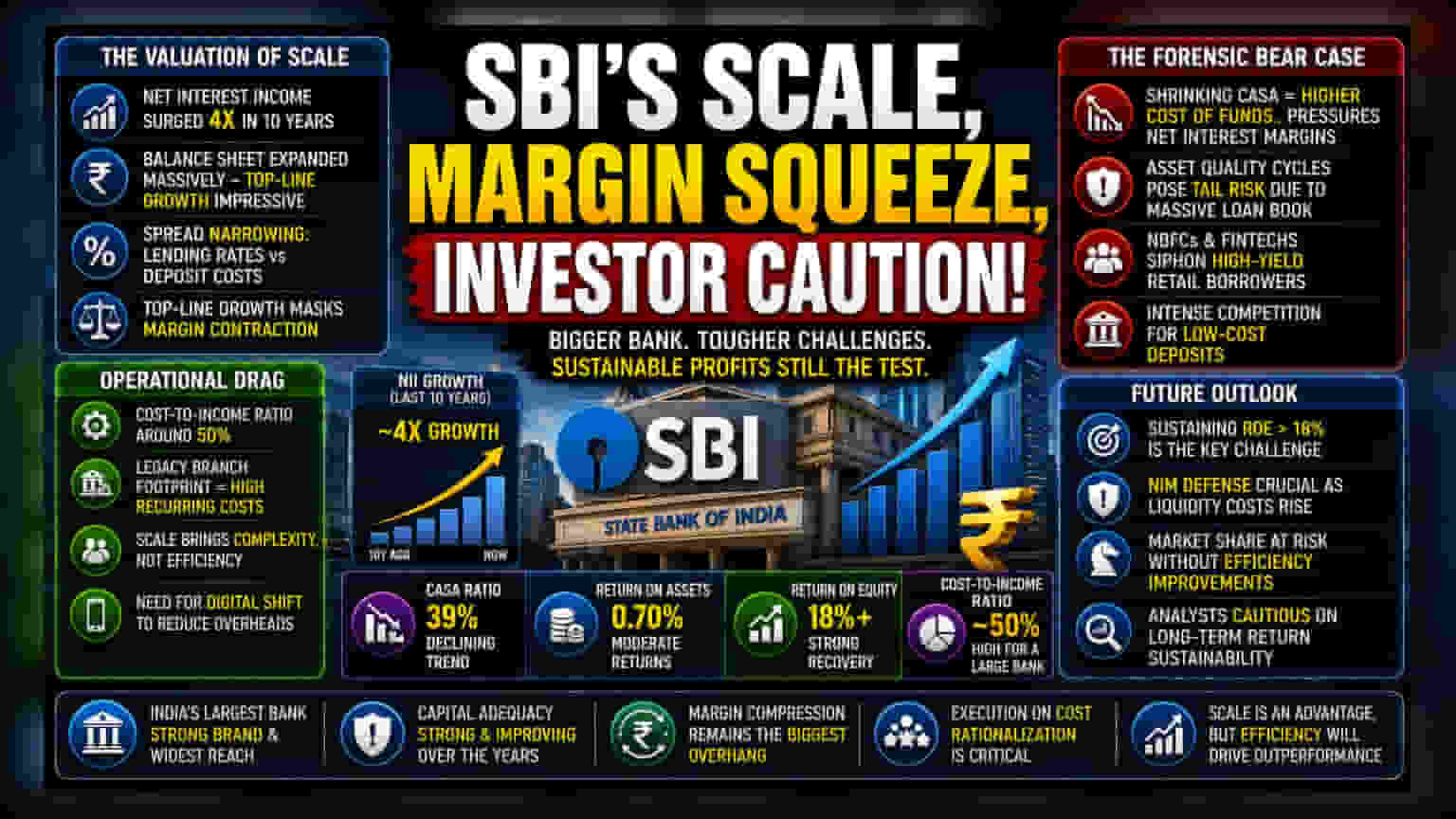


The Valuation of Scale
State Bank of India has successfully engineered a massive expansion in its balance sheet, with Net Interest Income surging fourfold over the last decade. However, the reliance on top-line growth to mask margin contraction is becoming increasingly transparent. While total income figures appear impressive, the underlying efficiency metrics suggest that the bank is working significantly harder to generate each incremental unit of profit. The narrowing spread between lending rates and deposit costs highlights a fundamental sensitivity to liquidity pricing that is unlikely to abate as private-sector competitors continue to capture market share.
Operational Drag and Efficiency Limits
Operational overhead remains a persistent anchor on the bank’s bottom line. Maintaining a cost-to-income ratio hovering around the 50% mark reflects the inherent difficulty of scaling a legacy physical infrastructure in an era of rapid digital banking adoption. Unlike nimble, technology-first financial institutions that operate with leaner cost structures, the bank’s extensive branch footprint necessitates high recurring expenditures. This structural dependency suggests that meaningful margin expansion will be difficult to achieve without a aggressive reduction in headcount or a radical shift toward automated, low-touch service delivery models.
The Forensic Bear Case
Investors must weigh the current Return on Assets against the reality of a shrinking CASA ratio. As the proportion of low-cost funds declines to 39%, the bank faces a higher cost of capital, directly pressuring net interest margins. Furthermore, the bank’s history of asset quality cycles requires constant vigilance; while current metrics show recovery, the sheer size of the loan book creates significant tail risk if economic conditions soften. Competitive dynamics are also shifting, as non-banking financial companies and fintech entrants increasingly siphon off high-yield retail borrowers, leaving the bank to compete more aggressively for a diminishing pool of low-cost deposits.
Future Outlook and Sector Positioning
Market participants are currently balancing the bank’s improved capital efficiency against the medium-term threat of margin compression. While the rebound in Return on Equity to over 18% provides a strong narrative for current profitability, institutional focus is shifting toward the sustainability of these returns. The bank’s ability to defend its market position without triggering further erosion in NIM will be the primary determinant of its stock performance. Analysts remain cautious on whether the current return profile can be maintained as the cost of attracting new liquidity rises across the broader banking sector.