

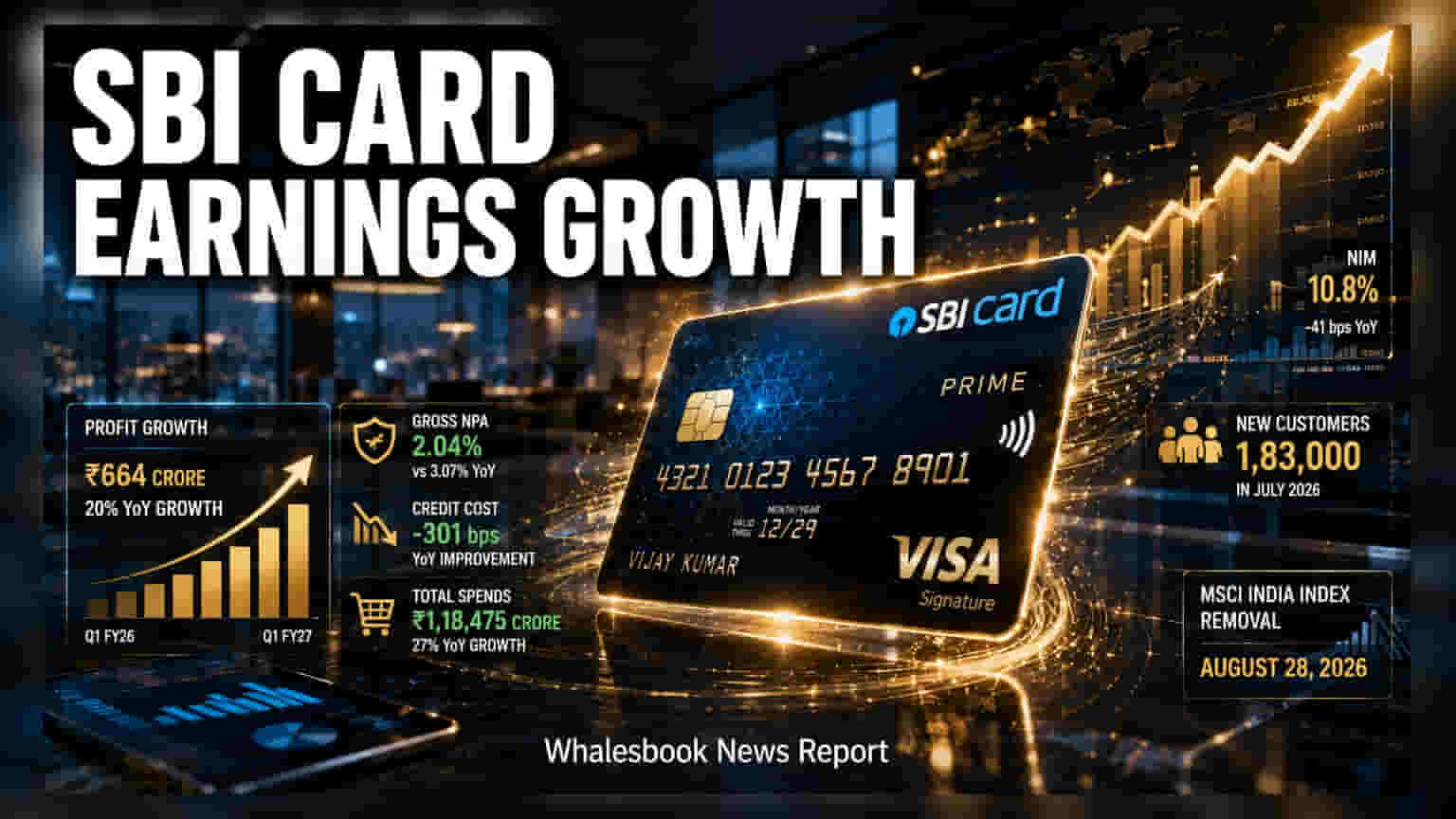
SBI Cards and Payment Services reported a 20% year-on-year rise in Q1 FY2027 net profit to ₹664 crore, driven by stronger asset quality. While the company is preparing for festive season growth, investors are monitoring its upcoming removal from the MSCI India Index and ongoing pressure on net interest margins due to high funding costs.
SBI Cards and Payment Services posted a solid financial performance for the first quarter of fiscal year 2027, with net profit climbing 20% year-on-year to ₹664 crore. This growth was primarily fueled by improved asset quality and a significant reduction in credit costs, which dropped by 301 basis points compared to the same period last year. The company’s focus on stricter underwriting standards and better portfolio monitoring appears to be paying off, as evidenced by a decline in Gross Non-Performing Assets (NPA) to 2.04% from 3.07% a year ago.
Balancing Margins and Funding Costs
While profitability metrics have improved, the company is managing headwinds in its core lending business. Net Interest Margins (NIMs) have seen pressure, settling at 10.8%, a decline of 41 basis points from the previous year. This compression is largely due to elevated funding costs, which continue to challenge the lender’s ability to maintain higher margins. To counter this, management is shifting its strategy toward a mix of higher-value customers and increased usage of Equated Monthly Installment (EMI) plans, which typically offer better returns than traditional credit products.
Festive Season Strategy and Market Sentiment
Looking ahead, the company is positioning itself for the upcoming festive season, a period that typically sees a spike in consumer retail spending. Despite a broader deceleration in industry-wide credit card spending growth, SBI Card has shown resilience by acquiring 183,000 new customers in July 2026 alone, leveraging its cross-selling capabilities with parent State Bank of India. The total spends for the period reached ₹1,18,475 crore, marking a 27% year-on-year increase. These figures suggest that while the industry is cooling, the company’s targeted approach is helping it gain ground.
Key Monitorables for Investors
Beyond operating performance, investors are paying close attention to technical factors impacting the stock. SBI Card is scheduled for removal from the MSCI India Index effective August 28, 2026. This rebalancing event often leads to selling pressure from passive funds that track the index, a factor currently influencing market sentiment around the stock. As of August 26, 2026, the company’s shares closed at ₹666.10 on the NSE. Looking forward, the critical update for shareholders will be how the company manages margin protection in a high-interest-rate environment and whether it can maintain its improved asset quality through the second half of the fiscal year.