 Whalesbook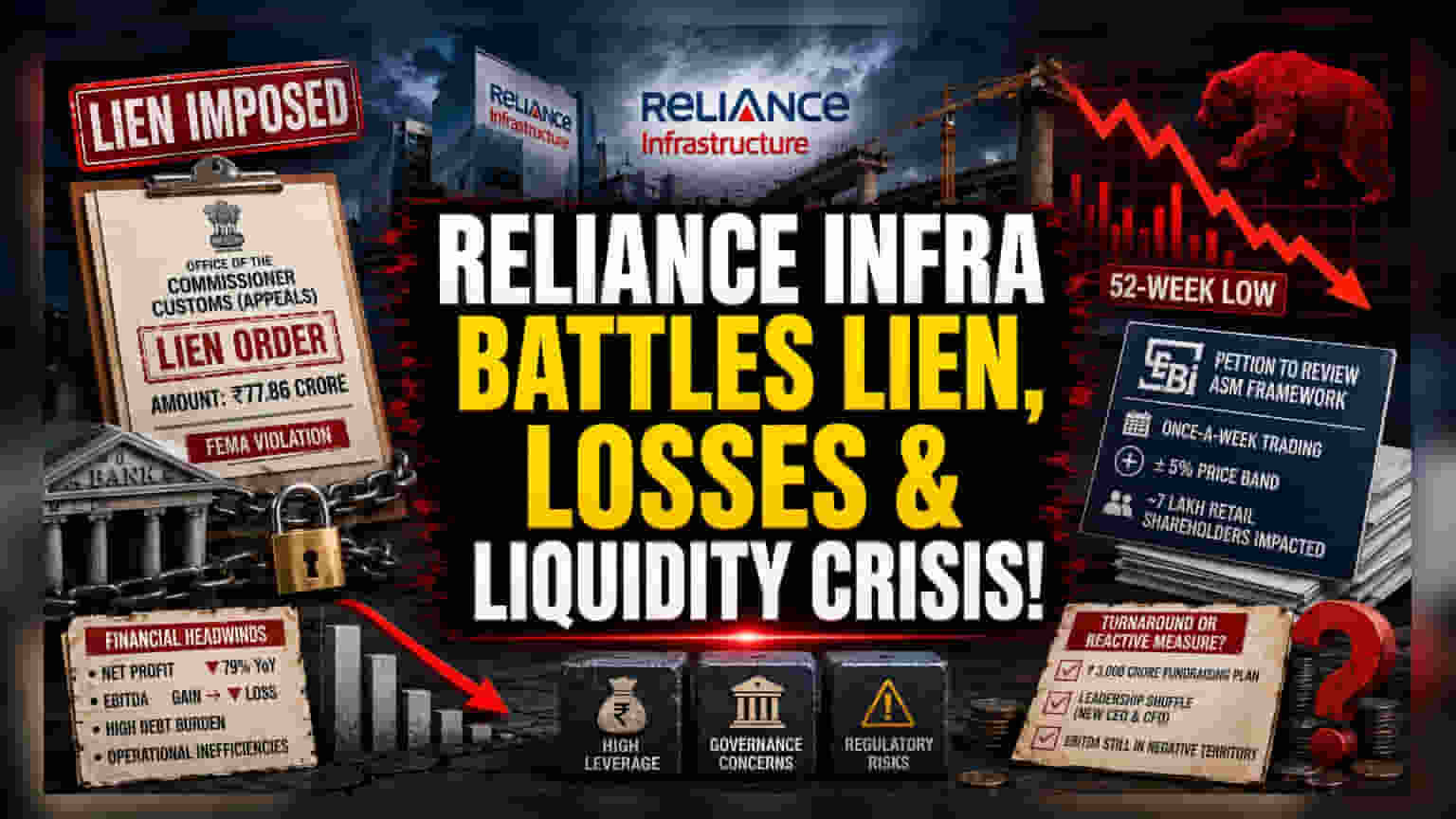


The Escalating Regulatory Standoff
Reliance Infrastructure has formally moved to challenge a Rs 77.86 crore lien imposed on its bank accounts by the Office of the Commissioner Customs (Appeals). This development, confirmed by the company in regulatory disclosures on June 6, 2026, solidifies a provisional order originally enacted in December 2025. The lien stems from long-standing allegations regarding Foreign Exchange Management Act (FEMA) violations, specifically concerning the alleged diversion of funds from the Jaipur-Reengus highway project to shell entities in the UAE.
Financial Headwinds and Market Pressure
This regulatory roadblock arrives at a fragile moment for the company. Recent financial statements for the quarter ending March 2026 revealed a staggering 79% year-on-year collapse in net profit, accompanied by a transition from an EBITDA gain to an operational loss. The firm is currently struggling with a high debt burden and operational inefficiencies, factors that have alienated conservative capital allocators. Consequently, the stock has faced intense selling pressure, recently touching 52-week lows and lagging significantly behind broader market performance.
The Battle for Liquidity and Visibility
Adding to the corporate complexity, Reliance Infrastructure has recently petitioned the Securities and Exchange Board of India (SEBI) and major stock exchanges to review the current Additional Surveillance Measure (ASM) framework. The company argues that the prevailing restrictions—specifically the limit to once-a-week trading within a narrow ±5% price band—are mechanical, predictable, and detrimental to its base of approximately 7 lakh retail shareholders. The company contends these curbs hinder fair price discovery, preventing the stock from reflecting its underlying business fundamentals.
The Bear Case: Structural Weakness
Investors remain skeptical of the recovery narrative. Beyond the FEMA-related legal entanglements, the company faces deep-seated structural challenges. Analysts frequently highlight the firm’s history of high leverage and recurring governance controversies as primary risks. With the board recently authorizing a Rs 3,000 crore fundraising plan and undergoing a leadership shuffle—including the appointment of a new CEO and CFO—market participants are wary of whether these steps represent a true turnaround or a reactive effort to manage a deepening liquidity crisis. The company’s inability to maintain positive EBITDA in a capital-intensive sector suggests that, absent a successful resolution to its regulatory and debt-related hurdles, the path to sustained value creation remains narrow.