

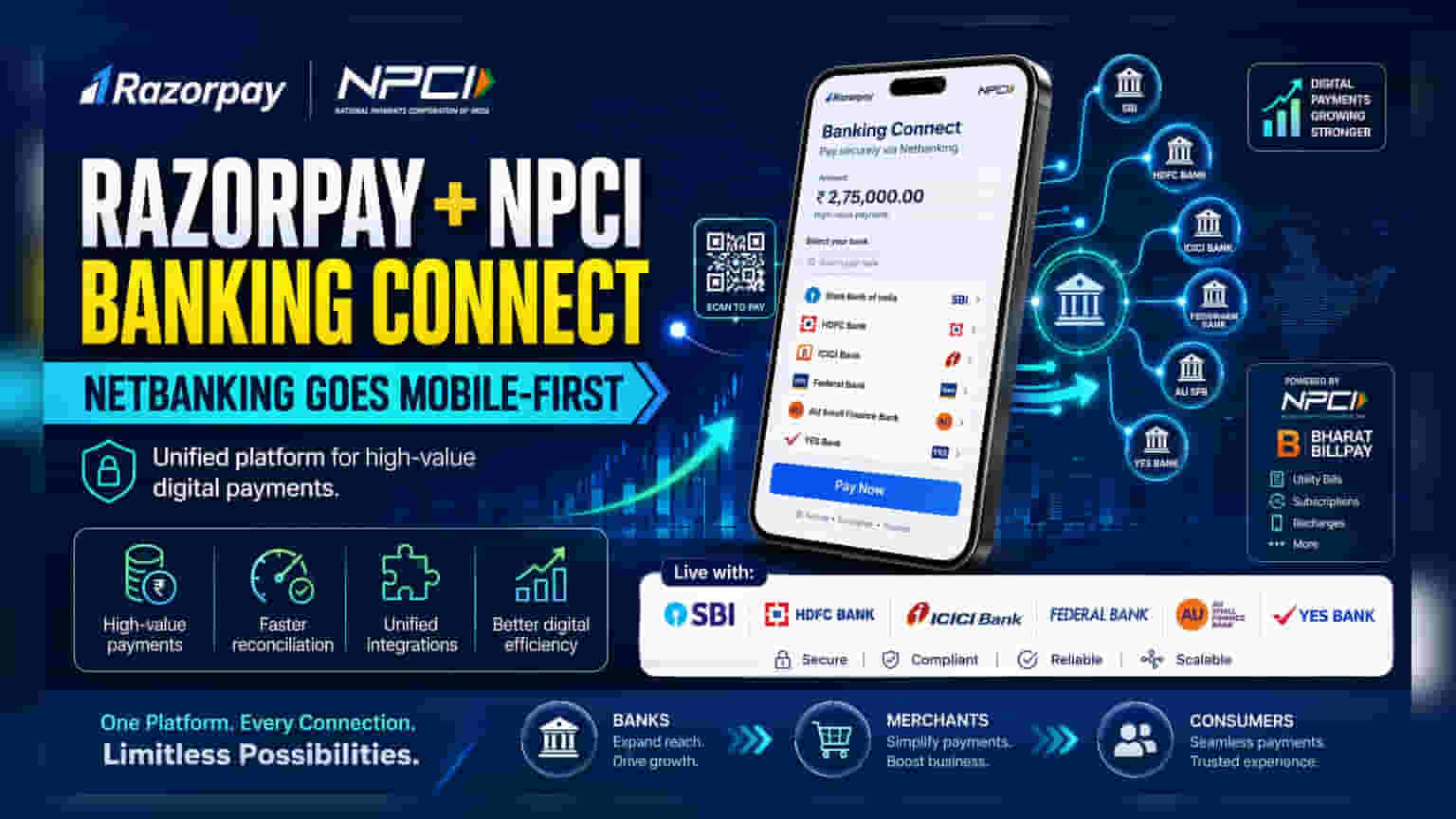
Razorpay has partnered with NPCI Bharat BillPay Limited (NBBL) to launch 'Banking Connect,' a solution to streamline NetBanking for businesses and consumers. By consolidating multiple bank integrations, the platform aims to reduce technical friction for high-value transactions. While Razorpay is private, the initiative involves several major listed banks, including HDFC Bank, ICICI Bank, and State Bank of India, aiming to boost digital payment efficiency.
What Happened
Fintech major Razorpay has teamed up with NPCI Bharat BillPay Limited (NBBL) to introduce 'Banking Connect.' This new mobile-first platform is designed to simplify how NetBanking is used for both businesses and individual consumers. Instead of managing complex integrations with dozens of different banks, businesses can now use this unified solution to offer a smoother payment experience. The platform is currently live with several major lenders, including State Bank of India (SBI), HDFC Bank, ICICI Bank, Federal Bank, AU Small Finance Bank, and YES Bank.
Why It Matters For Listed Banks
For investors in the Indian banking sector, this move highlights a continued focus on digital efficiency. While UPI dominates low-value, high-frequency transactions, NetBanking remains the preferred route for high-value payments—such as tax payments, educational fees, and government levies. By partnering with fintech infrastructure providers like Razorpay, these listed banks can ensure their NetBanking services remain competitive and user-friendly.
Consolidating these integrations allows banks to potentially reduce the operational cost and technical debt associated with maintaining separate, legacy-style web and app interfaces for every merchant or business partner. For the banks involved, this could lead to more stable digital payment systems that handle large volumes with fewer failures.
The Role Of NetBanking In Digital Payments
Despite the massive rise of UPI, NetBanking has not become obsolete. It acts as the backbone for high-value transactions where security and higher transfer limits are often required. The challenge for banks has historically been the clunky user experience, often involving multiple redirections and authentication layers. Banking Connect aims to solve this by providing intent-driven, QR-enabled flows, similar to the convenience of UPI, but built on the robust architecture of traditional NetBanking. For banks, retaining this high-value payment traffic is essential, as it often correlates with larger account balances and deeper corporate relationships.
Operational Efficiency And Reconciliation
One of the most tedious parts of digital payments for businesses is reconciliation—matching a payment received to the correct order or invoice. The new platform aims to simplify this by providing a unified operational framework. For merchants and businesses, this means faster processing and clearer transaction data. For banks, providing this streamlined infrastructure can help attract and retain corporate clients who value automated back-end processes, potentially improving the stickiness of the bank’s digital offerings.
What Investors Should Track
Investors may monitor the digital transaction growth data reported by banks in their quarterly results. Key focus areas include the adoption rate of these new payment integrations and whether they lead to a reduction in technical glitches or downtime. Furthermore, analysts often look for trends in digital transaction fees and the cost-to-income ratio, as more efficient payment infrastructure can eventually support better margins in the digital banking segment.