

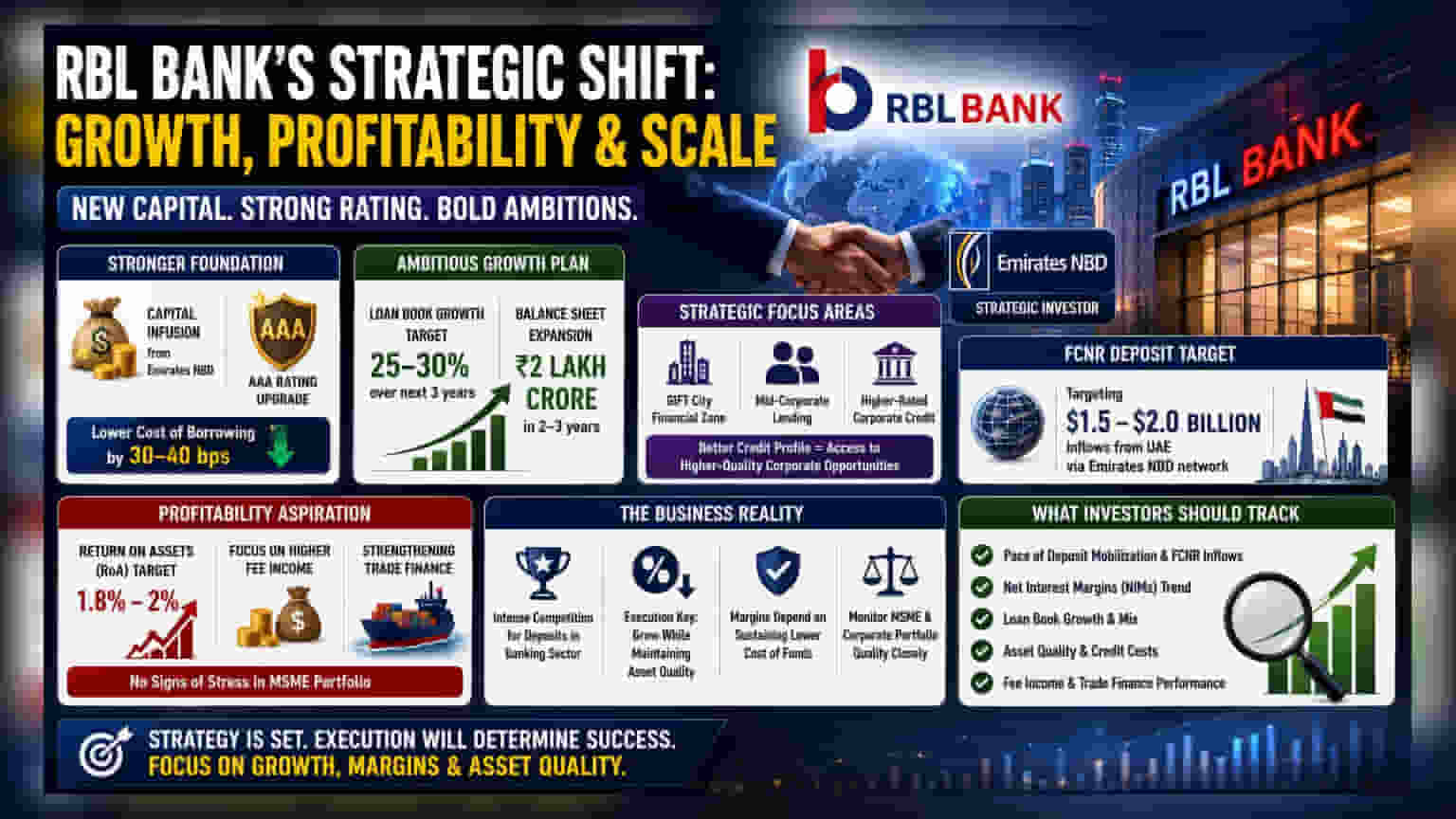
RBL Bank expects to cut funding costs and drive 25-30% loan growth following a strategic capital infusion from Emirates NBD and a AAA rating upgrade. The bank aims to use this capital to expand its corporate portfolio, targeting a return on assets of 1.8% to 2% over the next three years.
What Happened
RBL Bank has announced a strategic shift aimed at accelerating growth and improving profitability following a capital infusion from Emirates NBD and a recent AAA rating upgrade. The bank plans to use these funds to significantly reduce its cost of borrowing—the interest it pays to gather deposits—aiming to close the gap with larger banking institutions by 30-40 basis points. Management, led by CEO R. Subramanian Kumar, stated that the institution has begun reallocating capital to replace higher-cost borrowings with cheaper funding sources.
Loan Growth And Strategy
The bank has set an ambitious target to grow its loan book by 25-30% over the next three years. To achieve this, RBL Bank is pivoting its strategy toward the GIFT City financial zone, mid-corporate lending, and higher-rated corporate credit. By improving its credit profile through the new rating upgrade, the bank believes it can now access corporate lending opportunities that were previously out of reach.
Furthermore, the collaboration with Emirates NBD is designed to boost Foreign Currency Non-Resident (FCNR) deposits. The bank is targeting between $1.5 billion and $2 billion in inflows by tapping into the Indian diaspora in the UAE, utilizing Emirates NBD’s established network in the region.
Profitability Aspirations
Management has outlined a goal to expand the bank’s balance sheet by approximately ₹2 lakh crore within the next two to three years. The bank is aiming for a Return on Assets (RoA)—a key metric showing how efficiently a bank generates profit from its assets—of 1.8% to 2%. To support this, the bank plans to strengthen its fee-based income and trade finance businesses. While the management has indicated that there are currently no signs of stress within its MSME (Micro, Small, and Medium Enterprises) portfolio, investors typically monitor such segments closely, as they can be sensitive to economic cycles and cash flow fluctuations.
The Business Reality Check
While the capital infusion and rating upgrade provide a strong foundation, the bank faces a competitive banking sector in India. Most private banks are currently competing aggressively for deposits to fund loan growth. The ability to successfully execute the planned balance sheet expansion while maintaining asset quality will be the primary test for the bank. Additionally, achieving higher margins will depend on whether the bank can maintain its lower cost of funds amid fluctuating interest rates and sector-wide liquidity trends.
What Investors Should Track
Investors will likely watch several key indicators to assess the success of this strategy. First, monitor the actual pace of deposit mobilization, particularly the progress toward the FCNR deposit targets. Second, track the bank's net interest margins (NIMs) in upcoming quarterly results to see if the cost of funds is actually decreasing as expected. Finally, keep an eye on loan book quality as the bank expands into new corporate segments and increases its scale, ensuring that the growth does not come at the expense of higher bad loans.