 Whalesbook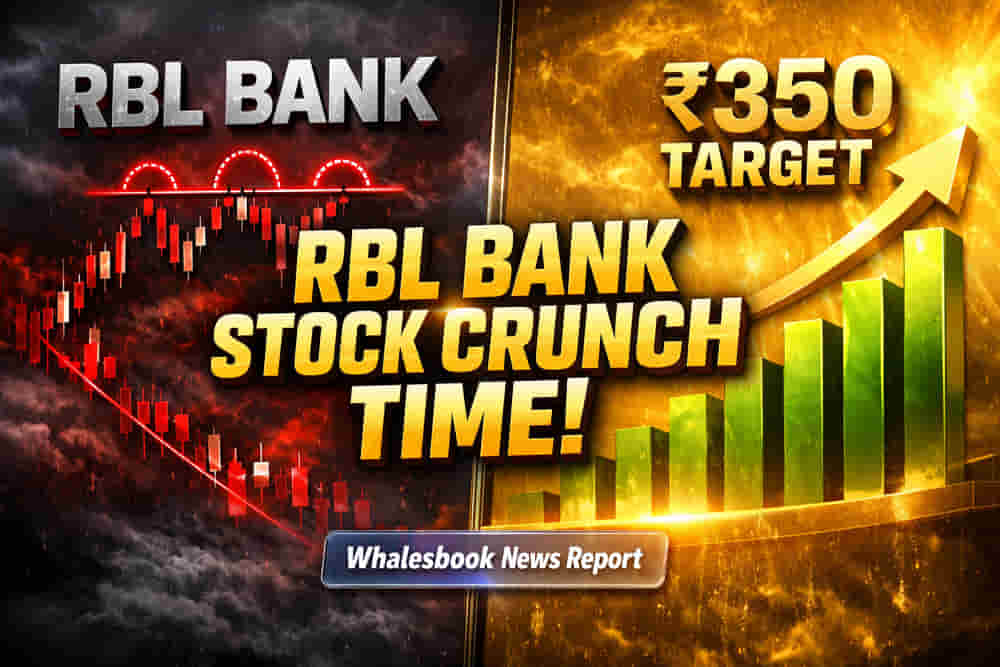
RBL Bank Stock Faces Technical Warning Amidst Strong Gains
RBL Bank's stock is currently navigating a complex technical landscape, showing signs of potential downward pressure despite a remarkable performance over the past year. The shares have seen a decline of approximately 9 percent from their all-time high of ₹332, which was registered on November 3, 2025. For the last two consecutive months, the stock has traded with a negative bias, leading technical analysts to identify a 'Triple Top' pattern on its daily charts. This pattern suggests that the stock is facing consistent resistance around the ₹314 level, posing a challenge for further upward movement.
Understanding the 'Triple Top' Pattern
The 'Triple Top' pattern is a significant indicator in technical analysis, often signaling a bearish reversal. It forms when a stock price attempts to break through a resistance level three separate times but fails on each occasion. These three peaks are typically around the same price point. A 'Neckline' or support level is established by connecting the troughs, or lowest points, between these peaks. For the bearish signal of a 'Triple Top' to be confirmed, the stock price must decisively break and close below this established Neckline support.
Stellar Performance and Market Context
Despite the recent technical headwinds, RBL Bank has demonstrated exceptional performance throughout 2025. The stock has surged by an impressive 93 percent year-to-date. At its peak, the stock had appreciated by as much as 111 percent compared to its previous year's closing price of ₹157. This stellar run significantly outpaces the broader market indices, with the NSE Nifty 50 index gaining only 10.2 percent and the Bank Nifty index rising 16.1 percent in 2025. A notable rally of nearly 18 percent in October was driven by the announcement that Emirates NBD Bank agreed to acquire a majority stake, specifically 60 percent, in RBL Bank for ₹26,853 crore.
Expert Analysis and Future Outlook
Looking ahead, analysts offer a mixed perspective. Dr. VK Vijayakumar, Chief Investment Strategist at Geojit Financial Services Limited, commented that while banks might view policy decisions favorably, recent RBI rate cuts could put pressure on their Net Interest Margins (NIMs) and make deposit mobilization more challenging if deposit rates are lowered. However, this cautious outlook contrasts with that of domestic brokerage firm Motilal Oswal, which maintains a 'BUY' rating on RBL Bank with a price target of ₹350, suggesting a potential upside of approximately 15.5 percent from current levels. SBI Securities, in its recent technical snapshot, noted that RBL Bank stock was trading with a sideways bias.
Market Signals and Corporate Developments
Further insights come from the futures and options segment data for the December series. Open interest in RBL Bank has seen a decline of around 31 percent over the last four trading sessions, even as the stock moved 2.2 percent. This divergence may indicate possible short-covering activity in the counter. In addition to market indicators, RBL Bank has also been in the news due to corporate developments. Buvanesh Tharashankar, the bank's Chief Financial Officer, resigned on December 15 to pursue opportunities outside the bank, as stated in a stock exchange filing.
Impact
The emergence of a 'Triple Top' pattern, coupled with the CFO's resignation, introduces a degree of uncertainty for RBL Bank's stock in the short term. Investors will be closely watching if the stock can hold its ground above the Neckline support, which currently sits near its 20-day moving average of ₹303.70. A break below this level could trigger further selling pressure, while a sustained move above ₹314 resistance, backed by positive fundamentals or further deal developments, could nullify the bearish signal. The conflicting analyst views present both risks and potential opportunities for investors, highlighting the importance of risk management and diversification. The recent RBI rate cut implications add another layer of complexity for the banking sector overall.
Impact Rating: 6/10
Difficult Terms Explained
- Triple Top Pattern: A bearish technical chart pattern consisting of three distinct peaks at roughly the same price level, indicating strong resistance and a potential reversal from an uptrend to a downtrend.
- All-time High: The highest price a stock has ever traded at.
- Negative Bias: A tendency for a stock's price to move downwards.
- Resistance Level: A price level where a stock's upward movement is expected to pause or reverse due to increased selling pressure.
- Neckline: In a 'Triple Top' pattern, this is a support line drawn by connecting the lowest points between the three peaks. A break below the neckline confirms the bearish reversal.
- Troughs: The lowest points or valleys in a stock price chart.
- Bearish Reversal: A change in the stock market trend from an upward direction to a downward direction.
- Technical Analysis: A method of evaluating securities by analyzing statistics generated by market activity, such as past prices and volume.
- NSE Nifty 50: A benchmark Indian stock market index representing the average performance of 50 of the largest Indian companies listed on the National Stock Exchange.
- Bank Nifty: An Indian sectoral index representing the banking sector, comprising the most liquid and well-capitalized Indian banking stocks listed on the National Stock Exchange.
- Net Interest Margins (NIMs): A measure of the difference between the interest income generated by a bank and the interest it pays out to its lenders (as a percentage of its interest-earning assets).
- Futures & Options (F&O) Segment: A part of the stock market where traders buy and sell contracts deriving their value from an underlying asset, like stocks.
- Open Interest: The total number of outstanding derivative contracts (futures or options) that have not been settled. An increase usually indicates growing participation, while a decrease suggests positions are being closed.
- Short-covering: The act of buying a security that was previously sold short. This is often done to close out a short position, potentially driving up the price.
- Chief Financial Officer (CFO): The senior executive responsible for managing the financial actions of a company.