 Whalesbook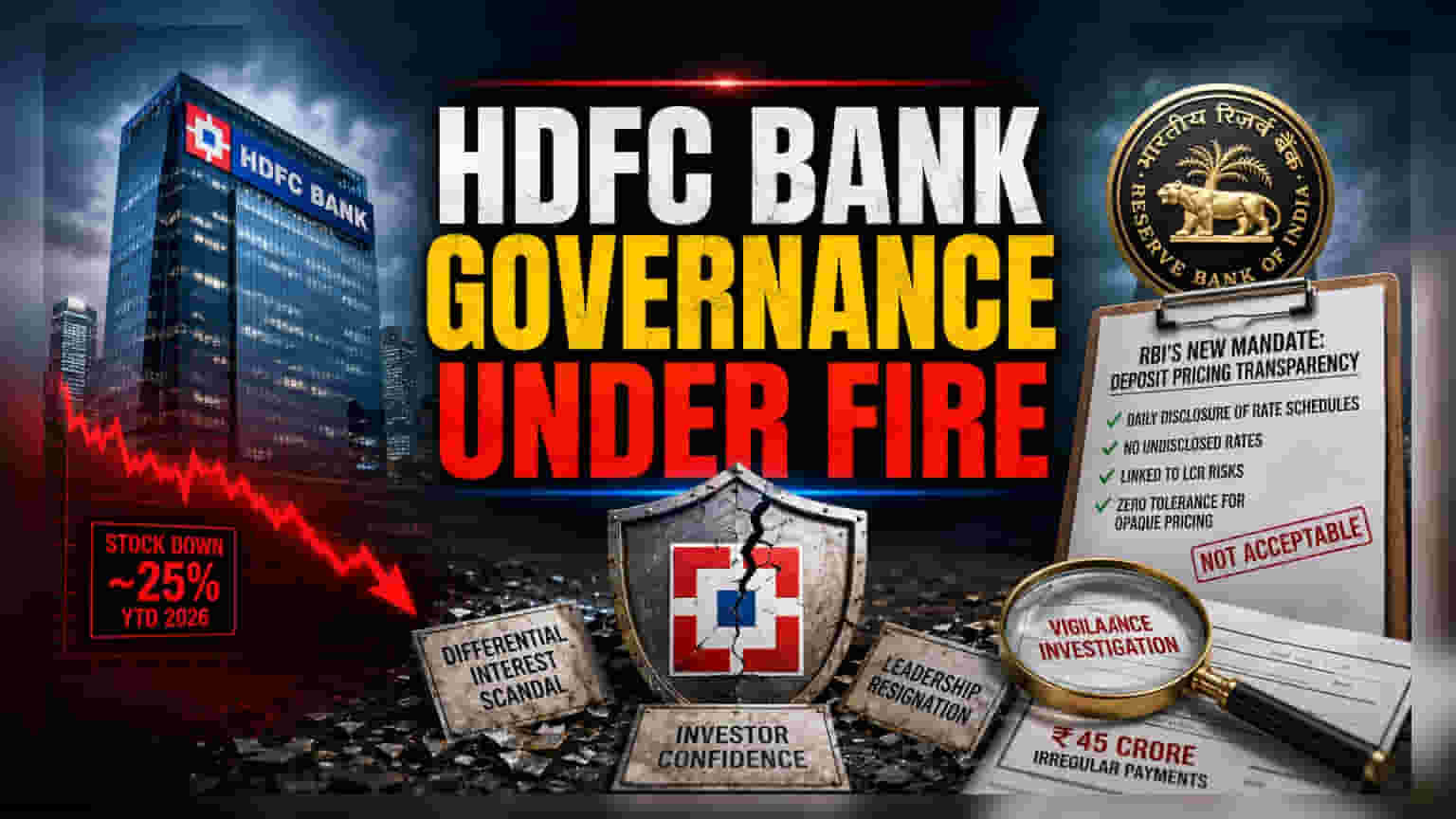


The Regulatory Pivot
The Reserve Bank of India (RBI) has sharpened its stance on deposit pricing transparency, with Governor Sanjay Malhotra asserting that interest rates offered beyond standard, disclosed brackets are "certainly not acceptable." This directive follows a period of intense regulatory scrutiny regarding how large private lenders manage bulk deposits. By requiring banks to display rate schedules daily and linking them to Liquidity Coverage Ratio (LCR) risks, the central bank is effectively dismantling the culture of relationship-based, opaque pricing that has long persisted in the institutional banking sector.
The HDFC Bank Governance Fallout
This regulatory hardening stems from a controversial internal vigilance investigation at HDFC Bank. During fiscal years 2024 and 2025, the bank allegedly made irregular payments totaling Rs 45 crore to the Maharashtra State Road Development Corporation (MSRDC). These payments, meant to compensate for a higher-than-market interest rate, were reportedly routed through the bank's marketing department and misclassified as sponsorship for a road safety campaign. While the bank has officially denied any wrongdoing and maintains that its internal audit controls remain robust, the incident has left a tangible mark on investor confidence. The stock has faced a volatile 2026, losing roughly 25% of its market value year-to-date, heavily influenced by this "governance discount" and the sudden resignation of former Chairman Atanu Chakraborty in March 2026, who cited a divergence between his ethical standards and the bank’s internal practices.
The Forensic Bear Case
From a risk-averse institutional perspective, HDFC Bank faces significant headwinds beyond simple regulatory compliance. The "differential interest" scandal has exposed potential systemic fractures in the bank's internal controls and oversight hierarchy, implicating senior leadership including the MD & CEO and the CFO. Unlike more transparently managed private peers, HDFC Bank is now navigating a period of heightened FII selling pressure. Furthermore, the bank’s recent performance—marked by a P/E ratio hovering around 15.2x and a stock price struggling near its 52-week low—reflects the market’s deep skepticism regarding its current governance framework. Any further lapses in compliance could invite heavier penalties or more restrictive capital mandates from the RBI, potentially crimping the bank's future net interest margins (NIMs).
Future Outlook
While the bank continues to report healthy profits, the focus has shifted toward its ability to restore institutional trust. The RBI’s new transparency mandates serve as a structural headwind for the entire industry, forcing a move away from discretionary bulk deposit pricing toward a more standardized, competitive model. For HDFC Bank, the path to recovery necessitates a radical overhaul of its vigilance and audit functions to pacify both regulators and the institutional investor base that has been retreating since early 2026.