

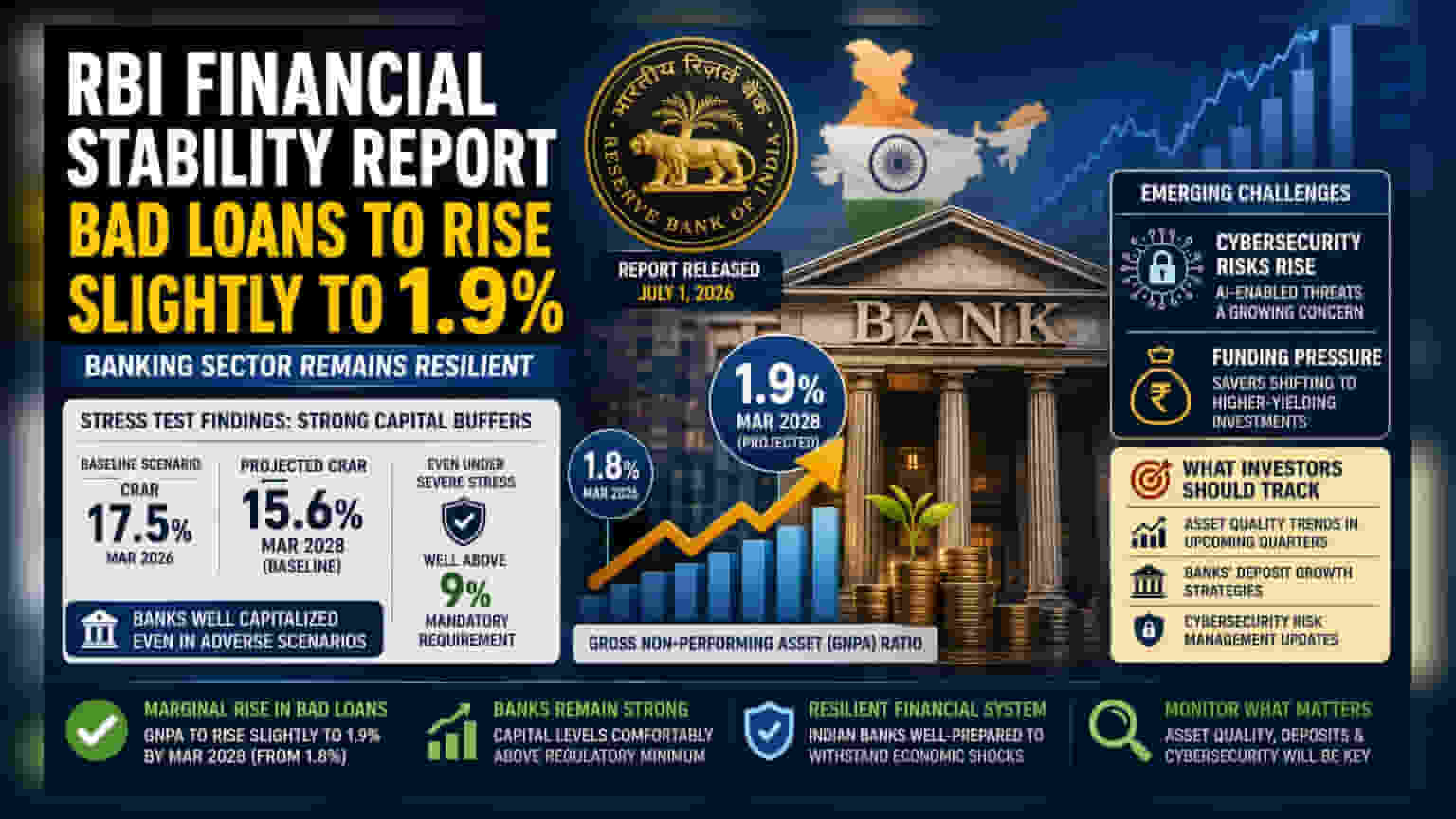
The Reserve Bank of India’s latest Financial Stability Report projects a marginal rise in bad loans to 1.9% by March 2028 from 1.8% in March 2026. Despite this slight uptick, the central bank confirms the banking sector remains stable, with capital buffers strong enough to withstand adverse economic conditions.
What Happened
The Reserve Bank of India (RBI) released its latest Financial Stability Report on July 1, 2026, providing a health check on the nation's banking system. The report highlights that the gross non-performing asset (GNPA) ratio—a measure of bad loans in the banking sector—is expected to rise slightly to 1.9% by March 2028, up from the 1.8% level recorded in March 2026. This projection is based on a baseline economic scenario derived from stress tests conducted on 46 scheduled commercial banks.
Why This Matters For Investors
For investors, the report serves as a key indicator of the banking sector's overall resilience. While a rise in bad loans—even if marginal—can sometimes signal potential stress, the RBI’s findings suggest the increase is small and manageable. The central bank emphasizes that the Indian economy and financial system have shown strength in the face of external shocks. For shareholders of banking stocks, this report provides context on the structural health of the sector, balancing growth potential with the reality of occasional asset quality fluctuations.
Stress Test Findings
To ensure banks can handle economic downturns, the RBI performed macro stress tests. The results were positive: even under severe adverse scenarios—where the economy might face a significant slowdown or higher inflation—banks are expected to maintain capital levels well above the regulatory minimum.
Specifically, the Capital to Risk-weighted Assets Ratio (CRAR) is expected to be stable. While the aggregate CRAR may moderate from 17.5% in March 2026 to around 15.6% by March 2028 under normal conditions, it is projected to stay comfortably above the mandatory 9% requirement even if severe economic stress occurs. This indicates that Indian banks have sufficient capital buffers to absorb losses without breaching regulatory limits.
Emerging Challenges
While the report is largely optimistic about capital and asset quality, it does flag new areas for caution. RBI Governor Sanjay Malhotra noted in the report that the financial system must remain alert to evolving risks. The report specifically points to cybersecurity—particularly threats enabled by artificial intelligence—as a growing concern for banks. Additionally, banks are facing funding challenges as savers shift money toward higher-yielding investment options, which could put pressure on deposit growth.
What Investors Should Track Next
Going forward, investors may track how individual banks manage their asset quality in the coming quarters. While the sector-wide trend is stable, performance can vary between large state-owned banks and private lenders. Additionally, watch for bank management commentary on deposit growth and their strategies to manage cybersecurity risks, as these are becoming central themes in the RBI's monitoring of financial stability. The next few quarterly results will be useful to see if the actual bad loan trend aligns with the central bank’s baseline projections.