

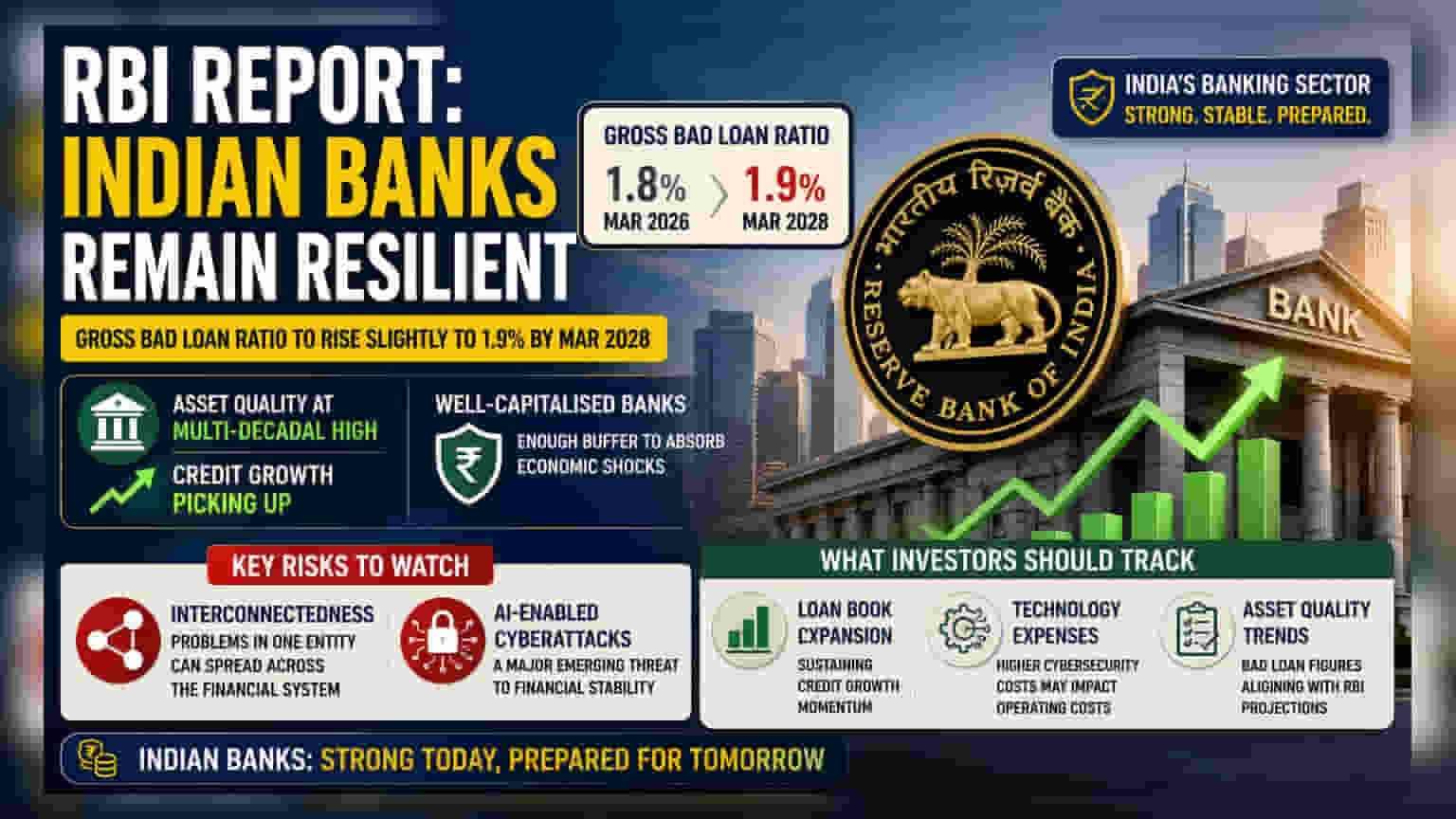
The Reserve Bank of India projects gross bad loans for banks will rise marginally to 1.9% by March 2028, up from 1.8% in March 2026. The report emphasizes that the banking system remains resilient with strong capital buffers, though it warns of emerging risks from cyber threats and the growing interconnectedness of financial institutions.
What Happened
The Reserve Bank of India (RBI) released its latest Financial Stability Report on Tuesday, signaling that India’s banking sector remains resilient despite global uncertainties. The central bank projects that the gross bad loan ratio—a measure of loans that are not being repaid—will rise slightly to 1.9% by March 2028. This is a marginal increase from the 1.8% level observed as of March 2026. While any increase in bad loans often draws attention, the RBI notes that this remains a modest projection following a long period of significant improvement in bank balance sheets.
Why This Matters for Investors
For investors, this report confirms that the banking sector has largely moved past the era of cleaning up massive legacy bad debts. Asset quality is currently at a multi-decadal high, which has supported bank profitability over the last two years. The shift from 1.8% to 1.9% is a reminder that while the cycle of rapid asset quality improvement has likely peaked, the sector is stable. Investors generally look for "credit cost"—the money banks set aside for potential bad loans—to remain predictable, and the RBI's stress tests suggest banks have enough capital to absorb adverse economic shocks.
Resilience and Growth
The report highlights that Indian banks are well-capitalized, meaning they hold enough financial cushion to support lending even during difficult times. Credit growth, which had slowed in the first half of the past fiscal year, picked up in the latter half. This recovery in lending activity is essential for banks to grow their interest income. Non-banking financial companies (NBFCs) and cooperative banks were also noted to be in a sound financial position, which is a positive sign for the broader financial ecosystem.
Risks to Watch
While the system is robust, the RBI flagged two specific areas that investors should track. First is the "interconnectedness" of financial institutions. As banks, NBFCs, and other financial entities become more linked, a problem in one area can spread more easily to others. This makes monitoring the credit quality of the entire financial ecosystem important. Second, the report specifically mentioned AI-enabled cyberattacks as a major emerging threat. This risk implies that banks will likely need to continue increasing their spending on technology and cybersecurity, which could impact operational costs in the coming quarters.
What Investors Should Track Next
The key monitorable for investors will be how banks manage the balance between growth and risk in the coming months. Specifically, market participants will watch for:
- Loan book expansion: Whether credit growth remains steady or shows signs of slowing.
- Technology expenses: Any increase in operating costs related to heightened cybersecurity requirements.
- Asset quality trends: Whether the actual bad loan figures for individual banks align with the system-wide projections in their upcoming quarterly results.