

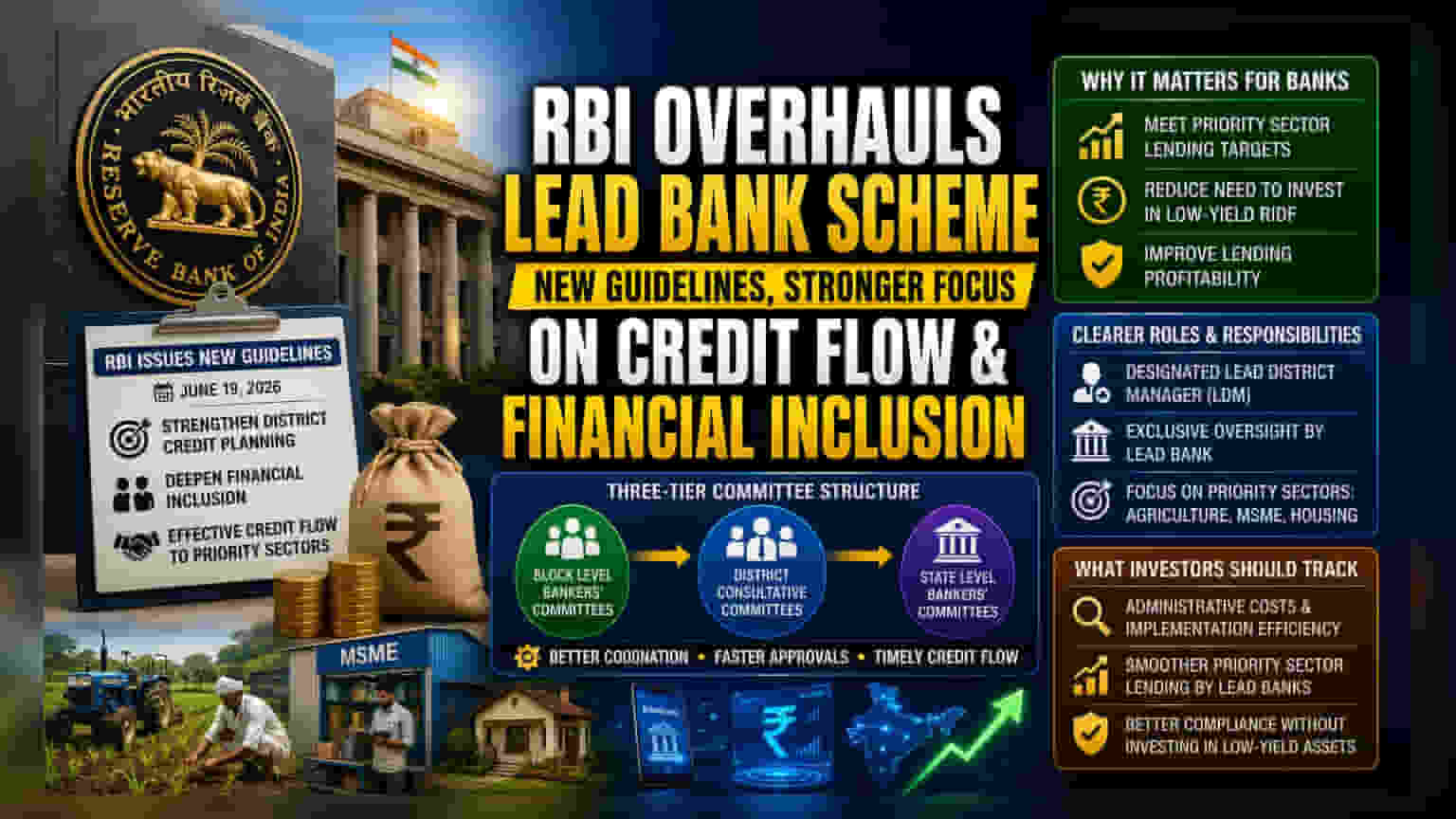
The Reserve Bank of India has issued new guidelines for the Lead Bank Scheme to enhance credit planning and financial inclusion at the district level. This update introduces a three-tier committee structure and clarifies bank responsibilities. Investors may track how this affects public sector banks, which typically serve as lead banks and must manage mandatory priority sector lending targets efficiently.
What Happened
The Reserve Bank of India (RBI) has issued a fresh set of guidelines for the Lead Bank Scheme (LBS) on June 19, 2026. The move aims to sharpen how credit is planned and distributed at the district level. By streamlining the roles of various stakeholders, the regulator intends to deepen financial inclusion and ensure that credit reaches priority sectors more effectively. The new framework supersedes all previous instructions regarding this scheme, which was first introduced in 1969 to coordinate lending in rural and semi-urban areas.
Why It Matters For Banks
For many banks—particularly large public sector banks (PSBs) that frequently act as 'Lead Banks' in districts—this scheme is directly linked to their regulatory obligations. Banks in India are required to meet specific 'Priority Sector Lending' (PSL) targets, which include loans to agriculture, small businesses, and housing.
When banks fail to meet these PSL targets, they are often required to park the shortfall in low-yielding funds like the Rural Infrastructure Development Fund (RIDF). A more efficient, well-coordinated district credit plan helps banks meet their targets, potentially reducing the need to divert capital into lower-return instruments. Consequently, the operational efficiency of the Lead Bank Scheme can have a subtle but direct impact on a bank's overall lending profitability.
The New Three-Tier Committee Structure
The updated guidelines introduce a formal three-tier committee system to improve coordination between banks and government agencies. This includes:
- Block Level Bankers' Committees
- District Consultative Committees
- State Level Bankers' Committees
These committees are responsible for creating District Credit Plans and resolving operational bottlenecks. The focus is on ensuring that bankers and government officials are in sync, which is intended to reduce delays in loan disbursements and project approvals at the grassroots level.
Clearer Responsibilities
The RBI has clearly defined the roles of Lead District Managers (LDMs) and Lead Banks. Each district will have a designated Lead Bank that is solely responsible for coordinating efforts to boost credit flow to priority sectors. By assigning exclusive oversight to a Lead District Manager, the RBI aims to create more accountability for the implementation of the scheme at the district level.
What Investors Should Track
Investors may monitor how public sector banks manage the administrative costs associated with these new committee structures. While the framework aims to improve long-term credit growth, there is a risk of initial administrative hurdles or resource pressure if the coordination between banks and state agencies faces delays. The key monitorable will be whether this overhaul leads to smoother priority sector lending for major lead banks, helping them maintain better compliance without the need for deploying funds in low-yield rural infrastructure assets.