

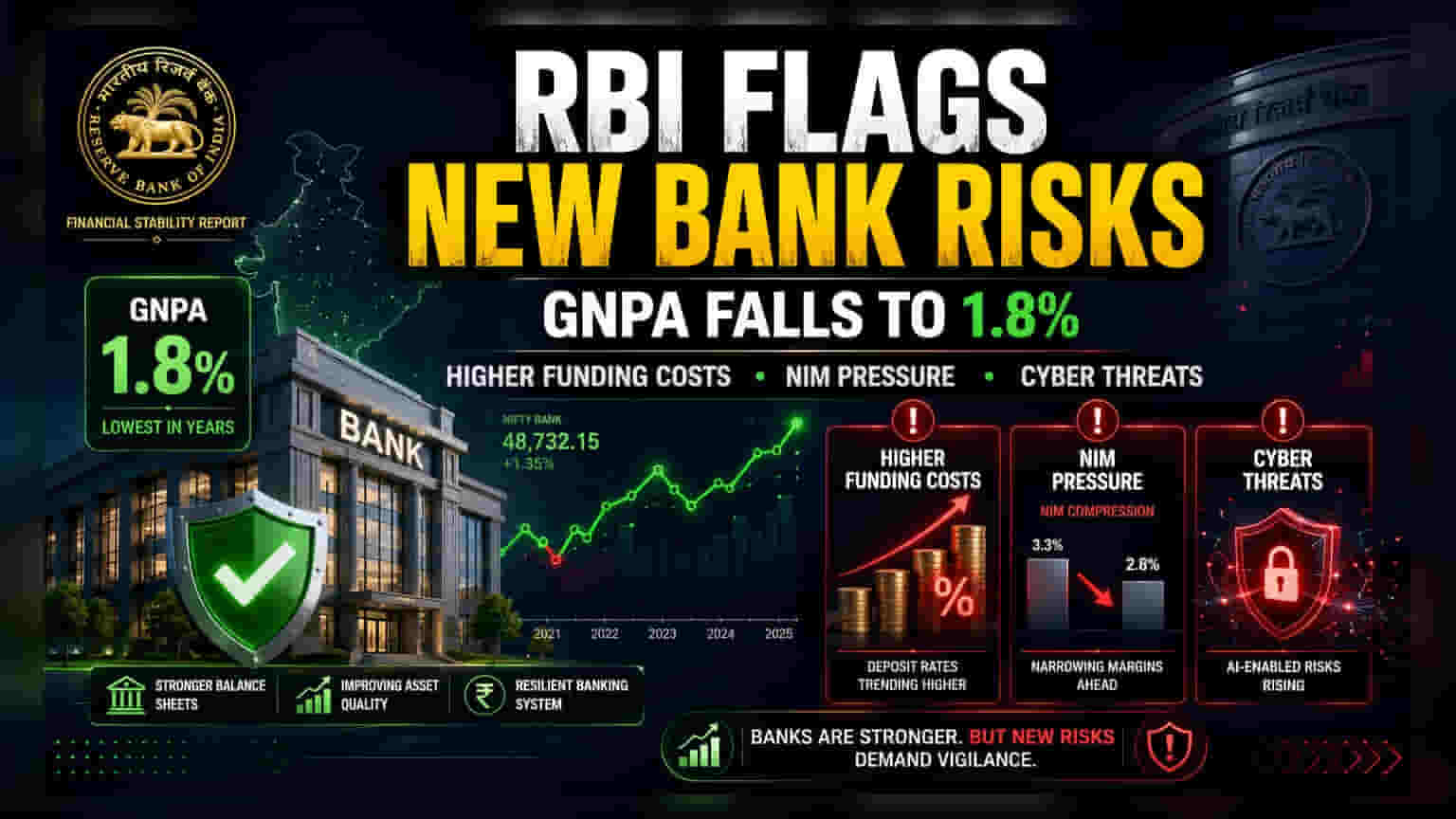
Indian banks' bad loans reached a multi-decade low of 1.8% by March 2026, according to the latest RBI report. While the financial system remains stable, banks face new pressure from rising deposit costs and cyber risks. Investors should track how banks manage their profit margins amid the shift from low-cost savings accounts to expensive term deposits.
What Happened
The Reserve Bank of India (RBI) released its latest Financial Stability Report (FSR), highlighting that the financial health of Indian banks has reached a multi-decade milestone. Gross Non-Performing Assets (GNPAs) for scheduled commercial banks dropped to 1.8% as of March 2026. This indicates that the banking sector has successfully cleaned up its balance sheets, maintaining robust capital and liquidity buffers even against global economic uncertainties. While this stability is a positive sign for the economy, the report also flags emerging challenges that could influence bank profitability in the coming quarters.
The Shift In Funding Costs
While asset quality has improved, the report highlights a clear shift in how banks are raising money. Indian households are increasingly moving their savings from traditional low-cost bank accounts—known as Current Account Savings Account (CASA)—into higher-yielding options like mutual funds and equities. As a result, banks are being forced to pay more for deposits to attract funds, relying heavily on term deposits and certificates of deposit.
This trend is putting pressure on the "cost of funds." When banks pay more to attract money, their Net Interest Margins (NIMs)—the difference between what they earn on loans and what they pay on deposits—can come under pressure. To protect these margins, banks are shifting their focus toward riskier, higher-yielding loan segments, such as small business lending. Investors should watch whether this shift impacts the long-term asset quality, as these loan segments can be more sensitive to economic downturns.
Emerging Cyber Risks
Beyond financial metrics, the RBI report identifies a critical non-financial risk: cybersecurity. The regulator highlighted that the banking sector is increasingly vulnerable to AI-enabled cyberattacks. As financial transactions become more digital and interconnected, the threat of sophisticated, technology-driven fraud is rising. The central bank emphasizes that protecting these systems is no longer just an IT issue but a core business priority that could impact bank operations and customer trust.
What Investors Should Track
- Net Interest Margins (NIMs): Watch for signs of margin compression in quarterly results as banks struggle to balance higher deposit costs with competitive lending rates.
- Deposit Growth vs. Credit Growth: A key monitorable is the credit-deposit ratio. If credit growth continues to outpace deposit mobilization, funding costs may rise further.
- Asset Quality Trends: While the 1.8% GNPA figure is positive, it is important to monitor for any signs of stress in the newer, higher-yielding loan segments that banks are targeting.
- Cybersecurity Spending: Banks that are consistently upgrading their digital infrastructure to counter AI-driven threats are better positioned to protect their operational stability.