 Whalesbook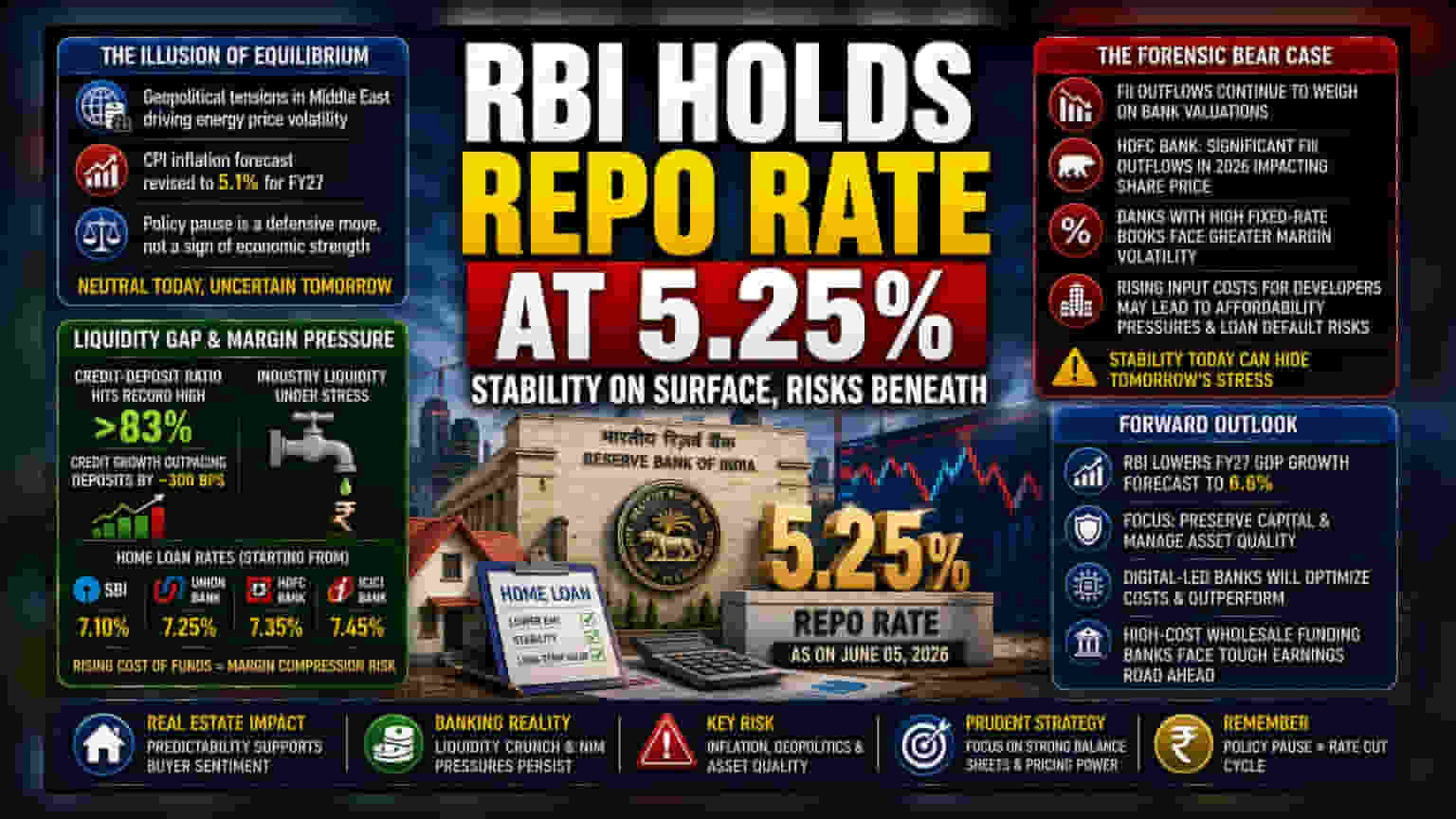


The Illusion of Equilibrium
The Reserve Bank of India’s decision on June 5, 2026, to maintain the repo rate at 5.25% provides a veneer of stability for the residential real estate market. While developers and homebuyers welcome the predictability, the policy pause is less an endorsement of economic strength and more a forced defensive maneuver. With geopolitical friction in the Middle East driving energy price volatility and domestic CPI inflation projections revised upward to 5.1% for FY27, the central bank’s neutral stance is a calculated attempt to avoid exacerbating systemic fragility.
The Liquidity Gap and Margin Compression
The narrative of 'competitive' home loan rates ignores the mounting pressure on bank balance sheets. As of late Q2 2026, the industry is grappling with a widening credit-deposit ratio, which recently hit historical highs above 83%. Credit offtake has consistently outpaced deposit growth by roughly 300 basis points, forcing institutions into a liquidity squeeze. While public sector lenders like the State Bank of India and Union Bank of India promote aggressive lending rates starting near 7.10% to 7.25%, the cost of raising incremental deposits is rising. For private players such as HDFC Bank and ICICI Bank, maintaining margins while underwriting long-term assets in a volatile interest rate environment is becoming an increasingly complex actuarial challenge. The divergence between repo-linked loan yields and the actual cost of funds suggests that NIMs could face significant contraction if the current liquidity crunch remains unaddressed.
The Forensic Bear Case: Structural Weaknesses
A cynical review of the banking sector reveals specific vulnerabilities. While market leaders like HDFC Bank and ICICI Bank maintain dominant valuations, they are not immune to the sector-wide structural repositioning by foreign institutional investors. HDFC Bank, in particular, has navigated a challenging 2026 marked by significant FII outflows, which have acted as a mechanical weight on the share price regardless of operational performance. Furthermore, banks with higher exposure to fixed-rate legacy books are significantly more exposed to margin volatility than those with nimble, repricable assets. Investors should note that the 'stable' interest rate environment also conceals the danger of rising input costs for developers, which could eventually filter into loan default risks if the residential market faces an affordability threshold breach.
Forward Outlook
Market participants should not equate the current policy pause with a permanent rate-cut cycle. With the RBI lowering its FY27 GDP growth forecast to 6.6%, the focus has shifted toward preserving capital and managing asset quality. Analysts anticipate that banks capable of leveraging digital infrastructure to optimize operational costs will outperform, while those tethered to high-cost wholesale funding may face a difficult earnings trajectory throughout the remainder of the fiscal year.