

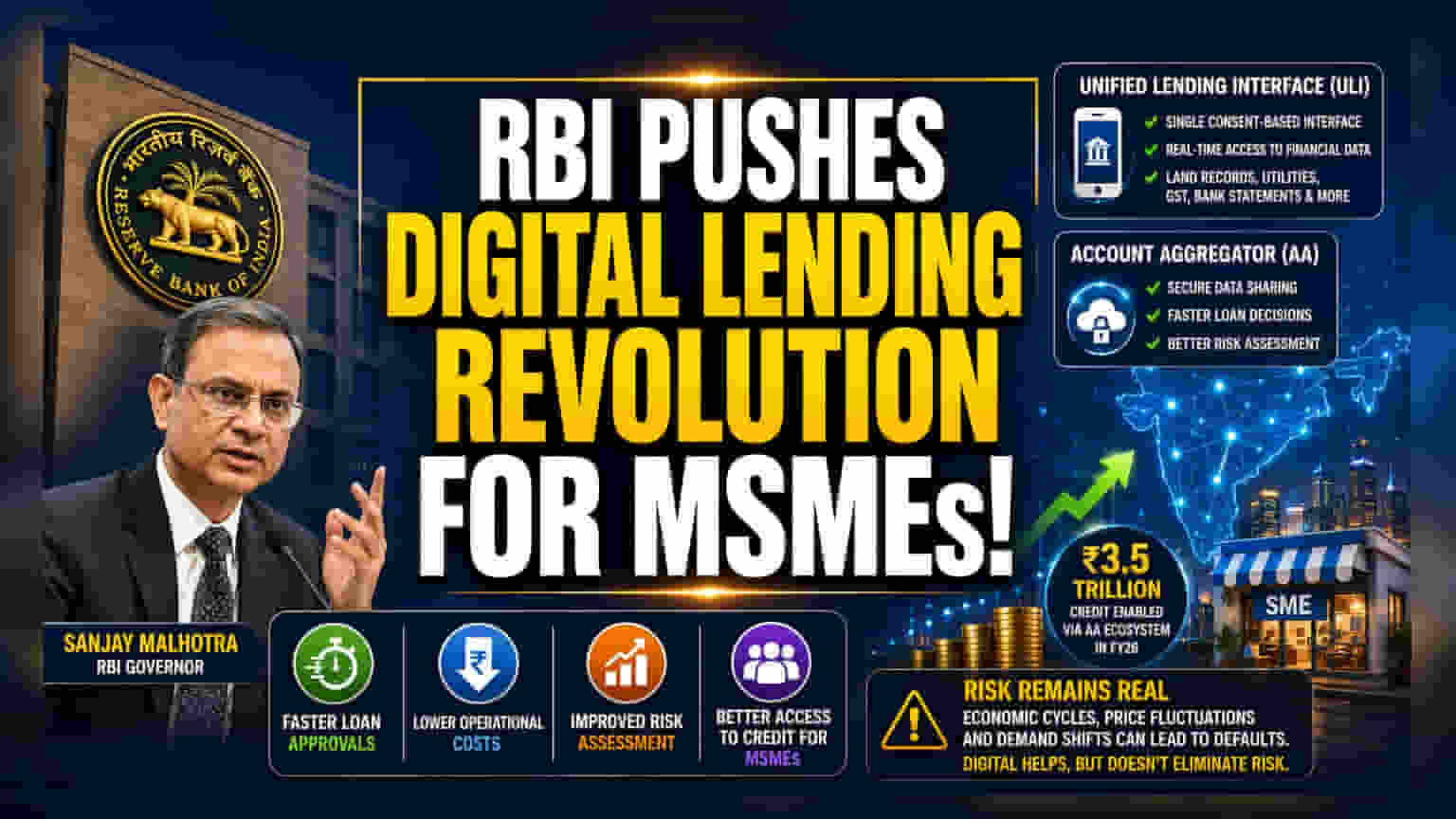
RBI Governor Sanjay Malhotra is urging banks to utilize digital infrastructure like the Unified Lending Interface (ULI) to expand credit access for MSMEs. With the Account Aggregator framework already facilitating ₹3.5 trillion in credit during FY26, the central bank aims to improve lending efficiency. Investors should track how this tech shift impacts underwriting costs and long-term asset quality for lenders.
What Happened
Reserve Bank of India (RBI) Governor Sanjay Malhotra has called for a major shift in how banks and non-banking financial companies (NBFCs) lend to micro, small, and medium enterprises (MSMEs). Speaking in Kochi, the Governor highlighted that India’s digital public infrastructure—specifically the Unified Lending Interface (ULI) and the Account Aggregator (AA) framework—is essential to solve the ongoing credit shortage in the MSME sector. The Governor emphasized that these tools allow lenders to assess borrower health more accurately using digital records like GST filings and bank statements, rather than relying solely on traditional, slower methods.
Understanding ULI and the Digital Shift
The central bank is positioning the Unified Lending Interface (ULI) as a potential game-changer, drawing parallels to the impact the Unified Payments Interface (UPI) had on digital payments. Currently, lending decisions often face delays due to difficulties in verifying borrower documents. ULI aims to simplify this by providing a single, consent-based interface where lenders can access a borrower’s financial footprint—including land records, utility payments, and GST data—in real time. This digital trail helps lenders create a more complete picture of a business, which is particularly helpful for smaller firms that may lack long-standing credit histories.
Why This Matters for Financial Institutions
For banks and NBFCs, adopting these digital platforms can lead to significant operational benefits. Traditionally, processing SME loans involves heavy manual work and high customer acquisition costs. By automating data collection through the Account Aggregator framework, lenders can reduce the time taken to approve loans and lower their operational expenses. The RBI noted that the Account Aggregator ecosystem has already facilitated ₹3.5 trillion in credit during FY26, signaling that adoption is gaining traction. Financial institutions that successfully integrate these tools may see improvements in their ability to scale their SME loan portfolios while keeping costs under control.
The Risk Factor: Why Digital Doesn’t Eliminate Credit Default
While digital tools improve the speed and efficiency of lending, they do not change the fundamental nature of the risk involved in SME lending. MSMEs are often sensitive to economic cycles, raw material price fluctuations, and demand shifts, which can lead to payment delays or defaults regardless of how advanced the loan application process is. Even with better data, the risk of non-performing assets (NPAs) remains a critical factor for lenders. Investors should be aware that technology helps in underwriting and monitoring, but it does not remove the need for lenders to maintain rigorous credit risk management practices.
What Investors Should Track
The integration of ULI and other digital systems into core banking operations will be a key monitorable in upcoming quarterly reports. Investors should pay attention to management commentary regarding the cost of implementing these technologies and whether the shift is actually resulting in better loan-to-deposit ratios or improved margins. Furthermore, as banks aggressively use digital tools to expand their MSME books, it will be vital to observe if this leads to an increase in the proportion of 'stress' in the SME portfolio, or if the improved data analytics effectively help in identifying viable borrowers early.