 Whalesbook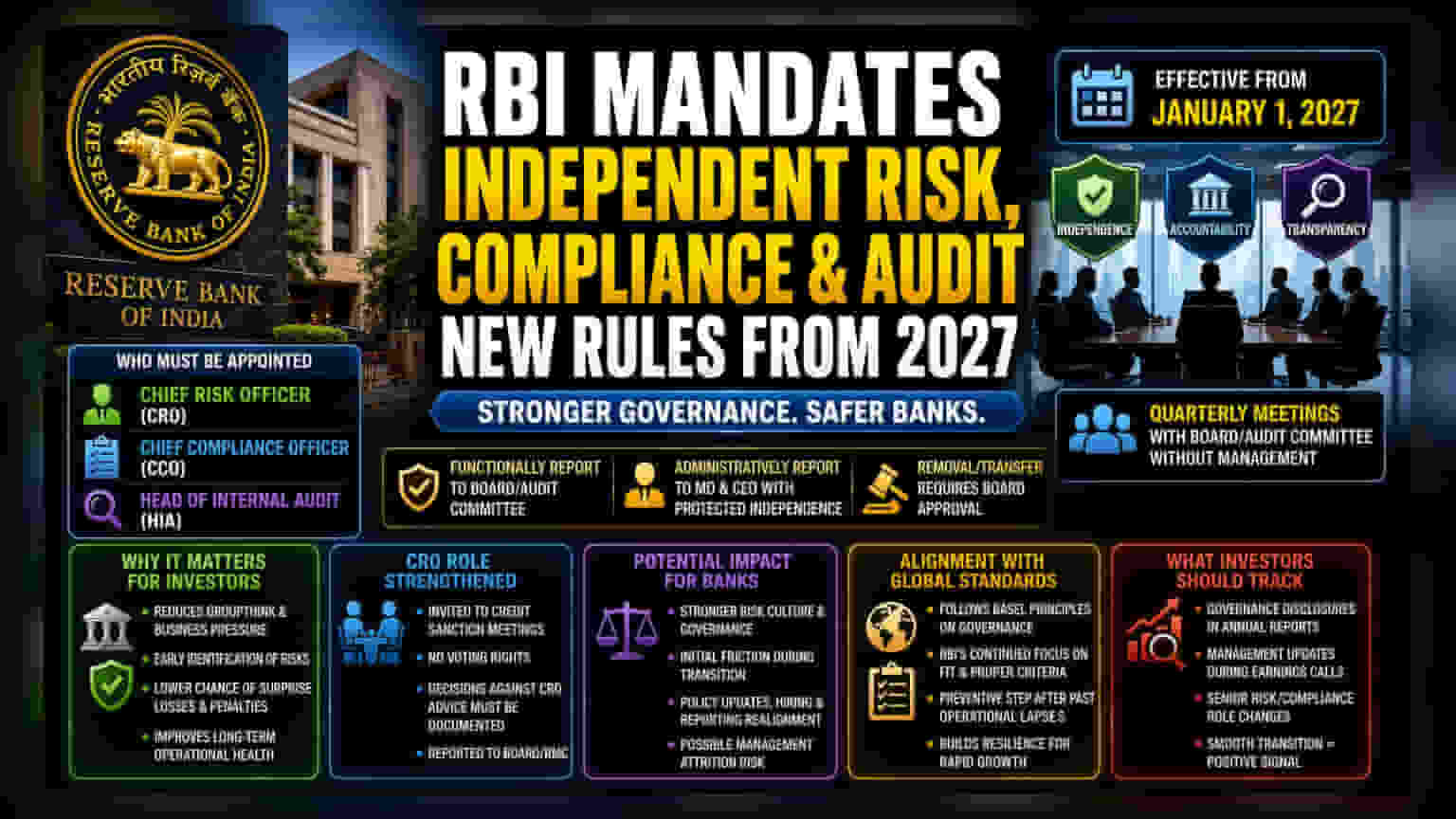


The Reserve Bank of India has mandated stricter governance rules for commercial banks, requiring independent roles for Chief Risk, Compliance, and Audit officers. These key officials will report directly to the board, ensuring they operate without pressure from business departments. This move aims to curb operational risks and strengthen accountability across the banking sector, with the rules effective from January 1, 2027.
What Happened
The Reserve Bank of India has announced a major update to how commercial banks in the country manage risk, compliance, and internal audits. Starting January 1, 2027, all commercial banks must appoint a dedicated Chief Risk Officer (CRO), a Chief Compliance Officer (CCO), and a Head of Internal Audit (HIA). The core objective is to ensure these functions operate independently from the bank's day-to-day business operations.
These officials must be senior-level, reporting functionally to the board of directors or an audit committee. Administratively, they will report to the Managing Director and CEO, but the RBI has introduced a specific mechanism to ensure their independence. They will now be required to meet with the board or its committee at least once every quarter without any other senior management present. Furthermore, their removal or premature transfer will now require board-level approval.
Why This Matters For Investors
For shareholders, this is a structural change in how banks manage risk. Historically, compliance and risk teams in banks have sometimes faced pressure from business heads to overlook risks in favor of meeting aggressive growth or revenue targets. By formally separating these roles from business lines, the regulator is looking to reduce the possibility of "groupthink" and operational lapses that can lead to large losses or regulatory penalties.
Investors often worry about unexpected issues like bad loan classification errors, poor IT system maintenance, or regulatory breaches that can suddenly impact a bank's stock price. By ensuring that risk and compliance officers have a direct, protected line to the board, the RBI is aiming to identify these problems much earlier. This could potentially lead to more stable, long-term operational health for the sector.
The Risk Management Framework
Under the new rules, the CRO’s role becomes more active in credit decisions. While they will not have a vote, they will be an invitee to credit sanctioning meetings. This is a crucial change. If a bank decides to move forward with a loan or an investment against the CRO's advice, the bank will need to document the risk-mitigation measures taken and report the decision to the board or its risk management committee. This creates an "audit trail" of accountability, ensuring that risk decisions are not taken lightly.
How Investors May Read This
Investors might see this as a mixed bag in the short term. On the one hand, it strengthens the governance culture, which is a positive for any financial institution. A bank with a strong risk culture is generally viewed as safer and more sustainable over the long run.
On the other hand, the implementation could bring some friction. Banks will need to adjust their internal reporting lines, hire or re-designate senior personnel, and update their board-approved policies. There may also be a period of adjustment where the internal power dynamics shift as compliance and risk officers gain more authority. Investors should watch for any management attrition during this transition, as a sudden exit of senior leadership could sometimes signal internal disagreements regarding these new, stricter reporting structures.
The Bigger Business Context
This move aligns with global best practices for banking governance. The RBI has been consistently focusing on "fit and proper" criteria and the independence of key management personnel. Previous regulatory actions against various banks for IT outages, operational deficiencies, or compliance gaps have highlighted that the central bank is increasingly intolerant of weak internal controls. This mandate is a preventive step to ensure that the banking sector remains robust even as it grows rapidly.
What Investors Should Track
Investors should monitor how individual banks implement these changes over the next 18 months leading up to the January 2027 deadline. Key monitorables include any disclosures in annual reports regarding governance updates, management commentary during earnings calls about the transition, and whether there are any abrupt exits in senior risk or compliance roles. A smooth transition without significant management churn will likely be viewed as a positive sign that the bank’s board is proactively aligning with these new governance standards.