 Whalesbook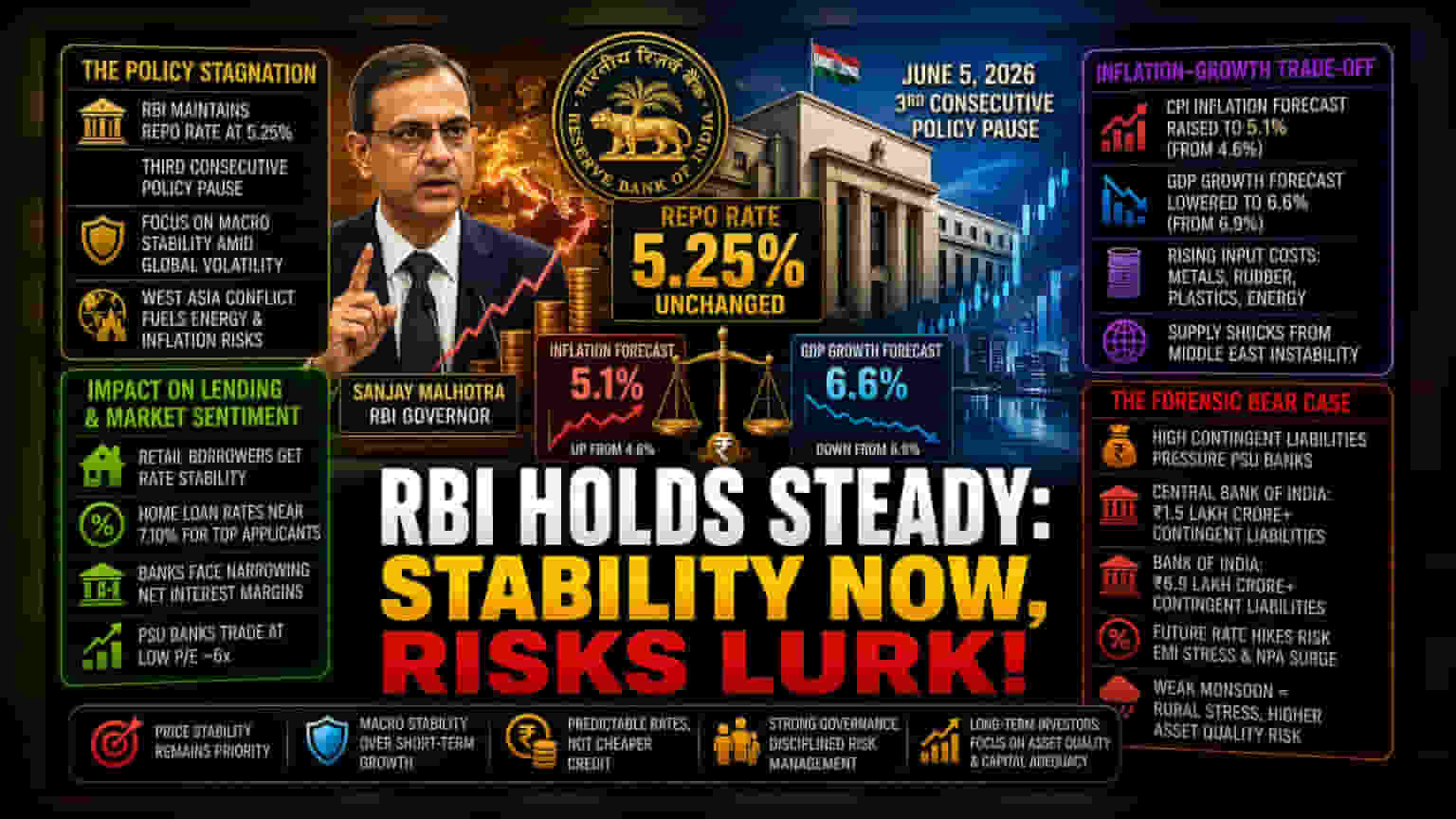


The Policy Stagnation
The Reserve Bank of India’s (RBI) decision to maintain the repo rate at 5.25% on June 5, 2026, marks the third consecutive policy pause. Governor Sanjay Malhotra justified this neutral stance by emphasizing the necessity of preserving macroeconomic stability against a volatile global backdrop. The committee’s focus remains anchored on managing the ripple effects of the West Asia conflict, which has introduced significant uncertainty into the global energy market and domestic inflation trajectory.
The Inflation-Growth Trade-off
Beyond the headline rate, the policy update contained sobering revisions for the financial year. The RBI has increased its consumer price inflation (CPI) forecast for FY27 to 5.1%, a notable rise from previous projections of 4.6%. This adjustment reflects escalating costs in industrial inputs, including metals, rubber, and plastics, alongside volatile energy prices. Simultaneously, the central bank lowered its GDP growth forecast to 6.6% from 6.9%, explicitly citing supply shocks stemming from the ongoing Middle East instability.
Impact on Lending and Market Sentiment
For retail borrowers, the repo-rate pause offers predictable, if not cheaper, borrowing costs, with public sector lenders like Central Bank of India and Bank of Maharashtra continuing to promote entry-level rates near 7.10% for highly-rated applicants. However, the banking sector faces a nuanced landscape. While steady rates prevent an immediate shock to EMI structures, banks must contend with narrowing net interest margins (NIMs) if deposit growth continues to lag behind credit expansion. Large-cap public lenders, such as Bank of India, are currently trading at low P/E valuations near 6x, reflecting investor concerns regarding potential asset quality slippage in a high-interest, slower-growth environment.
The Forensic Bear Case: Structural Risks
Despite the stability, institutional risks remain elevated. Many public sector banks are grappling with significant contingent liabilities, which remain a primary concern for long-term equity holders. Central Bank of India, for instance, reports contingent liabilities exceeding Rs 1.5 lakh crore, while Bank of India faces similar pressures with figures north of Rs 6.9 lakh crore. Furthermore, the banking sector's reliance on Repo-Linked Loan Rates (RLLR) means that while the current pause aids in stability, any future deviation by the MPC toward tightening to combat the revised 5.1% inflation target would immediately pressure household disposable income and could accelerate non-performing asset (NPA) formation. Investors should remain wary of the disparity between the sector's attractive P/E ratios and the underlying volatility in capital adequacy if the monsoon season falls short of expectations, exacerbating rural consumption stress.