 Whalesbook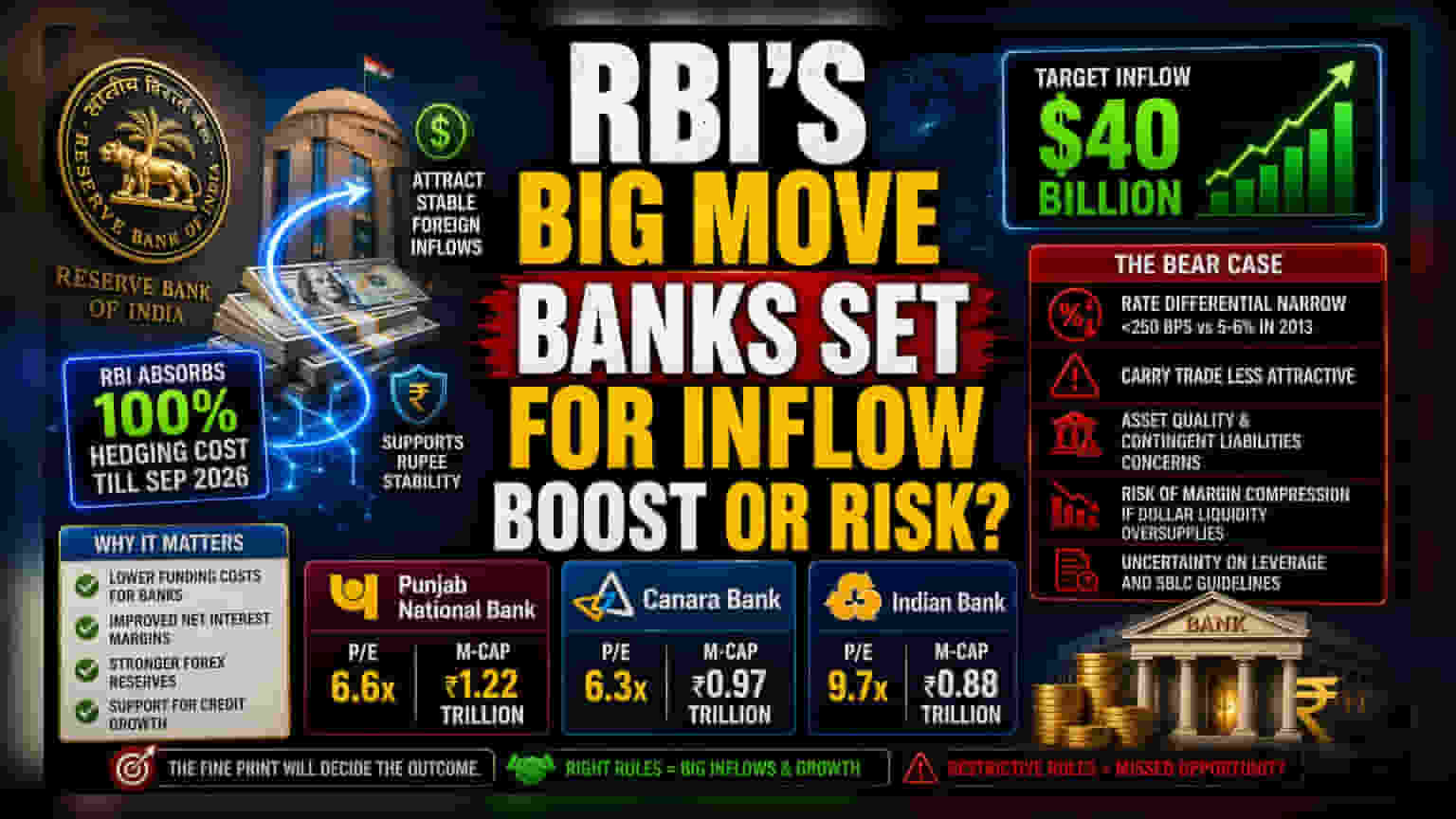


The Shift in Funding Economics
The Reserve Bank of India’s decision to absorb the full cost of hedging for Foreign Currency Non-Resident (Bank) deposits represents a significant pivot in domestic monetary management. By effectively removing the currency risk premium for banks, the central bank is creating a clear, subsidized incentive for lenders to aggressively court dollar inflows. This policy change, effective through September 2026, aims to stabilize the rupee by encouraging stable, medium-to-long-term foreign funding rather than relying solely on volatile, short-term capital flows.
Valuation and Peer Comparison
Public sector lenders like Punjab National Bank (PNB), which currently trades at a P/E ratio of approximately 6.6x with a market capitalization near ₹1.22 trillion, are positioned to benefit from enhanced net interest margins if they can successfully pass on these lower hedging costs. Similarly, peers such as Canara Bank (P/E ~6.3x) and Indian Bank (P/E ~9.7x) are expected to leverage their extensive branch networks to secure a portion of the anticipated $40 billion liquidity pool. While these banks are trading at relatively conservative valuation multiples compared to private sector giants, the success of this scheme will be measured by their ability to translate these inflows into long-term asset growth rather than just temporary balance sheet bloat.
The Forensic Bear Case
Despite the immediate optimism, the institutional view remains cautious. The primary risk is the structural weakness of the 2026 domestic deposit environment compared to the 2013 precedent. Currently, the interest rate differential between India and the United States has narrowed significantly to less than 250 basis points, making the carry trade far less compelling than it was a decade ago when the differential hovered in the 5-6% range. Furthermore, the banking sector faces lingering concerns regarding contingent liabilities and historical asset quality issues. There is also the potential for margin compression if the expected inflow leads to an oversupply of dollar liquidity that cannot be deployed efficiently into high-yielding domestic projects. Finally, if the RBI does not clarify the rules around leverage—specifically the use of Standby Letters of Credit (SBLCs)—the actual mobilization may fall well short of the optimistic $40 billion target currently priced into some market sentiment.
The Future Outlook
Market participants are now awaiting detailed operational guidelines from the central bank. The consensus among analysts is that while the scheme provides a necessary bridge for forex reserves, the true performance will hinge on the 'fine print' of the swap framework. If regulators replicate the favorable leverage terms of 2013, the inflow could surprise the market to the upside. Conversely, a restrictive framework could leave banks sitting on costly foreign currency liabilities with limited avenues for profitable deployment.