

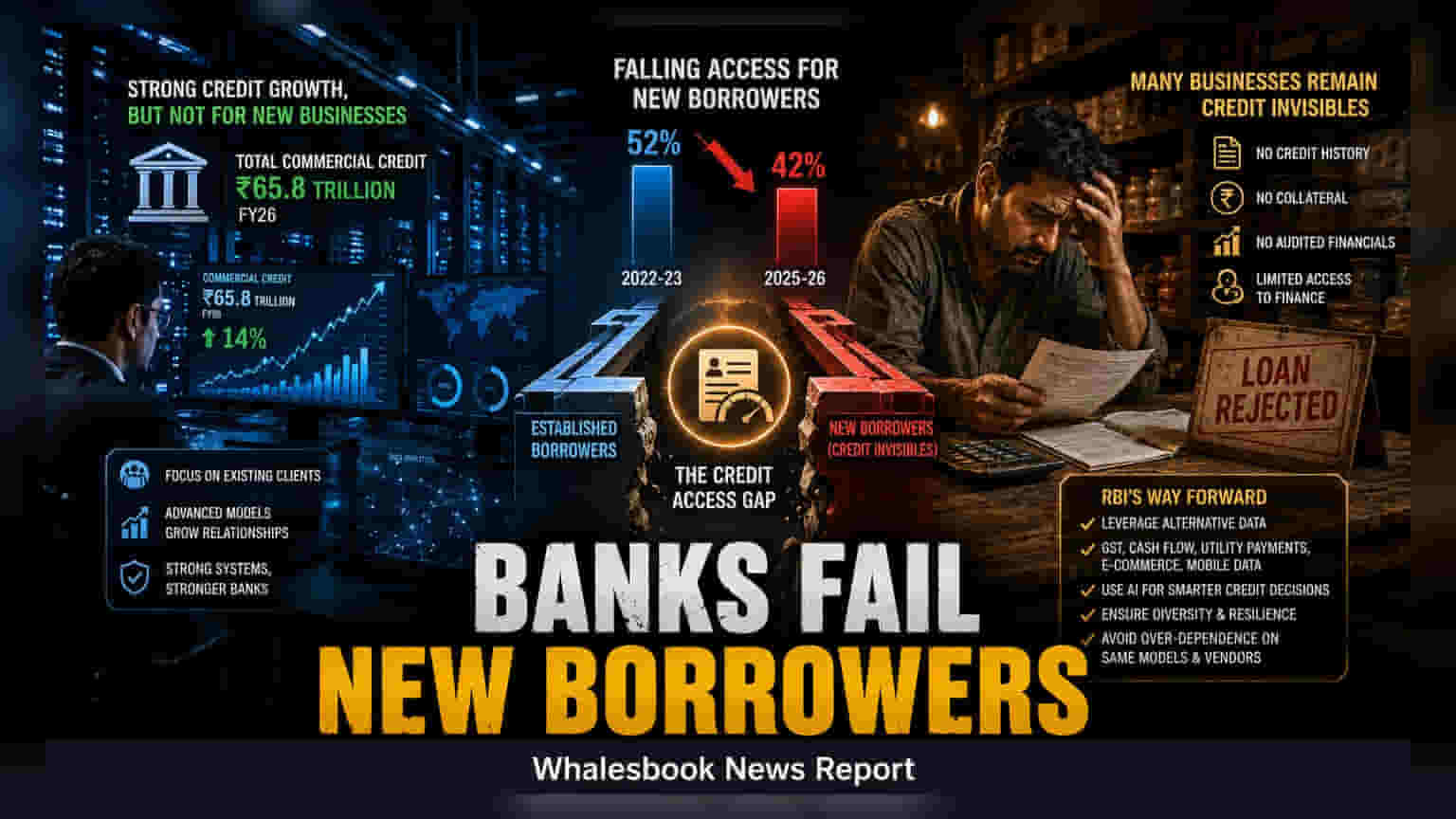
While commercial credit expanded 14% to ₹65.8 trillion in FY26, fewer new businesses are entering the formal credit system. RBI Deputy Governor Shirish Chandra Murmu warned that banks’ current technology and data models are optimized for serving existing clients rather than capturing new ones. This trend indicates a struggle to integrate 'credit invisibles' into the formal economy despite advanced digital capabilities.
The Reserve Bank of India (RBI) has highlighted a growing structural challenge in the nation's banking sector: while overall commercial credit is expanding, the ability of banks to bring new businesses into the formal financial fold is weakening. During the recent Banking Transformation Summit, RBI Deputy Governor Shirish Chandra Murmu pointed out that the share of fresh businesses accessing formal credit dropped to 42% in fiscal year 2025-26, down from 52% in 2022-23.
This trend persists even as the banking sector reports strong overall performance, with total outstanding commercial credit growing by 14% to reach ₹65.8 trillion in FY26. The RBI's observation suggests that while banks are becoming more efficient, that efficiency is largely benefiting their current customer base rather than expanding the market to underserved segments.
The core issue, according to the central bank, lies in how banks utilize their technological and data analytics capabilities. Banks have increasingly focused on using advanced models to manage and grow relationships with existing clients—those who already have a credit history and clear financial footprints. However, this same technological prowess is not being effectively deployed to identify and onboard new borrowers, often referred to as 'credit invisibles.' These are businesses that lack a traditional credit history, collateral, or audited financial statements, yet may have the capacity to repay loans.
To bridge this gap, the RBI has urged lenders to look beyond traditional lending metrics. Banks are being encouraged to integrate alternative data sources into their assessment models. Information such as GST filings, cash flow patterns, utility payments, e-commerce transaction records, and mobile usage data can provide a much clearer picture of a borrower’s repayment ability than collateral alone. Artificial intelligence (AI) has a significant role to play here, as it can help banks interpret this non-traditional data to make faster and more accurate credit decisions.
However, the move toward a data-driven lending model comes with its own set of concerns. The RBI Deputy Governor cautioned against the risk of systemic reliance on a narrow set of technology providers and identical data models. If too many financial institutions depend on the same AI models or tech vendors, it could create a single point of failure that might trigger widespread disruption. The central bank emphasized the need for robust oversight and strict concentration limits to ensure that as banks scale their operations, they are building resilience from the start rather than trying to fix systemic issues later.
For investors and market observers, the next important phase will be how individual banks adjust their lending strategies. Success will likely depend on whether financial institutions can successfully shift their tech investments from merely servicing existing, well-known clients to effectively capturing the untapped market of new borrowers without compromising on risk management.