

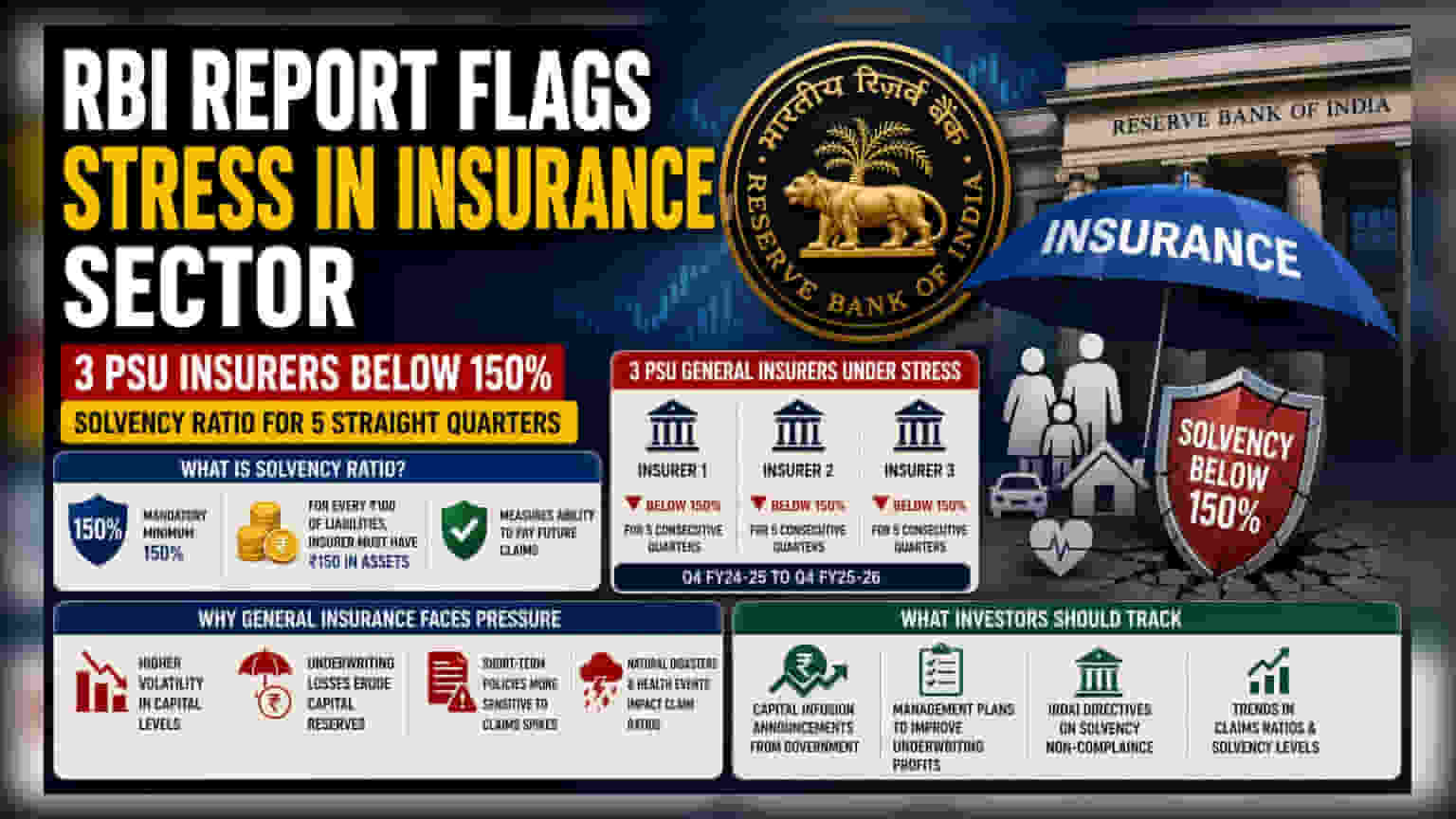
The Reserve Bank of India’s latest Financial Stability Report has warned of thinning solvency buffers across the insurance industry. Crucially, three public sector general insurers have failed to meet the mandatory 150% solvency ratio for five consecutive quarters. This persistent shortfall highlights capital risks and the potential need for strengthening the financial cushions of these state-run entities.
What the RBI Report Revealed
The Reserve Bank of India (RBI) has released its latest Financial Stability Report, which includes a stern observation regarding the health of India's insurance sector. While life insurance companies are reportedly maintaining regulatory compliance, the central bank has noted that their capital cushions are thinning. The situation is more critical in the general insurance segment, where three public sector entities have been operating below the mandatory solvency threshold for an extended period.
According to the report, these three insurers have failed to maintain the minimum 150% solvency ratio for five straight quarters, covering the period from the fourth quarter of the 2024-25 fiscal year through the fourth quarter of 2025-26. This data serves as a signal of ongoing financial stress within these specific state-run institutions.
Understanding the Solvency Cushion
For investors, it is important to understand what the solvency ratio actually means. In simple terms, the solvency ratio is a measure of an insurance company’s ability to pay its future claims. The Insurance Regulatory and Development Authority of India (IRDAI) mandates that insurers maintain a ratio of at least 150%.
Think of this as a safety net. If a company has a ratio of 150%, it means for every ₹100 of potential liabilities, it has ₹150 in assets set aside. When this ratio falls below 150%, it indicates that the company’s capital buffer is thinner than what the regulator considers safe. This can limit a company's ability to underwrite new business and may force the regulator to intervene.
Why the General Insurance Sector Faces Pressure
The RBI report identified several reasons why the general insurance segment is under greater pressure compared to life insurers. The sector suffers from higher quarterly volatility in its capital levels. This is often driven by underwriting losses, where the money paid out in claims and expenses exceeds the premiums collected from policyholders.
Because general insurance policies are typically short-term, such as annual health or motor covers, the sector is more sensitive to sudden spikes in claims due to events like natural disasters or health crises. When these underwriting losses persist, they eat into the capital reserves of the insurers, dragging down the solvency ratio.
What This Means for Capital and Regulation
The persistent inability of these three insurers to meet the 150% requirement raises questions about their long-term financial flexibility. For state-run entities, a low solvency ratio often leads to discussions about capital infusion from the government, which is the primary shareholder.
Regulatory intervention is also a possibility. If the solvency ratio remains low, the IRDAI may impose restrictions on the growth of the company or require it to submit a comprehensive plan to restore its capital levels. For the broader market, this emphasizes the need for operational efficiency and better pricing discipline in the general insurance business.
What Investors Should Track
Investors tracking this space should watch for any official announcements regarding capital infusion into these public sector insurers. Key items to monitor include:
- Management commentary on steps taken to improve underwriting profits.
- Future filings from these companies detailing their capital position.
- Any circulars or directives from the IRDAI regarding solvency non-compliance.
- Trends in claims ratios, which directly impact the ability to maintain the required capital cushion.