 Whalesbook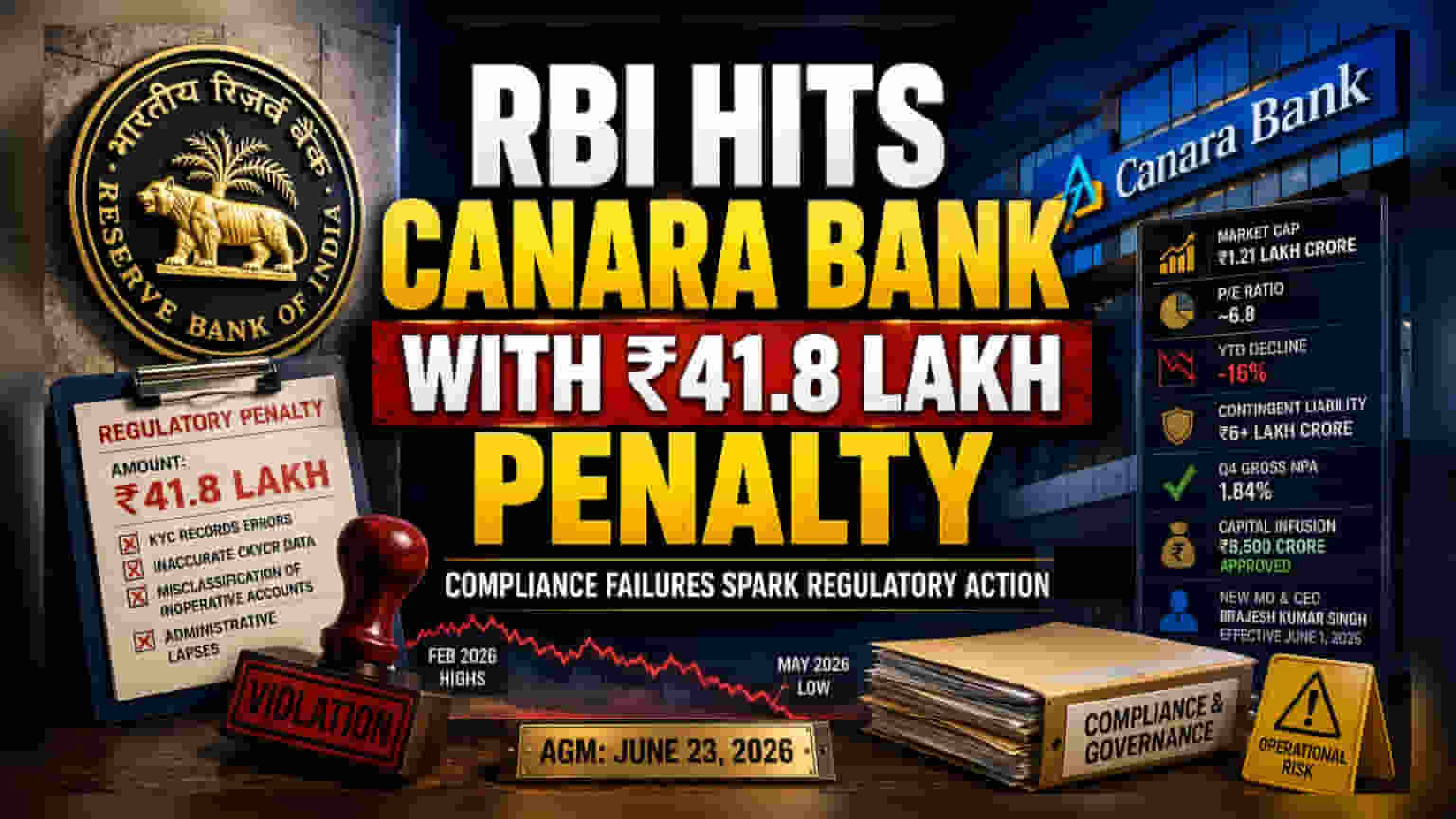


A Structural Regulatory Setback
The Reserve Bank of India (RBI) has issued a monetary penalty of ₹41.8 lakh against Canara Bank, citing critical failures in administrative compliance. The central bank’s action follows its 2025 supervisory evaluation, which scrutinized the lender's operational integrity as of March 31, 2025. The core of the issue lies in the bank's inability to maintain accurate records within the Central KYC Records Registry (CKYCR) and errors in the classification of accounts as inoperative, despite clear evidence of customer-initiated activity within the preceding 12 months.
Valuation and Market Context
While the penalty amount is relatively immaterial to a firm with a market capitalization of approximately ₹1.21 lakh crore, it underscores the operational challenges inherent in the Public Sector Bank (PSB) space. The stock, which currently trades at a price-to-earnings (P/E) ratio of roughly 6.8, has faced volatility throughout fiscal year 2026, struggling with a 16% year-to-date decline from its February 2026 highs. Investors are currently weighing these regulatory headaches against the bank’s recent leadership transition, which saw the appointment of Brajesh Kumar Singh as the new Managing Director and CEO effective June 1, 2026.
The Operational Bear Case
Beyond the headline fine, institutional observers point to a broader pattern of contingent liability risks. Canara Bank’s latest financial disclosures reveal a contingent liability footprint exceeding ₹6 lakh crore, a figure that continues to draw scrutiny from risk-averse analysts. Unlike private sector peers that often maintain higher investment in automated KYC infrastructure, the bank has grappled with legacy systemic inefficiencies. Furthermore, the bank’s capital-raising plans—including the recent approval for an ₹8,500 crore infusion—are being scrutinized to determine if they can effectively offset the drag of mounting operational expenses and the ongoing efforts to clean up internal administrative processes.
Future Outlook
The regulatory warning serves as a reminder of the heightened oversight expected by the central bank. While Canara Bank has demonstrated improved asset quality metrics—with gross non-performing assets contracting to 1.84% in the most recent quarter—the burden of proof remains on the new leadership to demonstrate that these regulatory lapses are not symptomatic of deeper governance issues. With the bank’s Annual General Meeting scheduled for June 23, 2026, institutional shareholders will likely press for clearer communication on how the bank intends to modernize its internal compliance framework to avoid recurring penalties that, while small in cash terms, threaten the institution's reputational standing with global investors.