

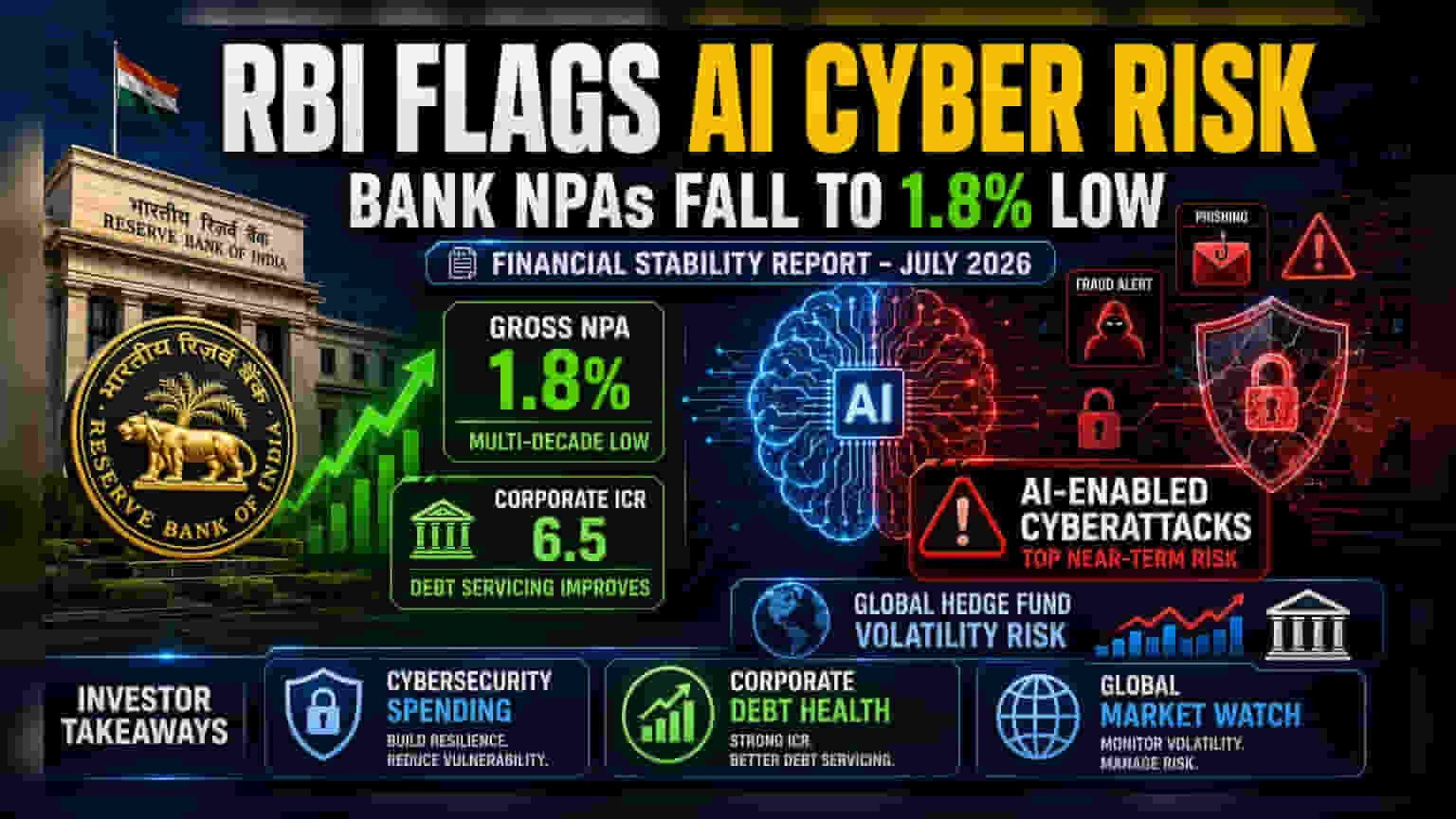
The Reserve Bank of India’s latest Financial Stability Report shows bank bad loans dropped to a multi-decade low of 1.8% by March 2026. While the financial system is robust, the regulator has warned of rising AI-driven cyber threats. Investors should track how banks adapt their technology and security spending to manage these new digital risks.
What Happened
The Reserve Bank of India (RBI) released its Financial Stability Report for July 2026, highlighting a period of strength for the Indian banking sector. The most significant finding is that gross non-performing assets (NPAs)—the amount of bad loans on bank books—have fallen to a multi-decade low of 1.8% as of March 2026. This indicates that Indian banks are currently in a strong financial position, with better-quality loan portfolios than seen in previous years.
The Rise Of AI Cyber Threats
While the financial health of banks is improving, the RBI has shifted focus to a new, modern danger: Artificial Intelligence (AI). The regulator flagged AI-enabled cyberattacks as the most serious near-term threat to the stability of financial institutions.
Modern hackers are using AI to create more sophisticated phishing scams and automated fraud attempts that are harder to detect than traditional threats. The RBI noted that while banks are doing well in basic cyber assessments, there is an urgent need to improve employee awareness and training. For investors, this signals that banks may need to increase their spending on cybersecurity technology and digital infrastructure to prevent data breaches and financial losses.
Corporate Debt Health
The report also offered a look at the health of listed private companies. The average interest coverage ratio (ICR)—a key metric showing how easily a company can pay the interest on its debt from its operating profits—rose to 6.5 in the March 2026 quarter.
A higher ICR generally means companies are generating enough profit to cover their interest payments comfortably. This improvement was largely driven by companies increasing their operating profits relative to the interest they have to pay. However, the report also included a cautious note that a small segment of companies remains financially vulnerable, which may be worth monitoring if borrowing costs rise or if business growth slows.
Caution On Global Hedge Funds
Beyond domestic factors, the RBI raised concerns about the growing role of large, highly leveraged hedge funds in the global bond market. The regulator warned that if these funds rush to sell their assets during times of market panic, it could lead to sudden, sharp price swings in global bond markets. While this is an international risk, it serves as a reminder to investors that sudden global volatility can impact liquidity and asset prices even within the Indian market.
What Investors Should Track
Investors can keep an eye on a few key areas following this report. First, track bank-level updates on cybersecurity spending, as banks that invest more in AI-defense systems may be better protected against future disruptions. Second, watch the earnings reports of corporate borrowers to see if the interest coverage ratio stays healthy or begins to drop. Finally, keep an eye on global market commentary, as the RBI's concerns regarding hedge fund leverage suggest that global market stability remains a factor for Indian asset prices.