

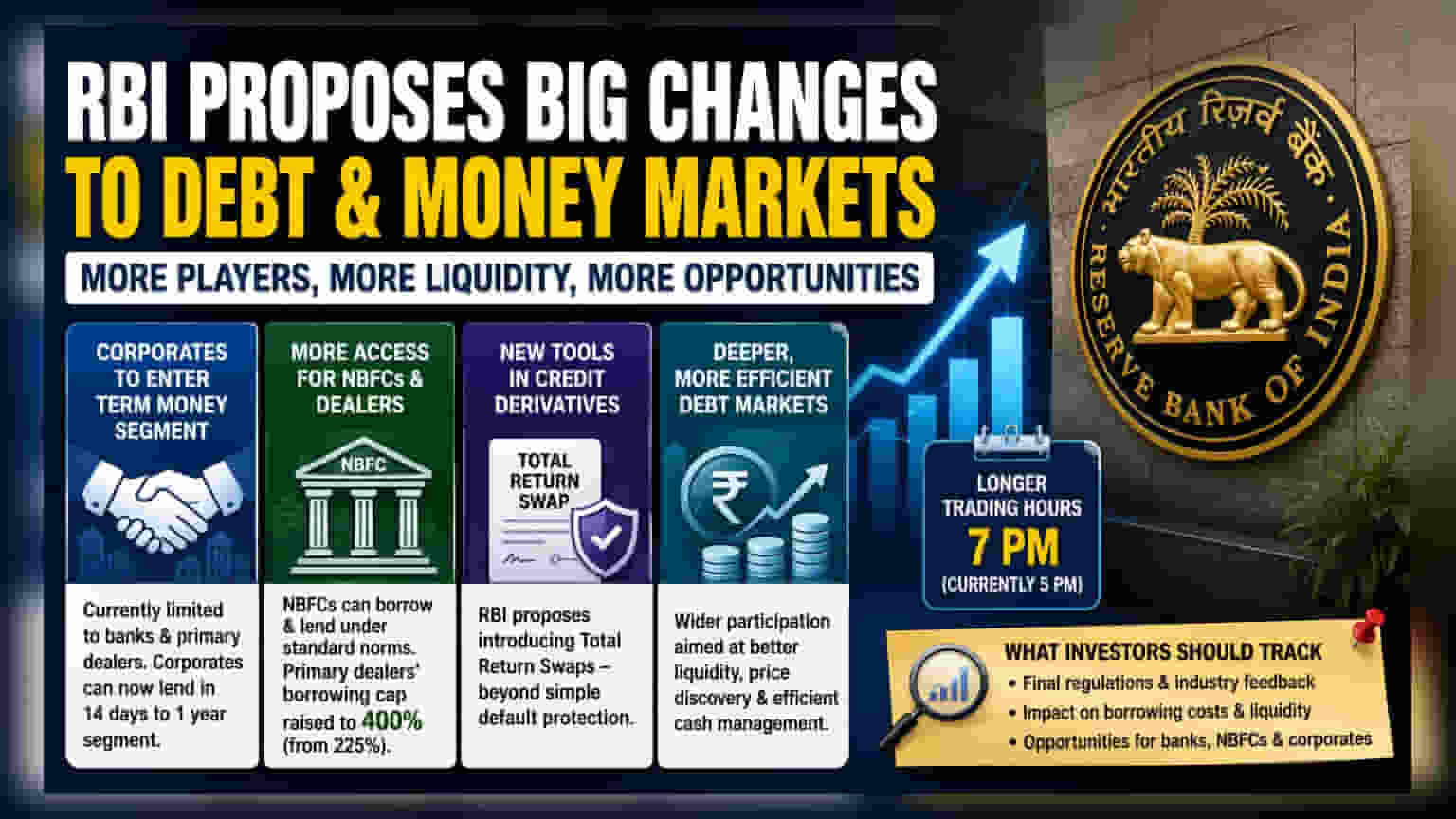
The Reserve Bank of India has released draft regulations that could allow corporate entities to lend in the term money market, a space previously reserved for banks. The proposal also introduces new financial tools and extends trading hours, aiming to increase liquidity and market efficiency.
What Happened
The Reserve Bank of India (RBI) has issued a draft framework aimed at broadening participation in India’s debt and money markets. A major proposal involves allowing corporate entities to participate in the 'term money segment,' which is currently limited to banks and primary dealers. This segment covers unsecured borrowing for periods ranging from 14 days to one year. If finalized, this change would allow corporates to lend in this market, marking a shift from the stricter regulations established in 2021.
Why This Matters For Markets
For the Indian financial system, this move is designed to make the debt market more active and efficient. By allowing more participants—specifically corporates—into the term money segment, the central bank aims to create better liquidity. In financial terms, this means there may be more options for companies to manage their short-term cash flow. It also potentially allows for better price discovery, as a wider pool of participants usually leads to more competitive borrowing and lending rates.
Changes For NBFCs and Dealers
The draft guidelines also affect Non-Banking Financial Companies (NBFCs) and primary dealers. The proposal suggests that all-India financial institutions and NBFCs be permitted to both borrow and lend in the term money market under standard regulations. Additionally, for primary dealers, the borrowing cap is proposed to be increased to 400% of their net owned funds, up from the current 225%. In this new framework, term money and inter-corporate deposits would be grouped together, simplifying the borrowing structure for these entities.
New Financial Tools and Timing
The RBI is also planning to introduce 'total return swaps' in the credit derivatives space. To put this simply, a total return swap allows an investor to receive the returns of a bond without actually owning the bond itself. This differs from standard default swaps, which typically only offer protection against a payment failure. Furthermore, the central bank has proposed extending trading hours for these markets to 7 p.m., moving away from the existing 5 p.m. closing time, to better align with international market schedules.
What Investors Should Track
Since these are draft regulations, the final implementation and any changes made after industry feedback will be the primary monitorables. Investors, particularly those tracking the banking and NBFC sectors, should watch for how these changes affect borrowing costs and overall liquidity in the system. The expansion of these markets may eventually provide a more robust environment for corporate debt, which is a key factor for credit-heavy businesses to watch over the coming months.