

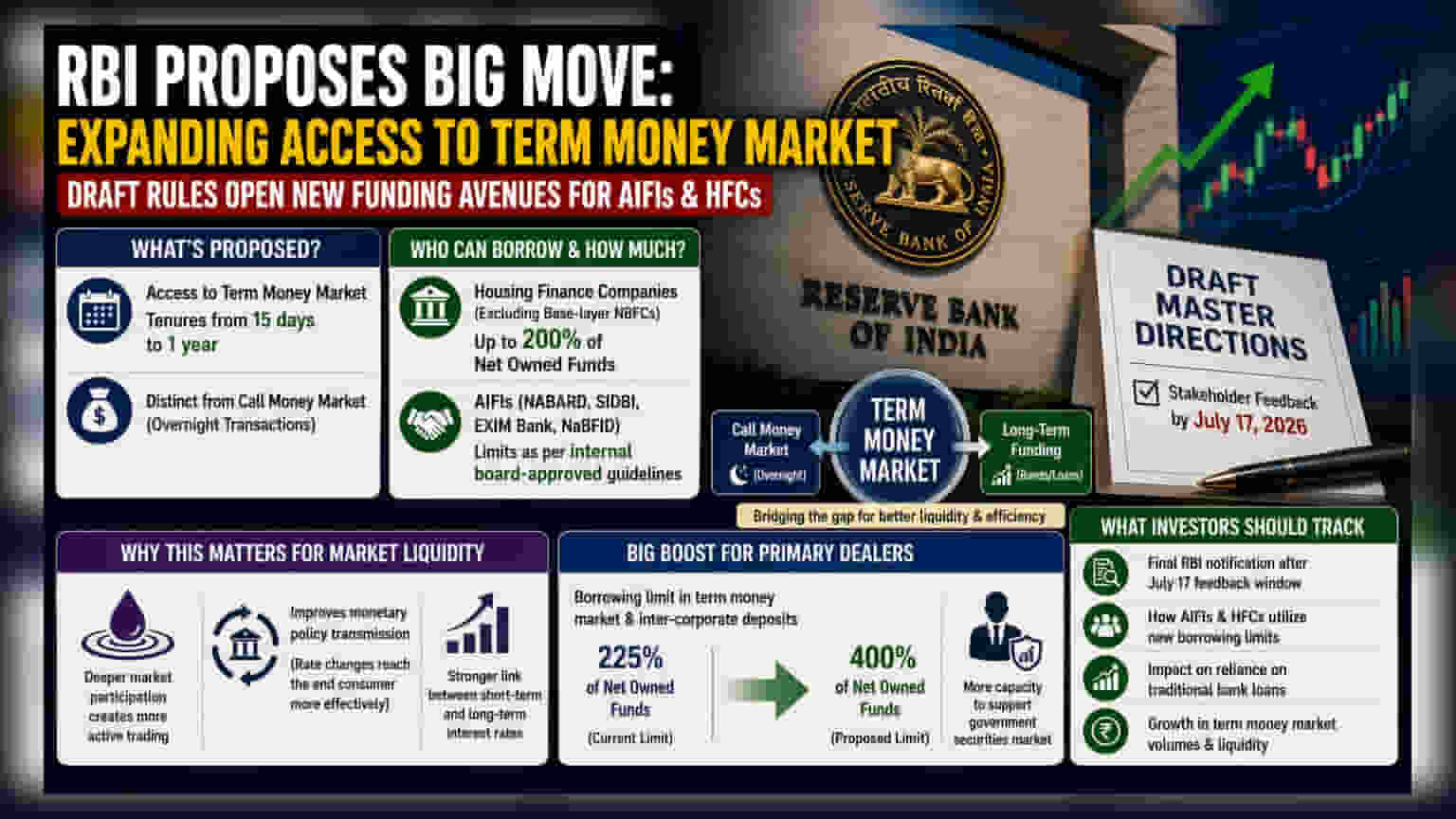
The Reserve Bank of India has issued draft directions allowing All India Financial Institutions and housing finance companies to borrow in the term money market. The proposal aims to increase liquidity and improve how monetary policy reaches the rest of the economy. Additionally, borrowing limits for standalone primary dealers have been proposed to increase to 400% of their net owned funds.
What Happened
The Reserve Bank of India (RBI) has released draft master directions that propose expanding access to the term money market. If finalized, this will allow All India Financial Institutions (AIFIs) and certain housing finance companies to borrow funds for tenures ranging from 15 days to one year. This segment is distinct from the call money market, which is used for overnight transactions. The central bank has invited stakeholders to submit comments and feedback on these draft rules by July 17, 2026.
Access to Short-Term Funding
Currently, AIFIs—such as NABARD, SIDBI, the Export-Import Bank of India, and NaBFID—rely heavily on long-term bonds or bank loans to fund their operations. By allowing these institutions to enter the term money market, the RBI is providing them with a new, flexible avenue to manage their cash flows.
For housing finance companies (excluding base-layer NBFCs), the draft suggests a borrowing limit of up to 200% of their net owned funds as of the end of the previous financial year. For AIFIs, the RBI plans to set limits based on internal board-approved guidelines that align with central bank parameters. This move is designed to ensure that these large financial entities have better tools to manage their short-term liquidity needs without relying solely on bank credit.
Why This Matters for Market Liquidity
The RBI’s goal is to deepen the financial market. When more entities are allowed to borrow and lend in the term money market, it creates a more active trading environment. This helps in "monetary policy transmission," which is a financial term for how effectively the central bank’s interest rate changes reach the end consumer. By creating a stronger link between the overnight money market and longer-term interest rates, the RBI aims to make the financial system more efficient.
Impact on Primary Dealers
Standalone primary dealers, who play a critical role in underwriting and trading government securities, are set to benefit significantly from these proposed changes. The RBI has proposed increasing their borrowing limit in the term money market and inter-corporate deposits to 400% of their net owned funds, up from the current limit of 225%. This adjustment, initially flagged in the RBI's April policy statement, is intended to give these dealers more breathing room to manage their capital and ensure they can continue supporting the government bond market effectively.
What Investors Should Track
Since this is currently a draft proposal, the final rules could see adjustments based on industry feedback. Investors and stakeholders should track the final notification from the RBI after the July 17 feedback window closes. A key monitorable will be how these institutions utilize these new borrowing limits and whether it reduces their reliance on traditional bank loans. Additionally, monitoring the volume of trading in the term money market will be important to see if the liquidity objective is actually achieved once the rules are implemented.