

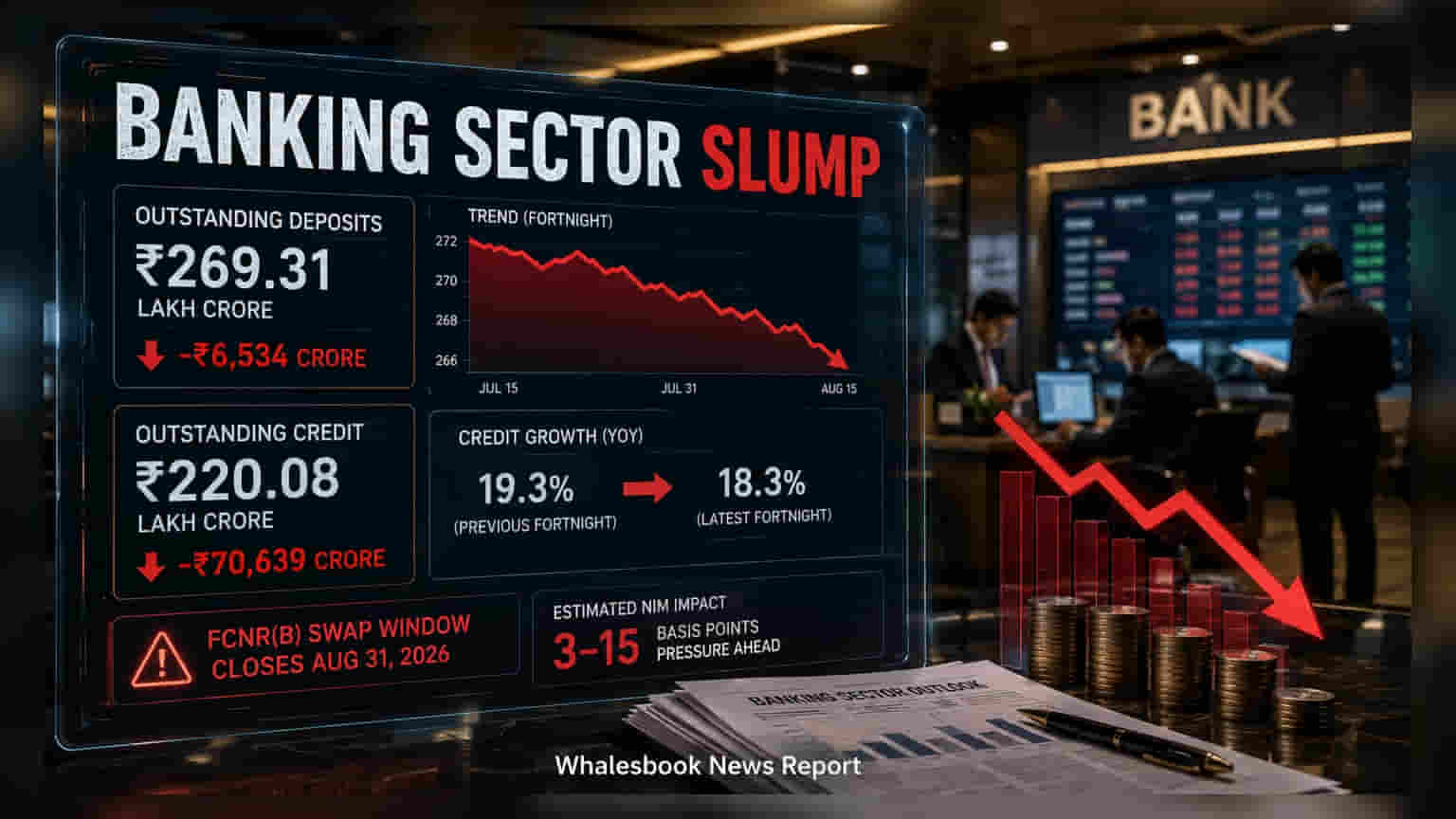
India’s banking system saw a contraction in both credit and deposits for the fortnight ending August 15, 2026. While credit dipped by Rs 70,639 crore, investors are focusing on the upcoming closure of the RBI’s concessional FCNR(B) swap window on August 31, which may impact bank funding costs and net interest margins.
For the fortnight ending August 15, 2026, the Indian banking sector recorded a rare contraction in both outstanding credit and deposit mobilization, according to the latest data from the Reserve Bank of India. Outstanding deposits fell by Rs 6,534 crore to Rs 269.31 lakh crore, while credit offtake saw a larger decline, dropping by Rs 70,639 crore to Rs 220.08 lakh crore.
Fortnightly Data Shows Rare Contraction
This decline marks a noticeable shift in the banking landscape. In the preceding months, credit growth had consistently outpaced deposit growth, keeping the loan-to-deposit ratio at elevated levels near decade highs. The recent cooling in credit offtake, with the year-on-year growth rate moderating to 18.3% from 19.3% in the prior fortnight, is being interpreted by market observers as a potential sign of cautious sentiment among corporate and retail borrowers.
During this period, banks were also observed rebalancing their funding strategies. Many lenders have been actively reducing their reliance on expensive, short-term domestic bulk deposits. Instead, they have been tapping into foreign currency non-resident bank (FCNR(B)) funds, which were supported by the regulator’s concessional swap facility. This move helped banks maintain liquidity while managing the cost of funds.
Margin Pressure Looms as Swap Window Closes
While the shift to foreign currency funds provided a temporary buffer, the most significant monitorable for investors is the Reserve Bank of India’s decision to close the concessional swap facility for FCNR(B) deposits effective August 31, 2026. Banks have mobilized substantial capital under this window, and its expiration is expected to change the funding equation for the sector.
As the swap window closes, banks may have to turn back to domestic sources of funding, such as Certificates of Deposit (CDs), which are typically more expensive than the swap-supported foreign currency funds. This transition is expected to put pressure on net interest margins (NIMs), with some analysts estimating a potential dilution of 3 to 15 basis points for banks in the coming quarters. Investors will be watching how banks adjust their deposit rates and loan pricing to protect profitability in an environment where the cost of borrowing may rise.
Looking ahead, the next few months will be crucial for the banking sector. The main areas for investors to track include the pace of credit growth in the second half of the financial year, the ability of banks to mobilize stable retail deposits without significantly raising rates, and any shifts in asset quality as the sector navigates a transition away from the central bank's liquidity support measures.