

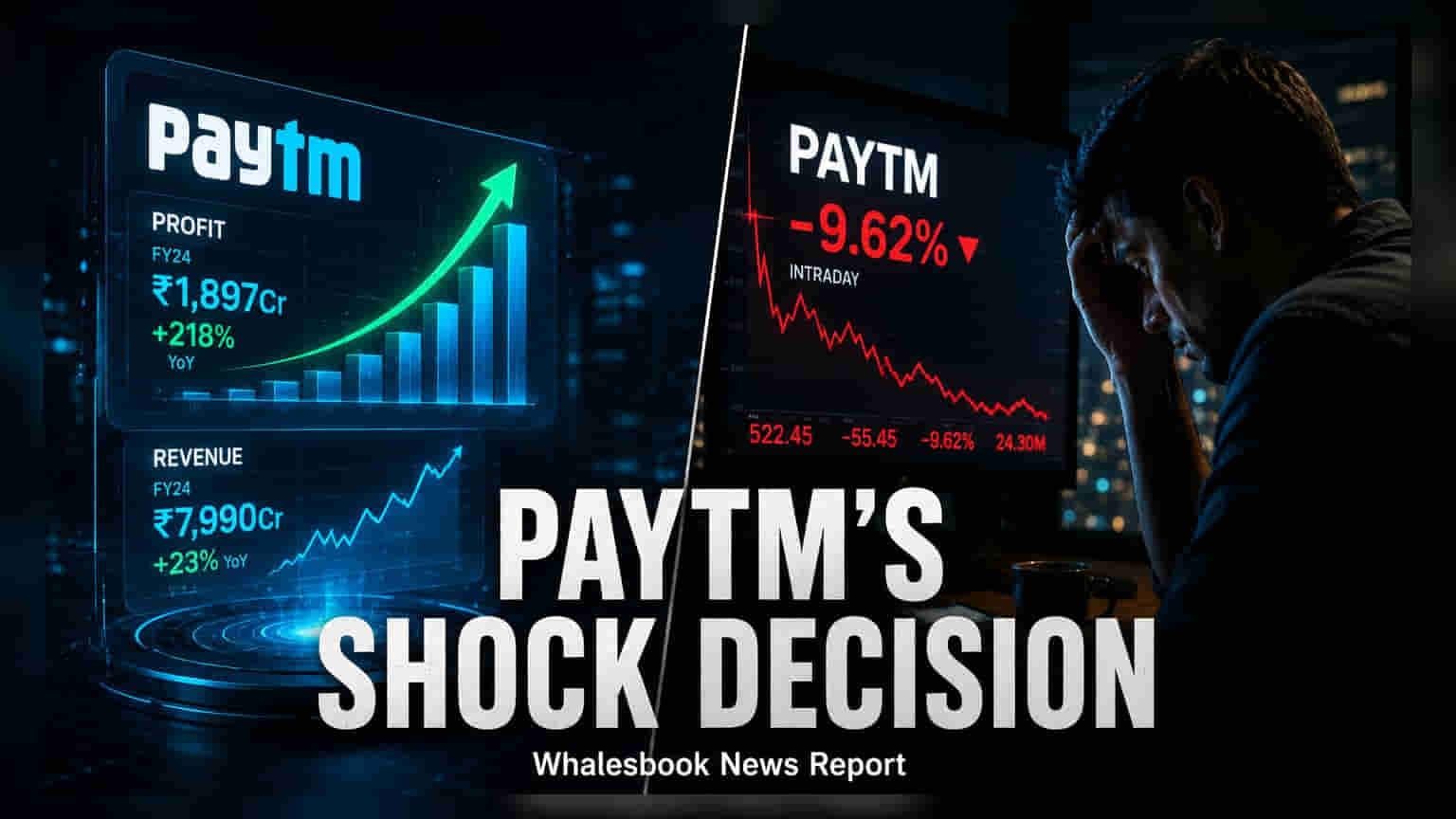
One 97 Communications shares fell 3% despite a 79% jump in quarterly profit to ₹220 crore. Investors reacted to the company's decision to skip a planned bonus share issue, choosing instead to focus on long-term capital growth and profitability.
Detailed Coverage
Shares of One 97 Communications, the parent company of the fintech platform Paytm, faced selling pressure on Tuesday, July 21, trading 3% lower despite reporting strong growth in the April-June quarter of the 2026-27 financial year. The decline followed the company’s decision to shelve plans for a bonus share issue, an move that disappointed some investors who were looking for short-term value rewards.
Q1 Financials Show Profit Growth
Paytm’s latest financial filing shows a 79% jump in year-on-year profit, which climbed to ₹220 crore from ₹123 crore in the same quarter last year. On a sequential basis, the company’s profits increased by 19.5%. Revenue for the quarter reached ₹2,448 crore, representing a 27.6% increase compared to the ₹1,918 crore reported in the same period of the previous year.
While the company showed improved revenue, it also recorded a 24.5% decline in other income, which fell to ₹182 crore. Total expenses rose to ₹2,383 crore, up from ₹2,016 crore in the same period last year, as the company continued its operational activities. Analysts at INVasset PMS noted that the quarterly EBITDA surge of 182% to ₹203 crore suggests that the company is successfully rebuilding its cost structure, allowing a larger portion of new revenue to contribute to bottom-line profit.
Strategic Shift and Market Context
Although the company has posted solid financial numbers, the board stated it would not proceed with the bonus share plan after an internal evaluation. The leadership indicated that the priority remains compounding growth and focusing on long-term shareholder value creation rather than issuing bonus shares at this time.
This market reaction comes after a period of strong stock performance. Over the past year, Paytm shares have risen by 34%, outperforming the BSE Sensex. Over a two-year period, the stock has seen significant gains of 197%. Despite this recovery, the share price continues to trade well below its initial public offering (IPO) price of ₹2,150.
Investors are now looking ahead to the next two quarters to confirm whether the current 8% profit margin can be sustained as a base level rather than a one-time peak. The management’s ability to maintain this cost-efficiency while scaling revenue will be the primary monitorable for the coming months.