

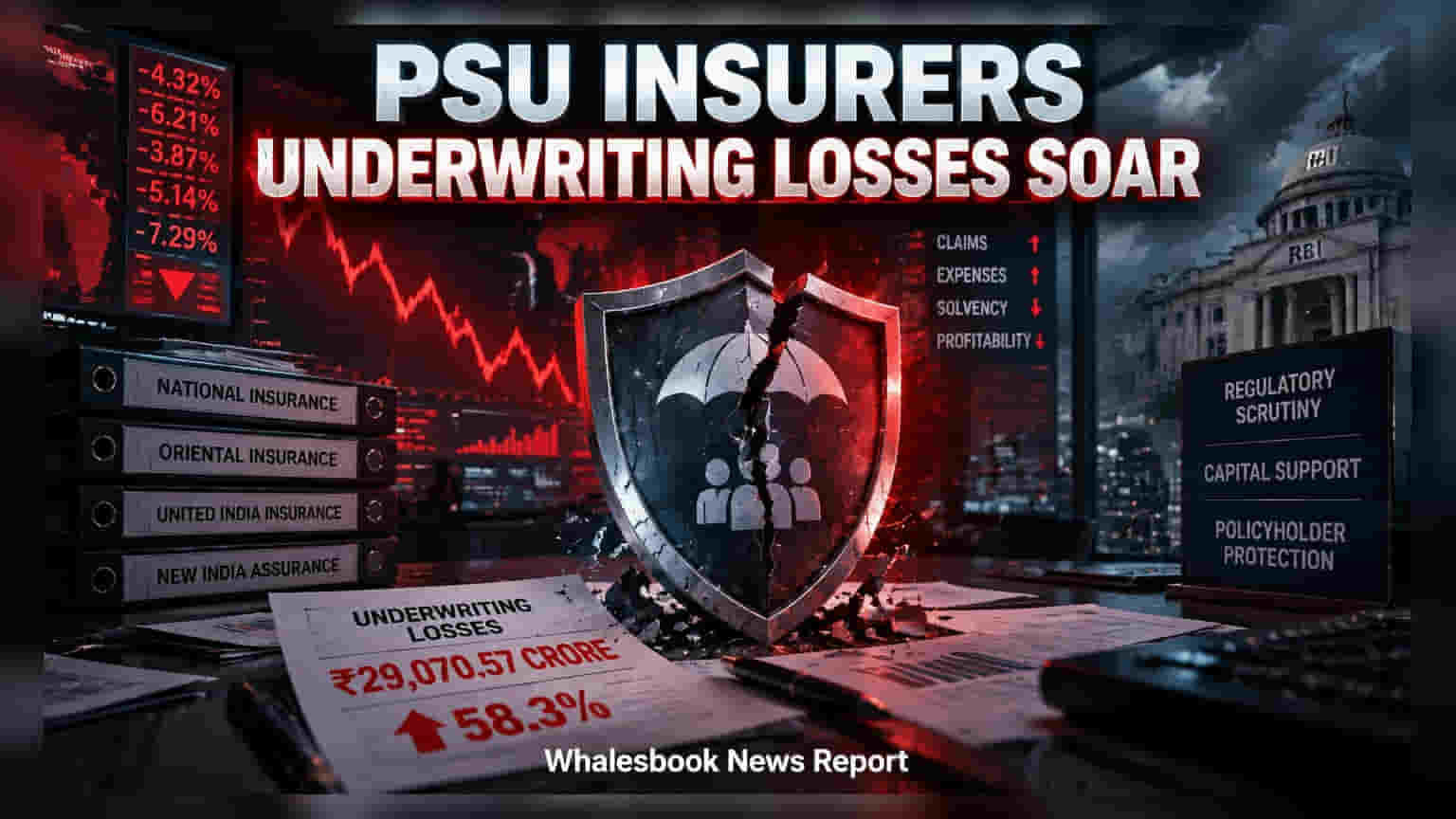
Public sector general insurers reported a 58% jump in underwriting losses to ₹29,070 crore for FY26. The RBI has flagged solvency risks for National Insurance, Oriental Insurance, and United India Insurance, which have failed to meet the 150% capital buffer requirement for five straight quarters. Meanwhile, New India Assurance remained the only profitable player with a net profit of ₹1,384 crore.
The public sector general insurance industry faced significant financial strain in FY26, as collective underwriting losses climbed to ₹29,070.57 crore. This marks a sharp 58.3% increase compared to the previous year, highlighting deep-seated challenges in how these companies manage claims and pricing. An underwriting loss occurs when an insurance company pays out more in claims and operating expenses than it collects in premiums from customers.
The Reserve Bank of India has now formally identified the financial health of three state-owned insurers—National Insurance Company, Oriental Insurance Company, and United India Insurance—as a systemic financial stability concern. These companies have remained below the regulatory-mandated 150% solvency ratio for five consecutive quarters. The solvency ratio is a critical measure used by regulators to ensure that an insurer has enough capital to pay out all its potential claims. A drop below 150% indicates that the company is struggling to maintain the required safety buffer.
While the sector as a whole is under pressure, performance has been uneven. New India Assurance remains the only profitable state-run general insurer, reporting a net profit of ₹1,384 crore for FY26. Its ability to stay profitable despite the difficult industry environment sets it apart from its peers.
The rise in losses is largely driven by a combination of factors. High claims in the motor and health insurance segments have consistently eroded margins. Additionally, the industry has faced pressure from increased management expenses, partly due to wage revisions, and aggressive pricing strategies that have left little room for profit. When insurers lower premiums to compete for market share but continue to face high claims, they eventually run into serious financial trouble.
For the industry, the path forward is complex. The persistent inability of the three struggling insurers to meet the 150% solvency requirement increases the risk of regulatory intervention. The Insurance Regulatory and Development Authority of India (IRDAI) typically monitors these ratios closely and could impose restrictions on business growth or require urgent capital infusion if the situation does not improve. Such measures are designed to protect policyholders, but they also limit the companies' ability to expand.
Investors and stakeholders will now look for updates on capital support. Given the systemic importance of these insurers, the government may need to step in with capital infusion to restore their solvency ratios. The key monitorable in the coming months will be whether these insurers can improve their pricing discipline, reduce high claim costs in the motor and health portfolios, and whether the government provides the necessary capital support to stabilize their balance sheets.