

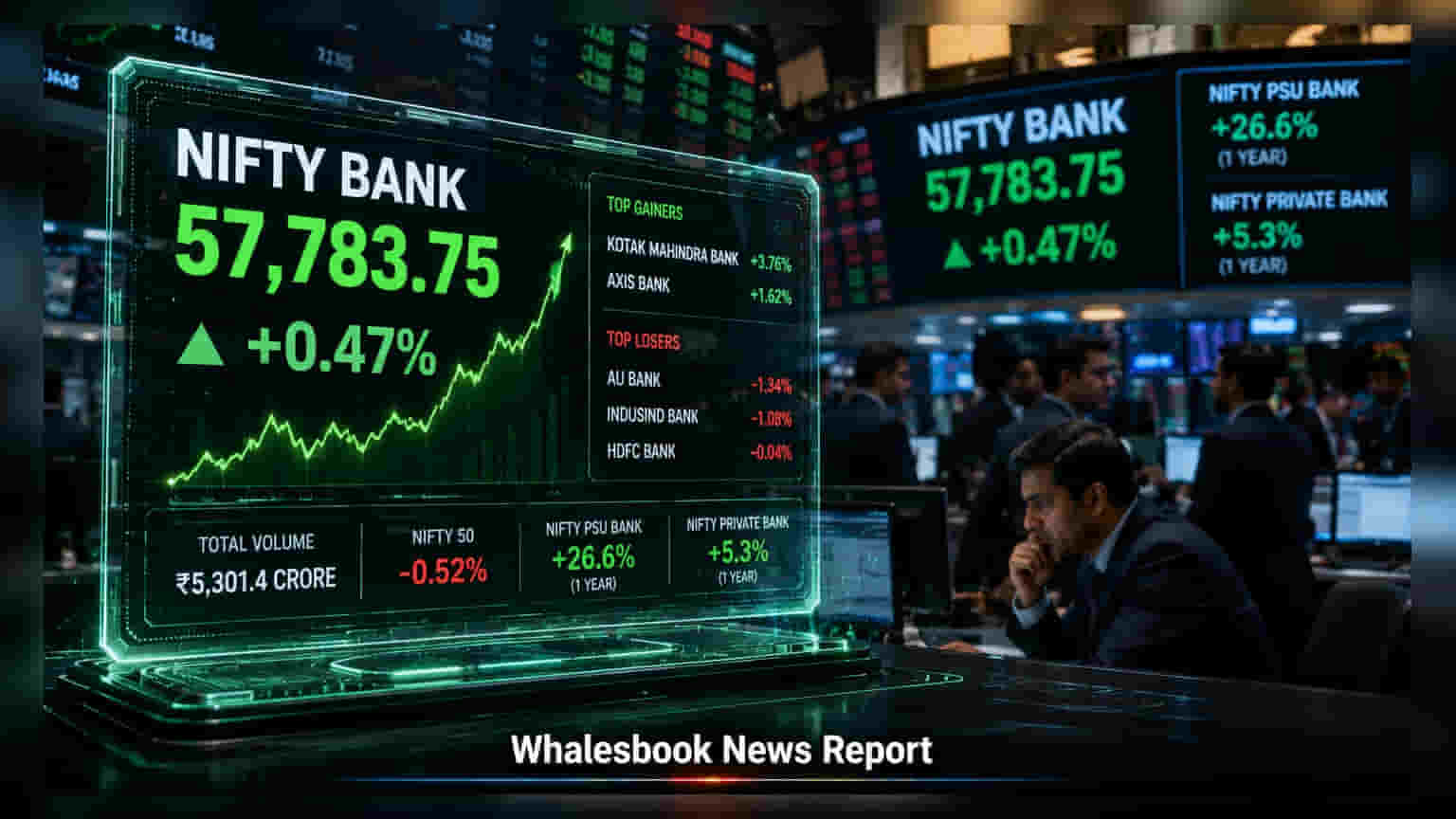
The Nifty Bank index climbed 0.47% to close at 57,783.75 on Wednesday, August 26, 2026, defying a 0.52% decline in the Nifty 50. While private sector banks led the daily session, long-term market trends show PSU banks maintaining a stronger one-year performance compared to their private counterparts.
The Nifty Bank index ended Wednesday, August 26, 2026, on a positive note, rising 0.47% to close at 57,783.75. The index displayed notable resilience against the broader market mood, as the Nifty 50 benchmark index fell by 0.52% during the same session. Total trading volume across the sector reached ₹5,301.4 crore, indicating that traders remained active in banking stocks despite the cooling sentiment in other parts of the market.
Daily Movers and Divergence
Private lenders were the primary drivers of this positive performance. Kotak Mahindra Bank was a significant contributor to the index, finishing the day 3.76% higher, while Axis Bank also supported the gains with an increase of 1.62%. However, the strength was not uniform across the private banking space. Several lenders faced selling pressure, with AU Bank dropping 1.34% and IndusInd Bank falling 1.08%. Meanwhile, HDFC Bank, a major constituent of the index, saw a minor dip of 0.04%, keeping the stock largely flat.
The Long-Term Performance Gap
While private banks dominated the daily price action, the structural performance over the past year tells a different story. Market data highlights a sharp divergence between the two banking segments. The Nifty PSU Bank index has logged a return of 26.6% over the last 365 days, significantly outperforming the Nifty Private Bank index, which has seen a 5.3% increase in the same period.
This gap suggests that while private banks often attract tactical, short-term trading interest due to their high daily volatility, the institutional appetite for public sector banks remains anchored by stronger momentum over the long term. For instance, while some private banking stocks have shown sharp movements, the overall public sector banking category has maintained a more consistent upward trend over the year.
Investor Monitorables
Investors may note that the private banking sector continues to experience higher volatility compared to public sector lenders. The ability of private banks to sustain gains during broader market downturns is often dependent on specific stock-level triggers rather than a broad sector-wide trend. Moving forward, market participants may track whether this short-term interest in private lenders persists or if the long-term preference for public sector banks remains the dominant theme in the banking landscape.