

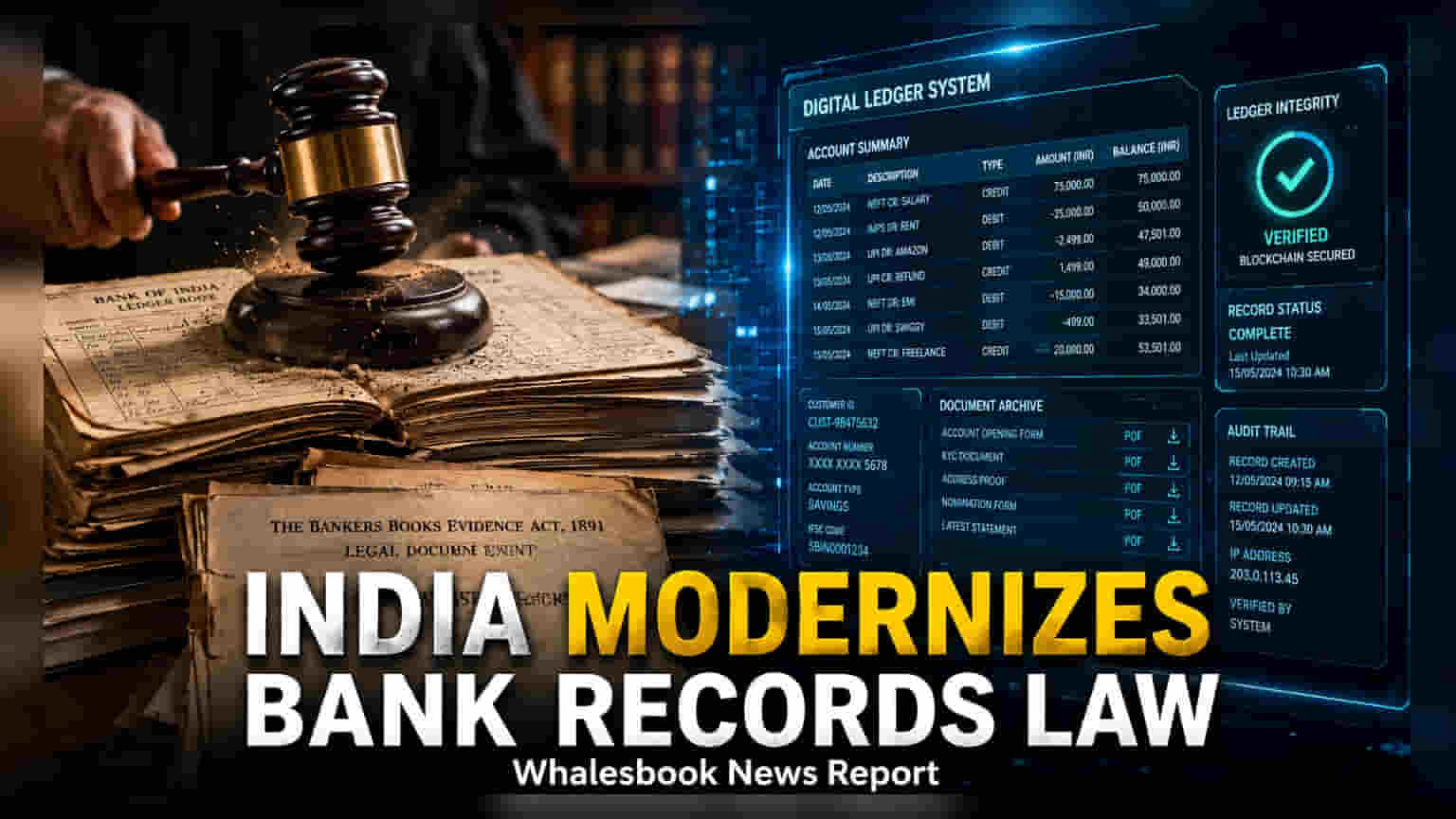
The government has introduced the Bankers' Books Evidence Bill, 2026, to modernize legal rules for digital banking records. This legislation replaces the colonial-era 1891 Act, ensuring electronic, cloud, and virtual records are legally valid evidence. The move simplifies court procedures for banks and financial institutions by updating how digital data is authenticated and presented in legal cases.
Finance Minister Nirmala Sitharaman introduced the Bankers' Books Evidence Bill, 2026, in the Lok Sabha on Monday, marking a significant step in updating India’s financial legal framework. The proposed law is set to replace the Bankers' Books Evidence Act of 1891, which was designed for an era of physical ledgers. As banking has shifted toward digital, cloud-based, and virtual record-keeping, the old law was increasingly insufficient for handling modern evidence in legal disputes.
Expanding the Definition of Bank Records
The most notable change in the new bill is the broadened definition of what constitutes a 'banker's book.' Under the 1891 law, the definition was largely focused on physical ledgers. The 2026 bill updates this to include all modern record formats, such as digital, electronic, virtual, and cloud-stored data. This update is designed to be technology-neutral, meaning the law will remain relevant even as banking technology continues to evolve.
Admissibility and Authentication in Courts
Currently, banks often face procedural difficulties when presenting electronic evidence in court. The new bill standardizes how electronic records are authenticated, explicitly allowing both digital and manual signatures. By clearly establishing the legal admissibility of electronic bank records, the bill aims to streamline court proceedings. This allows banks to submit evidence in either physical or digital formats without the need to produce the original source files in every instance, reducing the burden on bank officials.
Strategic Scope and Regulatory Oversight
A key feature of the legislation is the power granted to the central government to extend the scope of the Act to other financial entities beyond traditional banks. As the Indian financial system sees a rise in fintech companies, digital lenders, and non-banking financial institutions, this provision ensures that the legal protection and evidentiary standards can be applied across the broader financial sector when necessary.
Clarifying Court Procedures
The bill also provides clarity on the term 'special cause.' This refers to instances where a court might order a bank officer to appear as a witness or produce specific records in legal proceedings where the bank itself is not involved as a party. By defining these boundaries, the bill provides a clearer roadmap for courts and financial institutions to follow, minimizing operational disruptions for banks.
For investors and financial institutions, the next important update will be the parliamentary debate and the eventual notification of the bill’s implementation rules. These rules will likely dictate the technical standards for digital signatures and cloud-storage compliance, which banks will need to incorporate into their internal governance and data management systems.