

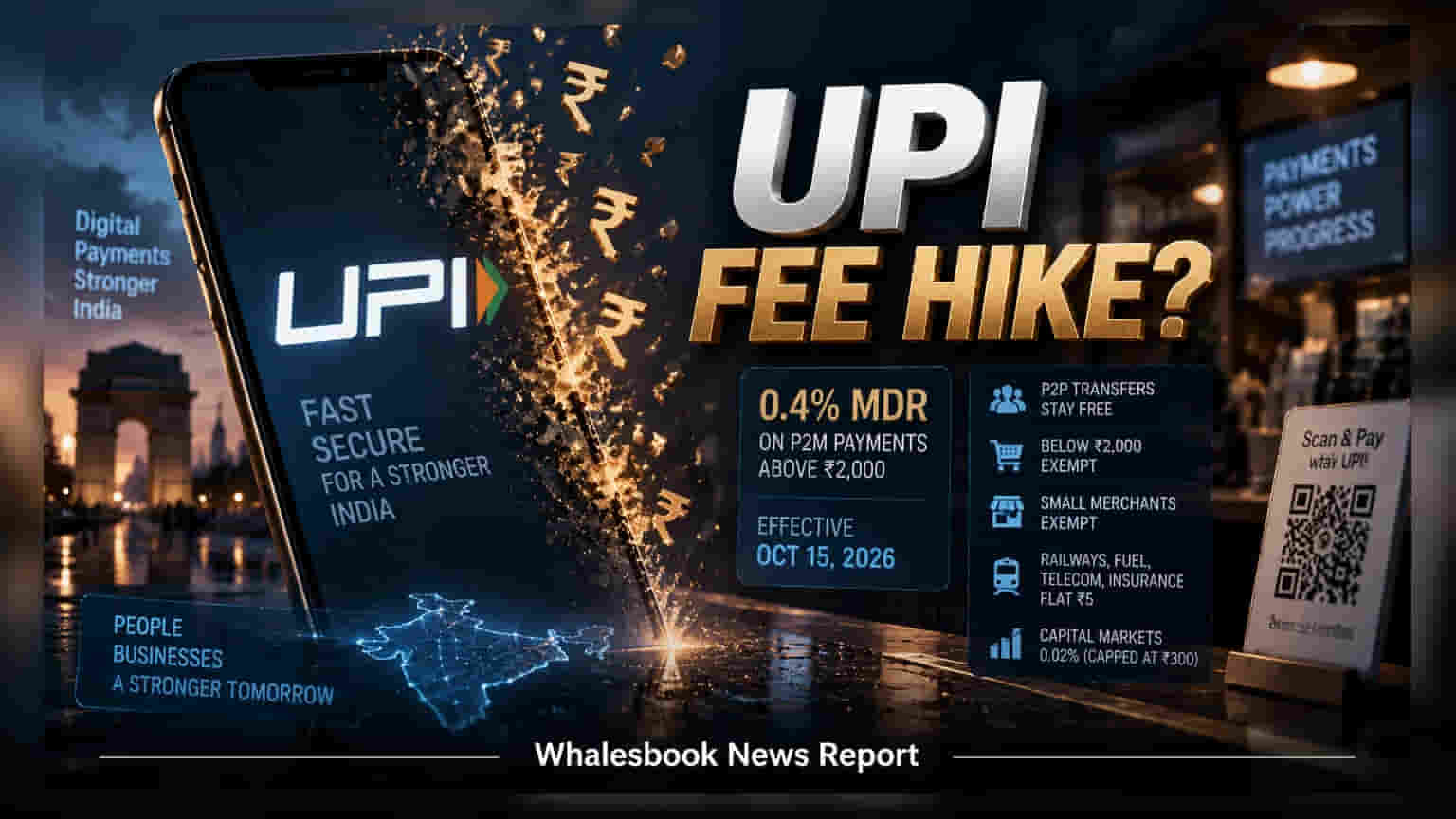
The National Payments Corporation of India has announced a new fee structure for large UPI merchant transactions. Starting October 15, 2026, payments exceeding Rs 2,000 will attract a 0.4% fee, capped at Rs 300. Crucially, the policy ensures 96% of all UPI transactions remain free, protecting small merchants and regular users from any additional charges.
The National Payments Corporation of India (NPCI) has released a new framework for digital payments, establishing a specific fee structure for merchant transactions. Starting October 15, 2026, a 0.4% Merchant Discount Rate (MDR) will apply to person-to-merchant (P2M) UPI payments that exceed Rs 2,000. This move aims to build a sustainable revenue model for the digital payments ecosystem, which has historically relied on zero-fee transactions.
Exemptions and Coverage
To maintain the widespread adoption of UPI, the new rules include several protections. Regular person-to-person (P2P) money transfers will continue to be free regardless of the amount. Furthermore, all transactions below Rs 2,000 are completely exempt from this new fee. Small merchants, defined as those receiving up to Rs 1 lakh per month via UPI QR codes, will also continue to process payments without any MDR charges. According to regulatory data, approximately 96% of all UPI merchant transactions fall below the Rs 2,000 threshold or are processed by small merchants, meaning the vast majority of daily payments remain unaffected.
Sector-Specific Rules
Recognizing the diverse nature of digital payments, the NPCI has introduced varied fee structures for specific sectors. Transactions in essential services such as railways, telecommunications, insurance, and fuel will attract a flat Rs 5 fee for payments above Rs 2,000, rather than the percentage-based levy. Meanwhile, transactions involving capital markets—such as payments to stock brokers or mutual fund investments—will be subject to a 0.02% fee, which is also capped at Rs 300 per transaction.
Consumer and Merchant Impact
The government has mandated that merchants are not allowed to pass these new fees on to customers. This ensures that the final price paid by a consumer at a shop or for an online service remains unchanged. While this development is intended to strengthen the financial infrastructure of payment providers, it introduces new operational requirements. Platforms like PhonePe, Paytm, and Razorpay will need to update their billing systems and software to accommodate these changes by mid-October.
Market Risks and Monitorables
For investors, this shift changes the revenue potential for payment service providers, who previously earned very little from high-volume UPI traffic. However, the move introduces potential risks, including the possibility of short-term friction or pushback from larger merchants who now have to pay for payment processing. Analysts are also watching for any initial impact on transaction volumes during the transition period as the ecosystem adapts to the new billing architecture. The primary focus for the market will be how effectively these systems are implemented and whether the new revenue model encourages further investment in digital infrastructure without slowing down the rapid growth of UPI adoption.