 Whalesbook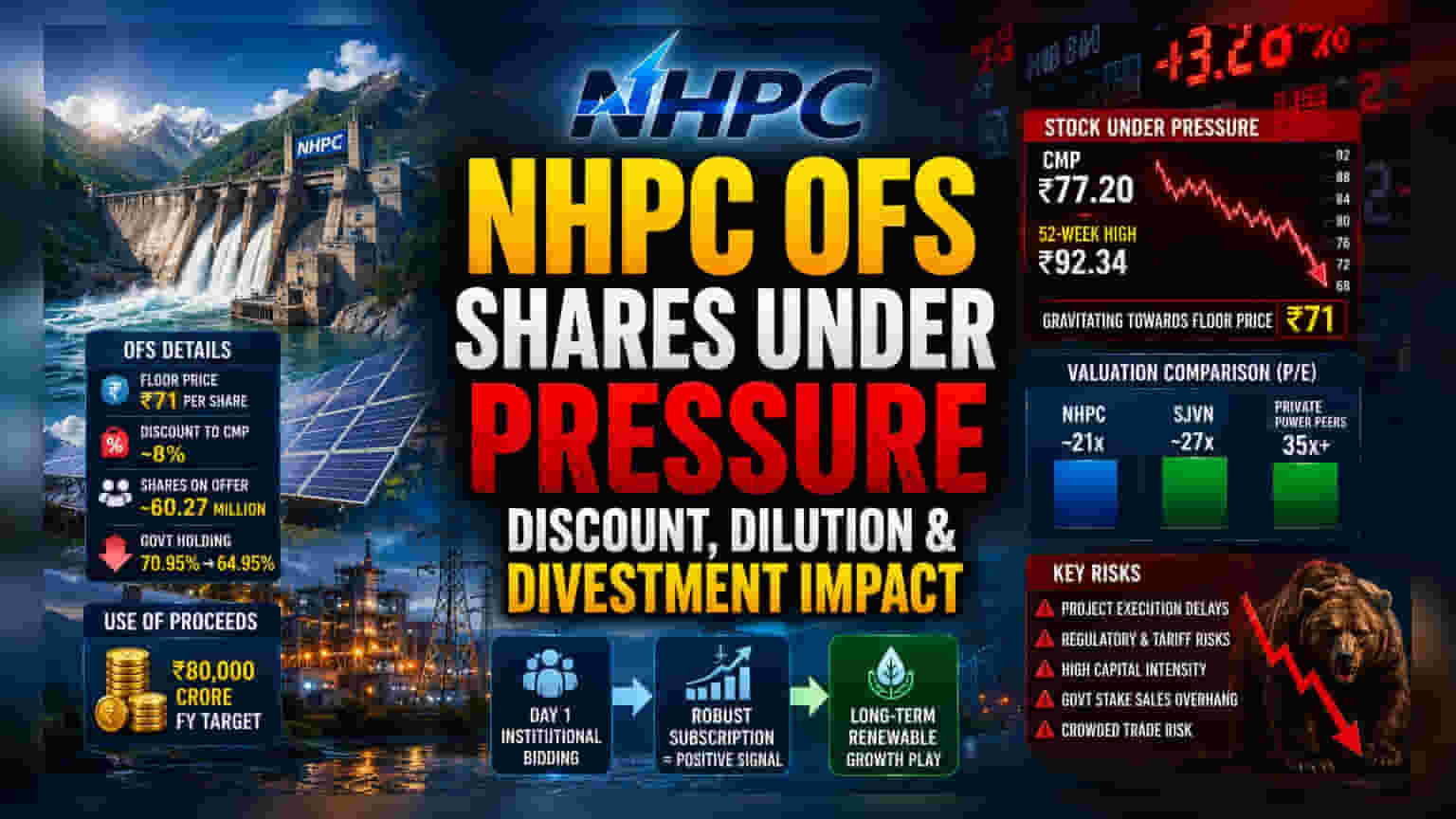


The Valuation Gap and Market Reaction
The decision to set the floor price at ₹71 per share—a roughly 8% discount to the stock's recent closing price of ₹77.20—has triggered immediate technical resistance. While the government aims to channel these proceeds into its ₹80,000 crore fiscal year target, the market is bracing for a supply overhang. With approximately 60.27 million shares entering the secondary market, the stock’s near-term performance is expected to gravitate toward the floor price as traders factor in the increased equity supply. This dilution of government holding from approximately 70.95% to 64.95% is a standard mechanics-driven event, yet it underscores the current volatility in PSU stocks as the administration intensifies its monetization efforts.
The Analytical Deep Dive: Comparing PSUs
NHPC’s valuation, currently trading at a P/E of roughly 21x, places it in a competitive position relative to peers like SJVN. Unlike private sector energy players that have seen massive multiple expansion, PSU power stocks like NHPC have been subject to the rhythmic flows of government divestment cycles. Historically, these OFS events act as a short-term liquidity drain. While NHPC holds a critical 15% share of India’s installed hydropower capacity, investors are increasingly looking at its capital allocation strategy. The firm’s pivot toward solar and pumped-storage is necessary for long-term growth, but the capital-intensive nature of these projects suggests that revenue growth will continue to face gestation delays. Unlike peers that may hold less debt, NHPC’s balance sheet remains tied to the execution timelines of these massive, ecologically sensitive projects.
The Forensic Bear Case: Execution and Risk
Beyond the immediate price volatility, systemic risks remain. The company’s history of project execution is a double-edged sword; while it cements its role as a core utility, large-scale hydropower in challenging terrains is prone to cost overruns and regulatory bottlenecks. Investors must consider that a low P/E ratio is often reflective of structural concerns—namely, the risk of government intervention in tariff setting or capital expenditure mandates that prioritize capacity over shareholder returns. Furthermore, the ‘crowded trade’ risk is palpable. With large institutional holdings, any disappointment in demand for the greenshoe option could exacerbate the downward trend. Any further government stake sales in the power sector throughout the year may keep the stock’s valuation suppressed, regardless of its fundamental utility status.
Future Outlook
Market participants are watching the Day 1 institutional bidding process as the primary indicator for the stock's short-term floor. If the subscription is robust, it may signal that institutional investors view the current discount as an attractive entry point for a long-term renewable play. However, the path back to the 52-week high of ₹92.34 will likely depend on earnings delivery and the successful commissioning of the current pipeline, rather than fiscal-driven equity rotations.