 Whalesbook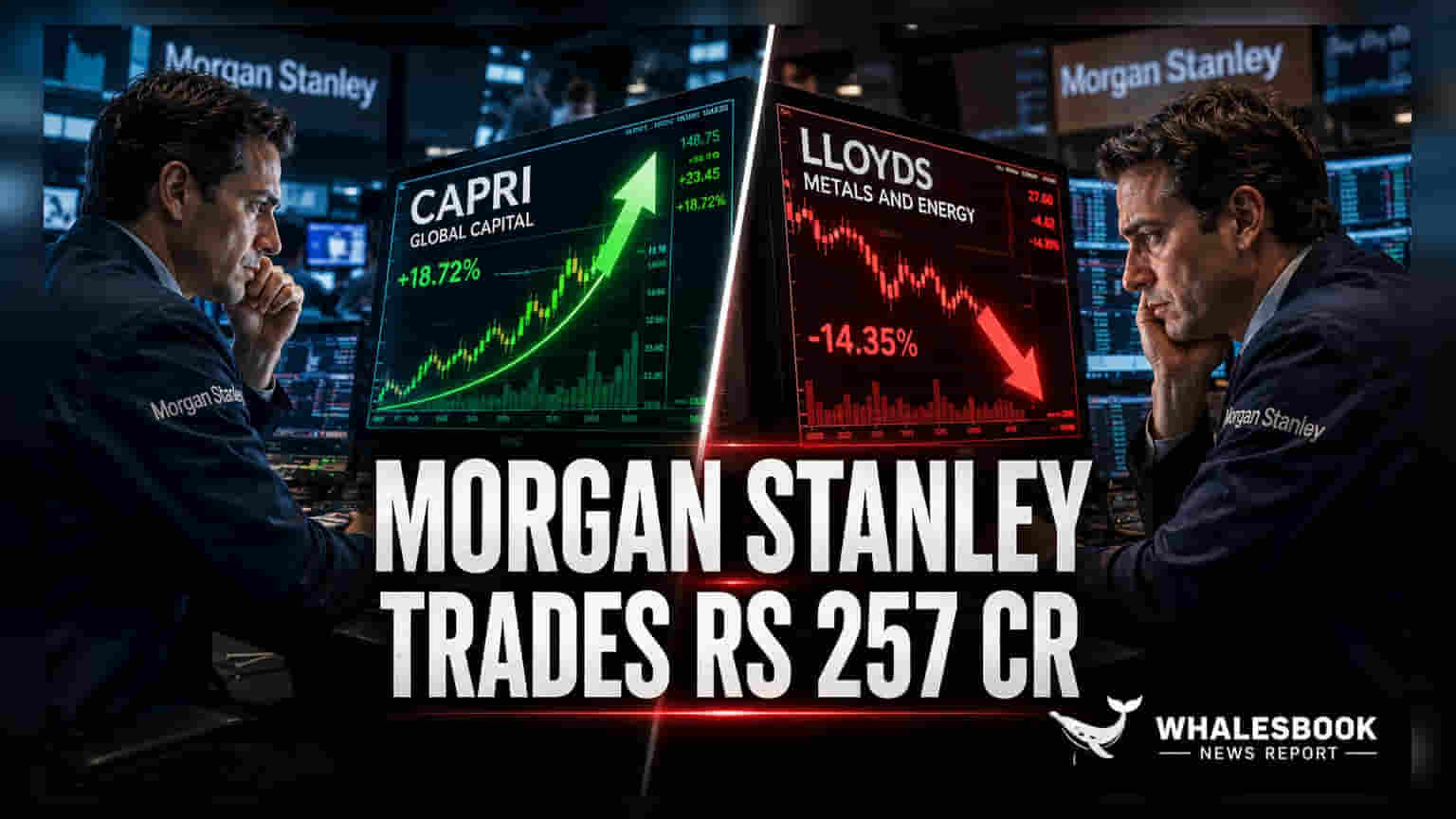


The Capital Reallocation Strategy
The recent equity maneuvers by Morgan Stanley Asia Singapore signal a strategic pivot rather than a simple liquidation event. By deploying Rs 96.25 crore into Capri Global Capital at Rs 192.5 per share, the firm is doubling down on a non-banking financial company (NBFC) that recently reported a 98% year-on-year surge in fiscal 2026 profit after tax, reaching Rs 949 crore. This acquisition follows a period where Capri Global Capital’s earnings growth significantly outpaced its share price appreciation, suggesting the firm may be capitalizing on a valuation disconnect. Conversely, the exit from Lloyds Metals and Energy—a firm that recently hit all-time highs following a 45% annual return—suggests a classic "sell the strength" approach. The sale of 8.96 lakh shares to BNP Paribas Financial Markets at Rs 1,802.1 per share locks in gains from a stock that has outperformed the Sensex by over 30% during the past year.
Analytical Context: Institutional Positioning
These trades occur against a backdrop of intensifying capital market activity in India, with May block deal volumes reaching a record Rs 20,000 crore. This surge is widely interpreted as a leading indicator of a deeper revival in equity capital markets, which had faced a sluggish start to 2026. Morgan Stanley’s activity aligns with its internal India strategy, which emphasizes a bottom-up, selective approach to NBFCs and cyclicals, favoring companies with strong balance sheets and established deposit franchises over broader market momentum. While many institutional investors remain cautious due to geopolitical uncertainties and crude oil volatility, the current block deal volume suggests that domestic and foreign liquidity remains robust for high-conviction assets.
The Forensic Bear Case: Sectoral Risks
Despite the bullish sentiment surrounding individual names like Capri Global Capital, structural risks persist for the NBFC sector. Morgan Stanley has previously issued warnings regarding the potential for consensus earnings downgrades across the NBFC space if macroeconomic headwinds intensify. For Capri Global Capital, despite strong recent performance, the company faces the inherent challenge of managing a large, high-growth retail lending portfolio in an environment where interest rate fluctuations could compress net interest margins. Meanwhile, Lloyds Metals and Energy, while technically strong, carries a debt-to-EBITDA ratio of 3.1 times and is trading at significant multiples of its book value. Investors should note that promoter holdings in such high-flying metal stocks have seen recent trimming, which can occasionally precede periods of increased price volatility.
Forward Outlook
Market participants continue to monitor the broader recovery of India’s equity pipeline. With upcoming institutional forums and a heavy calendar of planned listings, the current pace of block trades is expected to provide liquidity for larger, multi-billion dollar IPOs later in the year. Morgan Stanley’s recent rotation into consumer-facing financial services suggests a long-term expectation that domestic consumption will remain the primary driver of India’s growth, provided external geopolitical factors do not force a sudden tightening of systemic liquidity.