

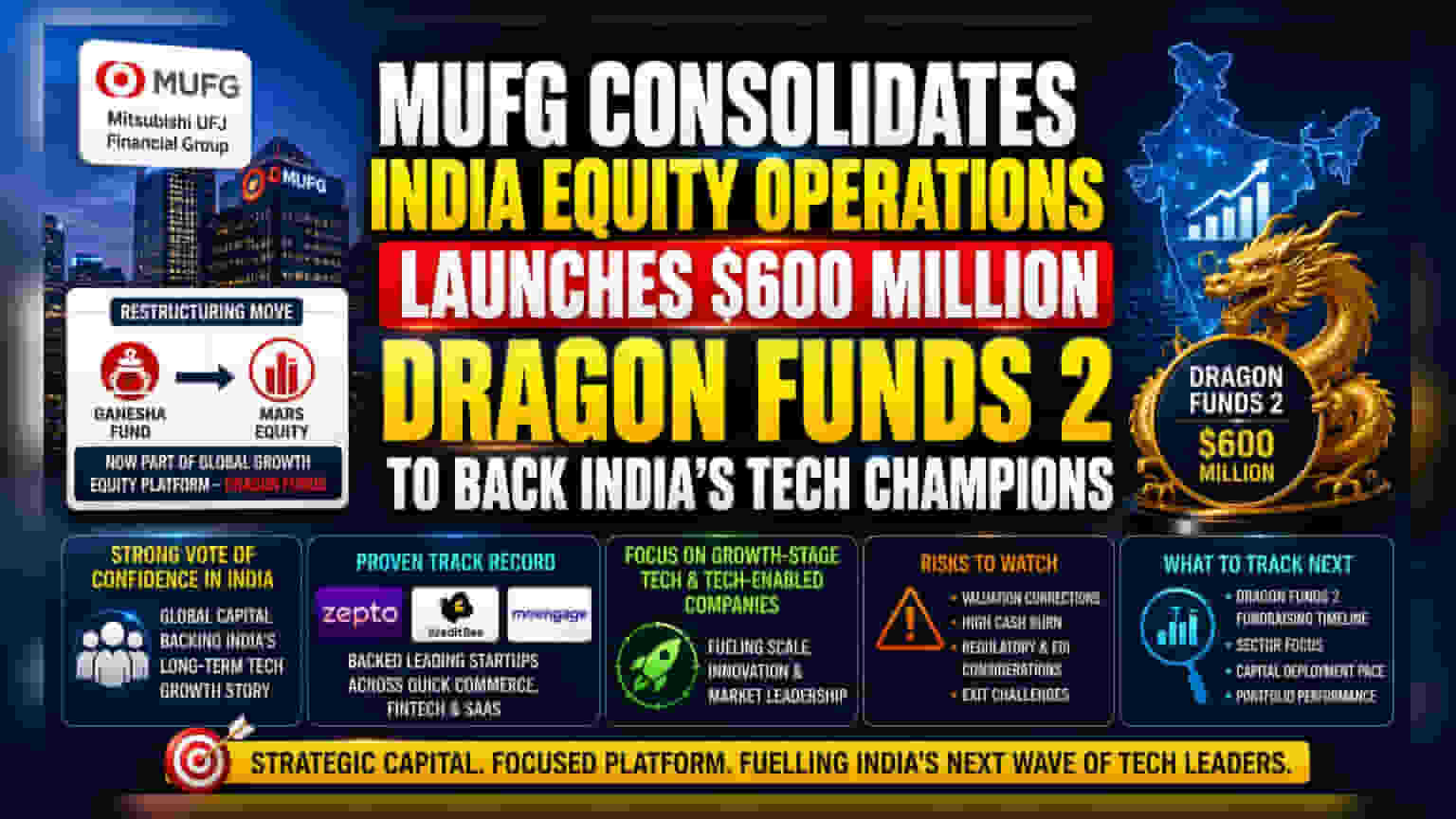
Global financial giant MUFG is consolidating its India-focused Ganesha Fund into the Dragon Funds platform and planning a $600 million growth-stage tech fund. This move signals continued foreign institutional interest in India's startup ecosystem. The focus remains on equity investments in expanding technology companies.
What Happened
MUFG Financial Group (Mitsubishi UFJ Financial Group) is restructuring its equity investment operations in India. The group is consolidating the assets and management functions of its Ganesha Fund into its subsidiary, Mars Equity. This consolidation falls under the umbrella of its global growth equity platform, Dragon Funds. Along with this organizational shift, MUFG has announced plans to launch a new investment vehicle, tentatively named Dragon Funds 2, which aims to raise $600 million. This capital is intended to support growth-stage technology and tech-enabled companies in India.
Why This Matters for the Tech Ecosystem
For the broader Indian startup ecosystem, this move indicates that large global financial institutions continue to view India as a key market for long-term technology investments. Foreign institutional capital is a major driver for growth-stage startups, which often require significant funding rounds to scale operations, acquire customers, and expand infrastructure. By creating a dedicated, consolidated platform like Dragon Funds, MUFG aims to standardize its investment processes and manage its portfolio more effectively, which could improve the efficiency of capital deployment in the local market.
The Business Context and Strategy
MUFG has been actively deploying capital in India since 2023. The platform has backed several prominent startups, including quick-commerce player Zepto, financial services provider KreditBee, and customer-engagement firm Moengage. The move to consolidate the Ganesha Fund into Mars Equity reflects a trend among global investors to streamline their India operations under more robust, dedicated platforms. This typically helps in achieving better oversight, unified reporting, and more efficient decision-making when evaluating new investment opportunities.
Risks and Market Realities
While the influx of foreign capital is generally viewed as a positive for growth, investors and market observers often monitor certain risks associated with private equity and venture capital in the technology sector. These include potential valuation corrections if growth-stage startups fail to meet profitability targets, the high cash-burn nature of the quick-commerce and fintech models, and the regulatory environment regarding foreign direct investment (FDI). Additionally, the ability of venture funds to provide successful exits—whether through IPOs or trade sales—remains a key metric for measuring the success of such funds. The long-term performance of these investments will depend on the startups' ability to achieve sustainable profit margins rather than relying solely on continued external funding.
What Investors Should Track Next
As this is a private equity initiative rather than a listed stock event, there is no direct impact on Indian stock market indices. However, investors and industry participants may watch for the following developments: the actual timeline for the fundraising of Dragon Funds 2, the specific sectors MUFG chooses to prioritize within the technology space, and the overall pace at which the new fund begins deploying capital. Monitoring the performance of existing portfolio companies, such as Zepto and KreditBee, may also provide insights into the firm's broader investment strategy and sector outlook.