 Whalesbook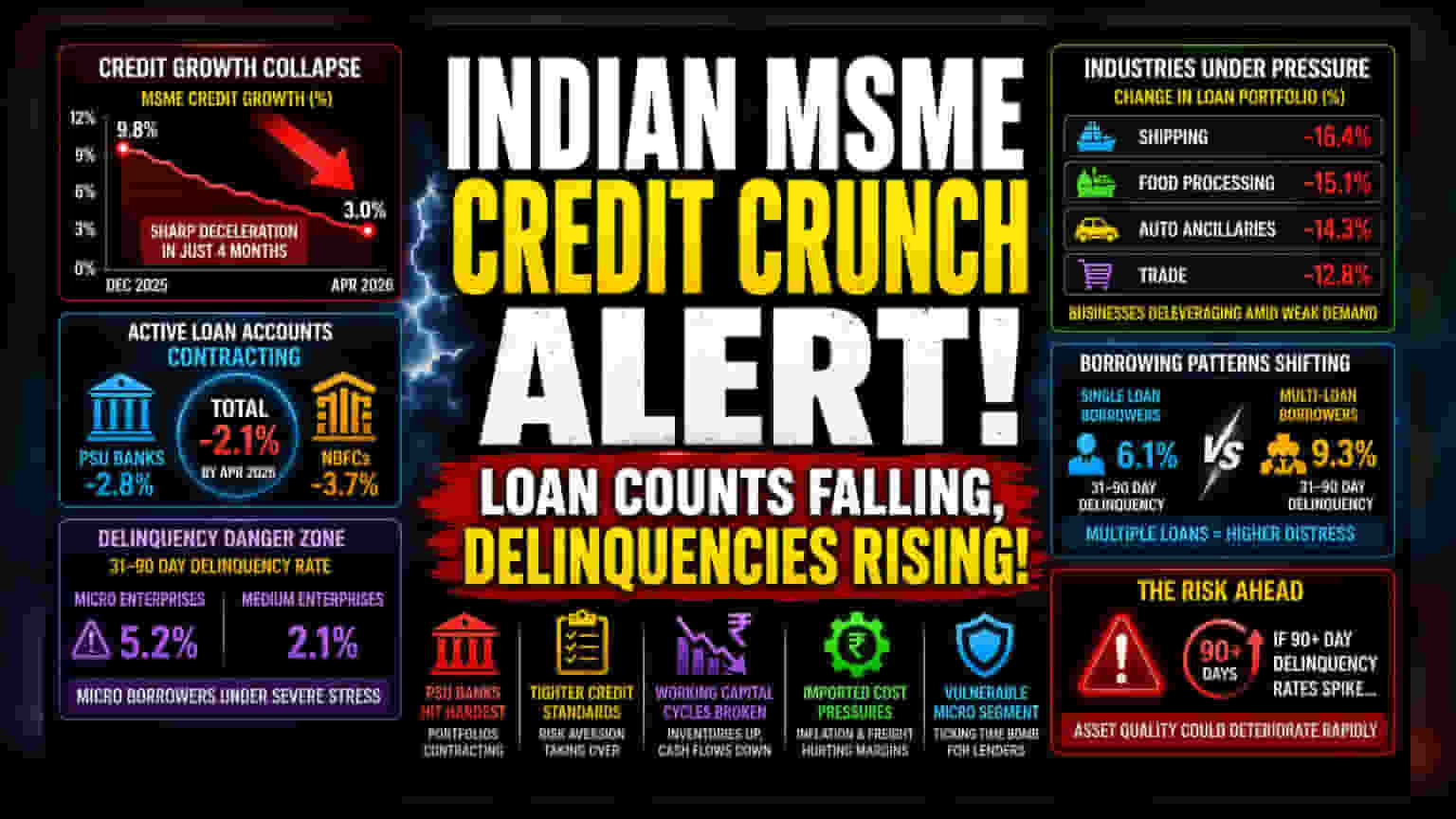


The Credit Contraction Paradox
While headline figures suggest a resilient credit environment, the underlying mechanics of Indian MSME financing are signaling a distinct liquidity trap. The shift from a growth-oriented expansion in late 2025 to a contraction in active loan counts by April 2026 suggests that lenders are prioritizing risk aversion over market share. This pivot is particularly acute among public sector banks and NBFCs, which have historically served as the primary conduits for MSME capital. The deceleration in credit growth—plummeting from near double digits to a sluggish 3% clip—reflects a tightening of underwriting standards in response to deteriorating repayment capacity in vulnerable industrial pockets.
Industrial Fragility and Supply Chain Sensitivity
Manufacturing and trade, the twin pillars of the sector, are currently undergoing a structural reset. The marked decline in credit utilization within shipping, food processing, and auto ancillaries indicates that businesses are not just borrowing less; they are actively deleveraging to manage operational cash flow. When industry sectors report loan portfolio drops exceeding 14%, it typically points to reduced inventory turnover and a breakdown in working capital cycles. These segments are highly sensitive to imported inflation and global freight costs, suggesting that the current stress is not merely internal but a direct byproduct of imported economic volatility.
The Micro-Borrower Crisis
Micro-enterprises, which account for the vast majority of active loan volume, are nearing a tipping point. With delinquency rates in the 31-90 day bucket significantly higher than those of their larger peers, these entities are struggling to absorb rising input costs. The data confirms a widening delta between the credit profiles of micro-entities and medium-sized firms. While larger MSMEs benefit from economies of scale and stronger balance sheets, micro-borrowers are increasingly reliant on high-cost, short-term liquidity, which effectively acts as a ticking time bomb for lenders if interest rates remain elevated.
Structural Weaknesses and Bank Exposure
Public sector banks are currently witnessing the most pronounced fallout, with portfolios contracting as they attempt to balance social lending mandates with deteriorating asset quality. Unlike private banks, which have maintained more stringent credit filters, public lenders are facing the double jeopardy of market share loss and rising early-stage delinquencies. The trend toward multi-loan borrowing as a survival strategy further complicates the risk assessment, as single-source borrowers show significantly higher distress. Should the 90+ day delinquency bucket begin to climb, the current stability in overall portfolio quality may rapidly deteriorate, forcing a sharp contraction in credit availability for the most vulnerable segments of the economy.