

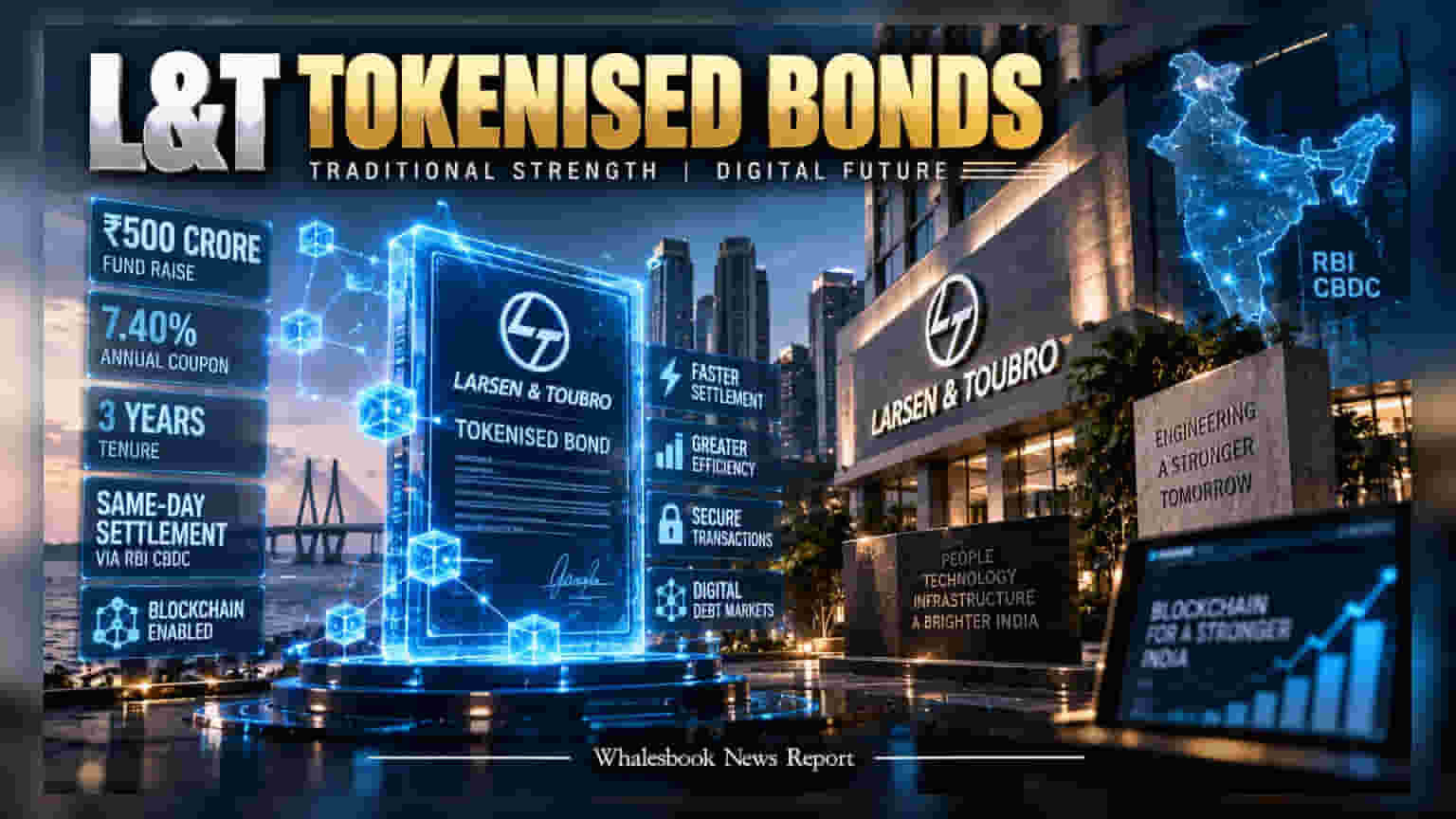
Larsen & Toubro is set to raise ₹500 crore through tokenised bonds with a three-year maturity and a 7.40% coupon rate. This move utilizes blockchain technology and the Reserve Bank of India's digital currency for same-day settlement. While significant for debt market modernization, this remains an experimental step restricted to institutional investors, with potential risks tied to liquidity and infrastructure readiness.
Larsen & Toubro (L&T) is taking a step into blockchain-based finance, with plans to raise ₹500 crore through a tokenised bond issuance. The company is offering three-year notes with an expected annual coupon rate of 7.40%. Unlike traditional corporate bonds that typically follow a multi-day settlement cycle, these tokenised instruments are designed to settle on the same day, a feature enabled by the Reserve Bank of India’s (RBI) central bank digital currency (CBDC).
Moving Toward Faster Debt Settlement
For a large infrastructure conglomerate like L&T, this issuance represents a shift toward more efficient debt market operations. Traditional bond settlements often involve clearing corporations and multi-step verification, which can take up to two days. By using tokenisation—where ownership and transfer are recorded on a blockchain—the company aims to eliminate these delays. This process relies on participants holding active CBDC wallets, essentially keeping the entire transaction within a digitized, regulatory-approved ecosystem. This initiative follows a recent successful pilot by state-owned REC, which raised ₹500 crore via tokenised bonds earlier this week, signaling that major Indian entities are actively testing these new digital funding channels.
Investor and Market Context
For investors, the primary takeaway is the focus on technological adoption rather than immediate financial impact. A ₹500 crore issuance is relatively small compared to the massive capital requirements and total borrowing profile of a company the size of L&T. Therefore, this move is less about a desperate need for capital and more about participating in the modernization of India's corporate debt infrastructure.
However, there are practical risks for the market to consider. Because the issuance is restricted to institutional investors equipped with specific CBDC wallets, the immediate pool of participants is narrow. This restriction could lead to limited liquidity in the secondary market for these specific bonds, at least until the infrastructure becomes more widespread. Furthermore, as this is an experimental phase for blockchain-based debt, the long-term legal and regulatory status of these instruments remains a space for observation. Investors may also note that while this model offers faster settlement, it requires a higher level of technical readiness compared to standard bond market operations. The success of this issuance will likely be monitored by regulators and market participants alike to determine if blockchain-based debt can move from a pilot project to a mainstream funding tool.