 Whalesbook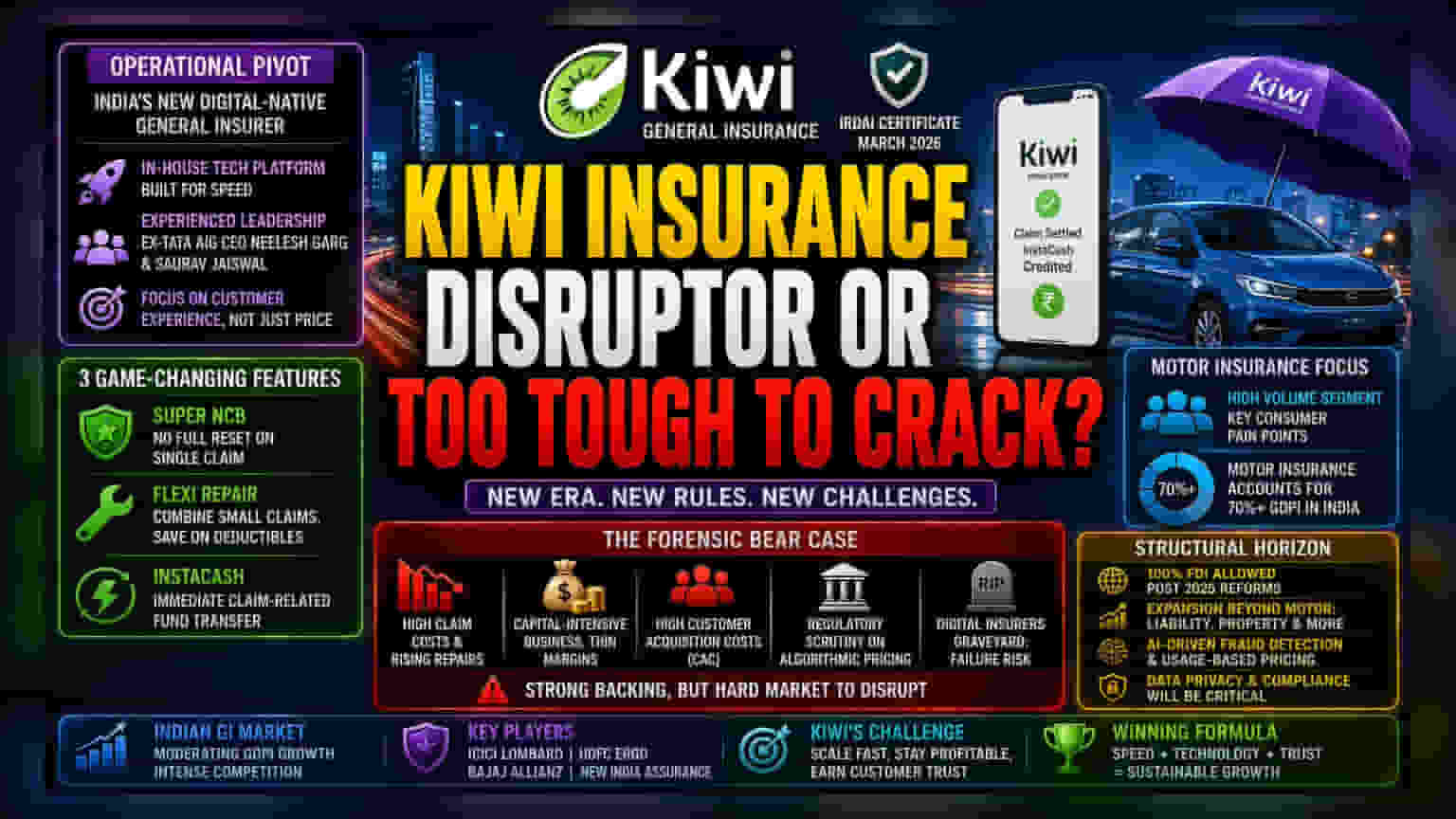


The Operational Pivot
Kiwi General Insurance, having secured its regulatory certificate from the Insurance Regulatory and Development Authority of India (IRDAI) in March 2026, has entered a domestic general insurance market that is increasingly defined by the battle between scale and technical agility. Unlike the industry norm, where legacy systems frequently anchor operational speed to manual intervention, Kiwi’s strategy centers on a proprietary, in-house technology platform. The company's leadership—comprising former Tata AIG CEO Neelesh Garg and industry veteran Saurav Jaiswal—is banking on the premise that India's insurance consumer is less concerned with lower premiums and more frustrated by the opaque, friction-heavy nature of current claim settlements.
The Competitive Differentiation
Kiwi’s entry strategy focuses on the motor insurance segment, a deliberate choice given its high transaction volume and historically documented consumer pain points. The company has introduced three functional features designed to reset customer expectations: a modified No-Claim Bonus (Super NCB) that prevents full reset upon a single claim, Flexi Repair to allow the aggregation of minor damage claims to avoid multiple deductibles, and InstaCash for immediate claim-related fund transfers. By addressing these specific friction points, the firm is attempting to bypass the commoditized price war that defines much of the private insurer competition in India, where incumbents like ICICI Lombard, HDFC ERGO, and Bajaj Allianz have long dominated via extensive agency networks.
The Forensic Bear Case
Despite the optimism surrounding its digital-native model, Kiwi faces a formidable environment. The Indian general insurance landscape is notoriously capital-intensive, with a combined ratio that remains highly sensitive to underwriting discipline and the rising cost of motor-related claims. While the company benefits from the financial backing of WestBridge Capital, it enters a sector currently seeing moderating growth in gross direct premium income (GDPI) due to broader economic pressures. Furthermore, new entrants in the Indian market often struggle with high customer acquisition costs (CAC) that can quickly erode the thin margins offered by motor insurance. Skeptics point to the graveyard of digital-first insurance platforms that attempted to disrupt the market over the last decade, only to be marginalized by established players with deep, multi-line distribution and existing economies of scale.
The Structural Horizon
While motor insurance serves as the initial anchor, the regulatory environment in India—bolstered by the 2025 legislative reforms allowing 100% foreign direct investment—provides a long-term runway for expansion into specialized liability and property coverage. However, the true test for Kiwi will not be its ability to launch an app, but its ability to maintain underwriting profitability while scaling its infrastructure. As the industry shifts toward AI-driven fraud detection and dynamic, usage-based pricing, Kiwi’s 'clean slate' approach provides a tactical advantage, provided it can navigate the complexities of data privacy and the intense regulatory scrutiny governing algorithmic pricing and claim payouts.