

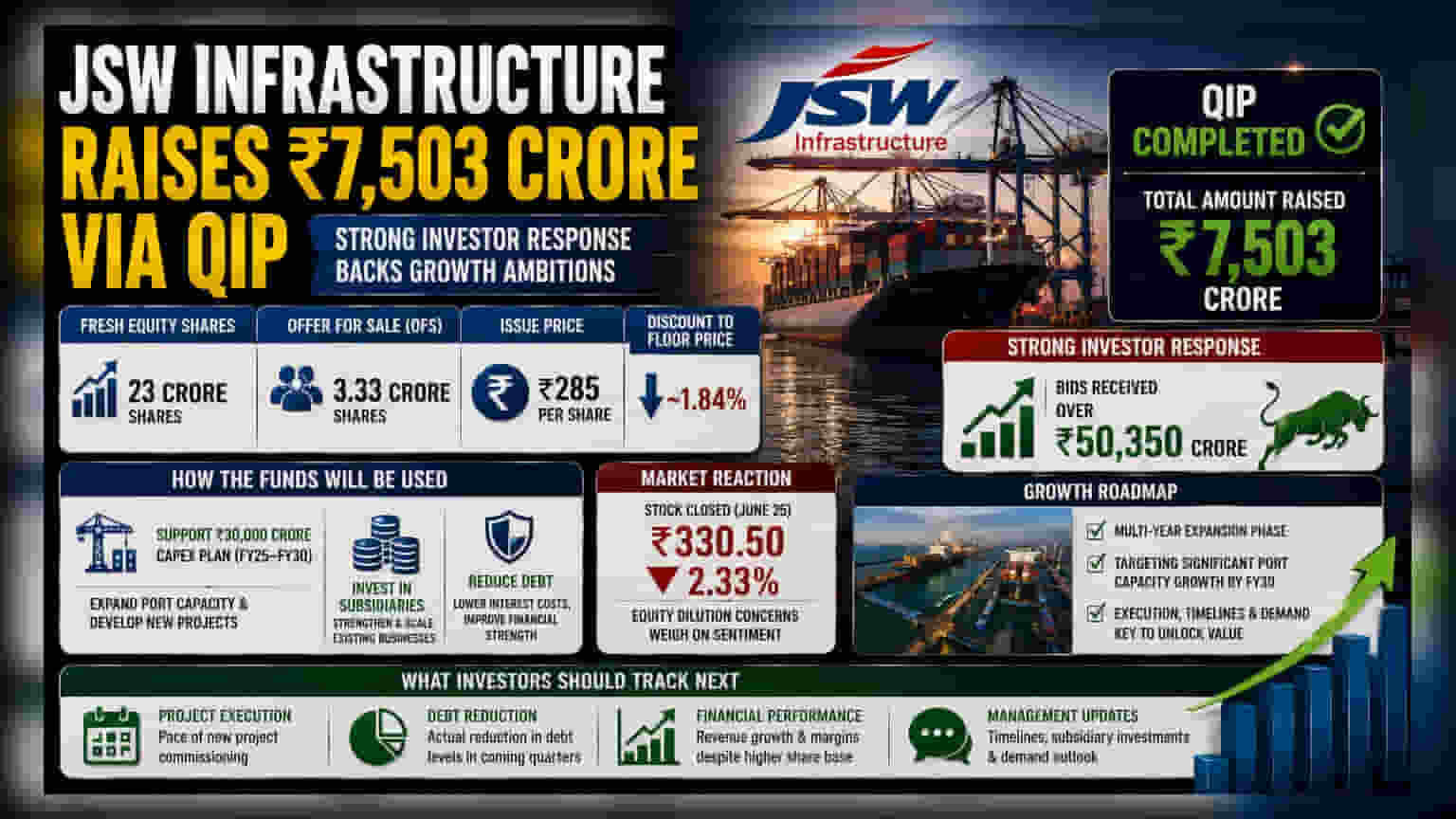
JSW Infrastructure has successfully completed its institutional fundraising, bringing in Rs 7,503 crore. The company issued 23 crore fresh equity shares and facilitated an offer for sale of 3.33 crore shares by promoters. While the funds aim to drive massive capacity expansion and reduce debt, investors are closely watching the impact of equity dilution on earnings per share.
What Happened
JSW Infrastructure has successfully concluded its Qualified Institutional Placement (QIP), raising a total of Rs 7,503 crore. The company’s finance committee approved the allotment of 23 crore fresh equity shares and 3.33 crore shares via an Offer for Sale (OFS) by the Sajjan Jindal Family Trust. The issue price was set at Rs 285 per share, which was a discount of approximately 1.84% against the SEBI floor price of Rs 290.35. The offering attracted strong demand, with bids totaling over Rs 50,350 crore, significantly exceeding the target size.
The Funding And Growth Strategy
The company is looking to utilize the fresh capital of Rs 6,555 crore to support its large-scale capital expenditure plans. JSW Infrastructure is currently in a multi-year growth phase, aiming to expand its port capacity significantly between FY25 and FY30, with a planned expenditure program of Rs 30,000 crore. These funds will be directed toward developing new projects, investing in subsidiaries, and reducing debt. For infrastructure companies, reducing debt is a critical move as it lowers interest costs, allowing a larger portion of operating profits to move to the bottom line.
How Investors Are Reading The Dilution
Following the announcement, JSW Infrastructure's stock closed 2.33% lower at Rs 330.50 on June 25. When a company issues a large number of fresh shares, it leads to 'equity dilution.' This means that existing shareholders now own a slightly smaller percentage of the total company, and future profits will be divided across a larger number of shares. Investors often react cautiously to such dilution until the company shows how this new capital translates into higher revenue and profit growth. The market is currently balancing the positive news of capital availability with the immediate effect of share dilution.
Execution And Project Risks
While the company has clear plans to expand, the infrastructure sector carries inherent risks. Large port projects require long lead times, complex regulatory approvals, and sustained demand from cargo and logistics partners. Investors should be aware that the actual benefit of this capital will depend on the company's ability to execute these projects on time and within budget. Any delays in commissioning new ports or slower-than-expected demand for cargo handling can pressure margins and delay the return on these investments.
What Investors Should Track Next
With the capital raised, the immediate focus for investors will shift to the execution of the company’s expansion pipeline. Key monitorables include the pace of new project commissioning, the actual reduction in debt levels in the coming quarters, and whether the company can maintain or improve its profit margins despite the expanded share base. Management commentary on the timeline for these new projects and the progress of its subsidiary investments will be essential updates for shareholders in upcoming quarterly reports.