

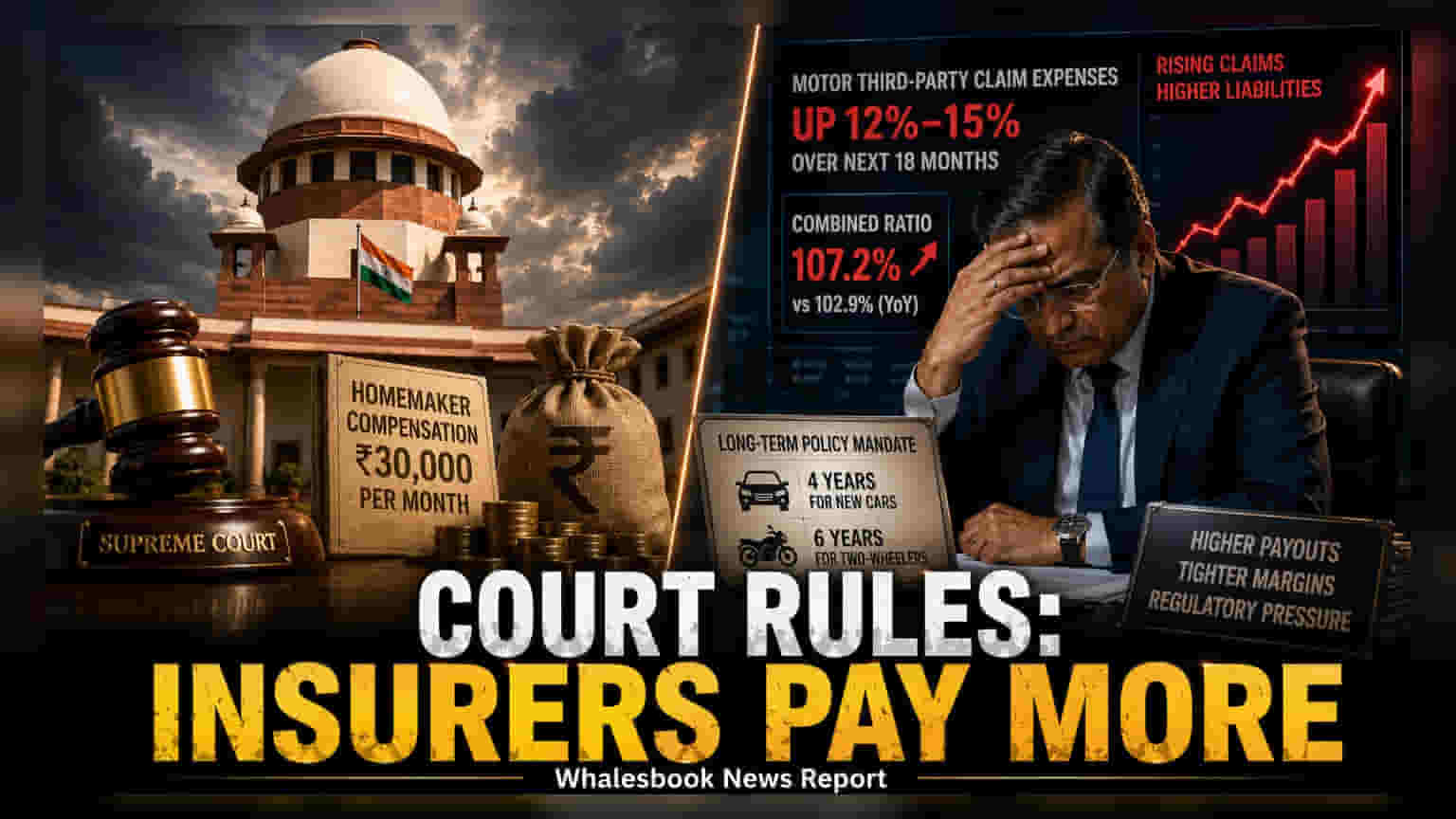
General insurers must increase claim reserves following a Supreme Court ruling setting a ₹30,000 monthly income for homemakers in accident claims. Additionally, new mandates extending third-party insurance tenures for new vehicles are creating pricing and underwriting uncertainty. These dual developments are expected to weigh on industry profitability and combined ratios in the coming months.
Indian general insurance companies are adjusting to a challenging financial environment following two major Supreme Court directives that have altered the landscape for motor third-party insurance. The combination of higher compensation payouts and new long-term policy mandates is creating immediate pressure on the balance sheets of insurers across the sector.
Impact of the Homemaker Compensation Ruling
The June 2026 ruling in the Shishu Pal v. Surjeet case is the primary driver of increased provisioning for insurers. By recognizing the role of homemakers and setting a notional monthly income of ₹30,000 for compensation calculations in accident claims, the court has significantly raised the liability for insurance companies. Industry estimates suggest this change alone could increase motor third-party claim expenses by 12% to 15% over the next 18 months, as courts apply this new benchmark to both pending and future accident claims.
Long-Term Tenure Mandates and Pricing Uncertainty
Beyond the homemaker ruling, insurers are navigating an August 2026 directive from the Supreme Court that extends mandatory third-party insurance tenures to four years for new cars and six years for two-wheelers. While this policy aims to improve the compliance rate of uninsured vehicles, it limits the flexibility of insurers to adjust premiums in response to rising claim costs. Underwriting these long-duration policies presents forecasting challenges, as insurers must balance fixed premium income against potentially rising inflation and medical costs years into the future.
Financial Impact on Insurers
Investors are closely watching how individual companies manage this transition. For instance, ICICI Lombard General Insurance recently added ₹165 crore to its motor third-party provisions during the June 2026 quarter specifically to account for the homemaker compensation ruling. This adjustment, combined with higher fire insurance claims, contributed to the company’s combined ratio—a key measure of underwriting profitability—rising to 107.2%, up from 102.9% in the previous year. A combined ratio above 100 indicates that a company is paying out more in claims and operating expenses than it collects in premiums.
Investor Monitorables
The insurance sector is also preparing for a potential pilot project aimed at linking fuel purchases with valid third-party insurance to address the high rate of uninsured vehicles. As these changes take effect, the key monitorable for investors will be whether insurers can maintain profit margins amid rising claim liabilities, particularly since motor third-party premium rates remain government-regulated. This regulation limits the ability of companies to pass on increased costs directly to policyholders, making operational efficiency and accurate provisioning critical for financial health.