 Whalesbook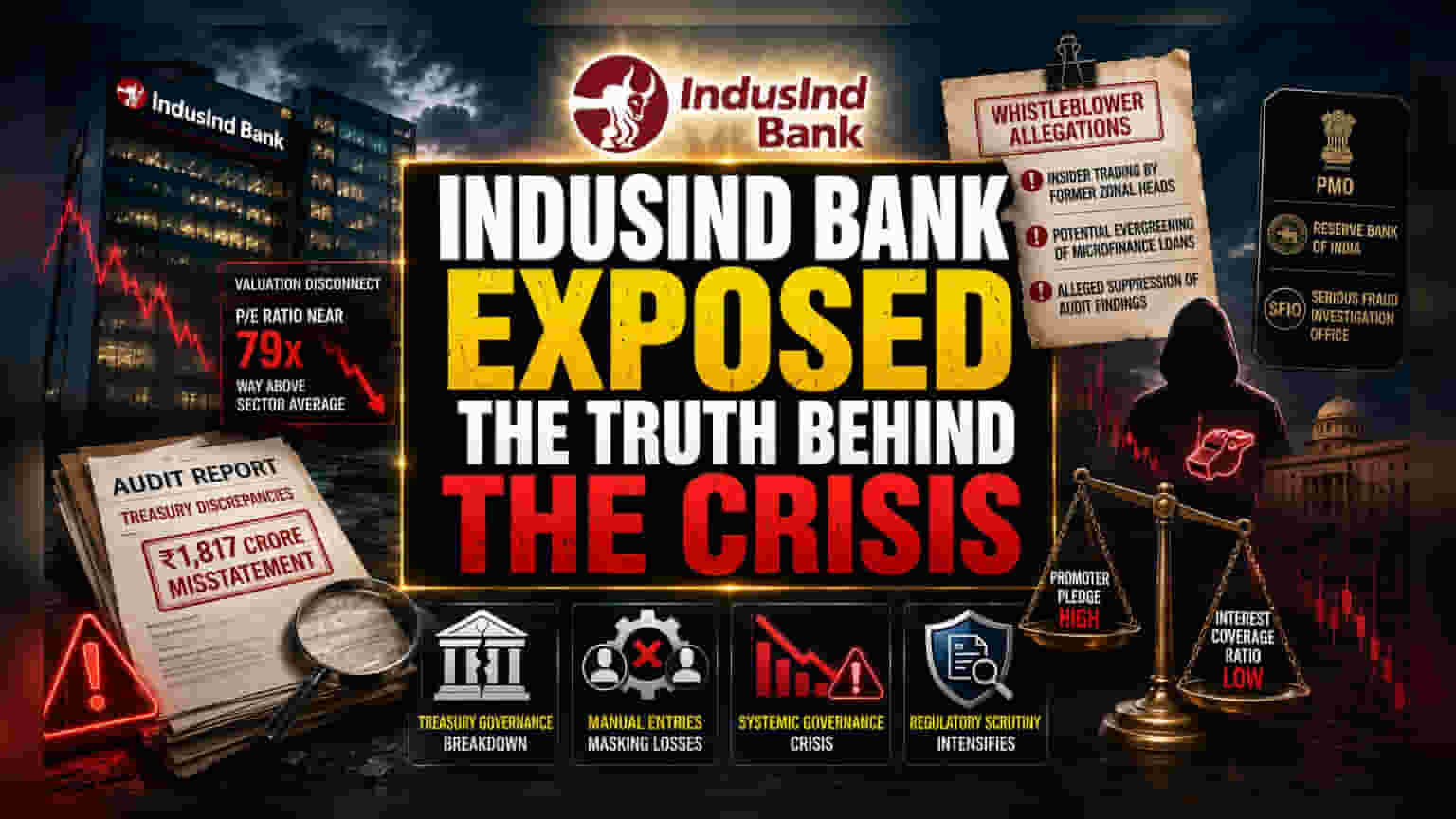


The Valuation Gap and Treasury Fragility
IndusInd Bank currently trades at a valuation that masks underlying operational instability. With a price-to-earnings ratio near 79x, the market is pricing in significant growth that appears increasingly disconnected from the bank’s actual earnings quality. The latest audit findings expose a fundamental breakdown in treasury governance, specifically a disconnection between the Asset Liability Management (ALM) desk and trading operations. By utilizing manual entries to mask trading losses, the bank effectively engineered a synthetic profitability that failed to account for accurate mark-to-market valuations on derivative portfolios. This reliance on manual manipulation, rather than systematic hedging, suggests a corporate culture that prioritized optics over rigorous risk oversight.
The Forensic Deep Dive
While the current focus is on the ₹1,817 crore misstatement, this is not an isolated event. Historical context confirms that the bank has been grappling with derivative portfolio discrepancies since early 2025. Previous internal and external reviews already identified significant unrealized losses that were systematically deferred until settlement. When benchmarked against larger private sector peers, IndusInd’s recurring reliance on complex manual overrides stands out as an outlier. Unlike institutions like HDFC Bank or ICICI Bank, which have prioritized robust, automated risk architectures, IndusInd’s treasury back-office has repeatedly demonstrated an ability to bypass standard maker-checker controls, creating a dangerous information asymmetry for investors.
The Forensic Bear Case
The risk profile for the bank has shifted from a one-time accounting correction to a systemic governance crisis. A new, high-stakes whistleblower complaint—currently circulating among the Prime Minister’s Office, the Reserve Bank of India, and the Serious Fraud Investigation Office—alleges a deeper rot: insider trading by former zonal heads and the potential evergreening of microfinance loans. These allegations are particularly damaging because they strike at the integrity of senior management and the independence of the audit committees. If regulators confirm that audit findings were suppressed or that management participated in the concealment of these losses, the bank could face heavy penalties, management reshuffles, or stricter operational limits that would further compress its already fragile margins. The combination of high pledge levels by promoters and a low interest coverage ratio exacerbates these risks, leaving the bank with a narrow margin for error in a volatile rate environment.
The Future Outlook
Analysts are increasingly divided on the bank's ability to navigate this period of heightened regulatory supervision. While the bank maintains that it has proactively addressed past discrepancies in line with regulatory expectations, the persistence of these issues has severely eroded market confidence. Investors are waiting to see whether upcoming board-level actions will move beyond internal reviews toward substantive structural changes. Until the bank can demonstrate a complete overhaul of its treasury controls and provide transparency on the recent whistleblower allegations, the stock remains highly susceptible to volatility triggered by any further regulatory intervention.