

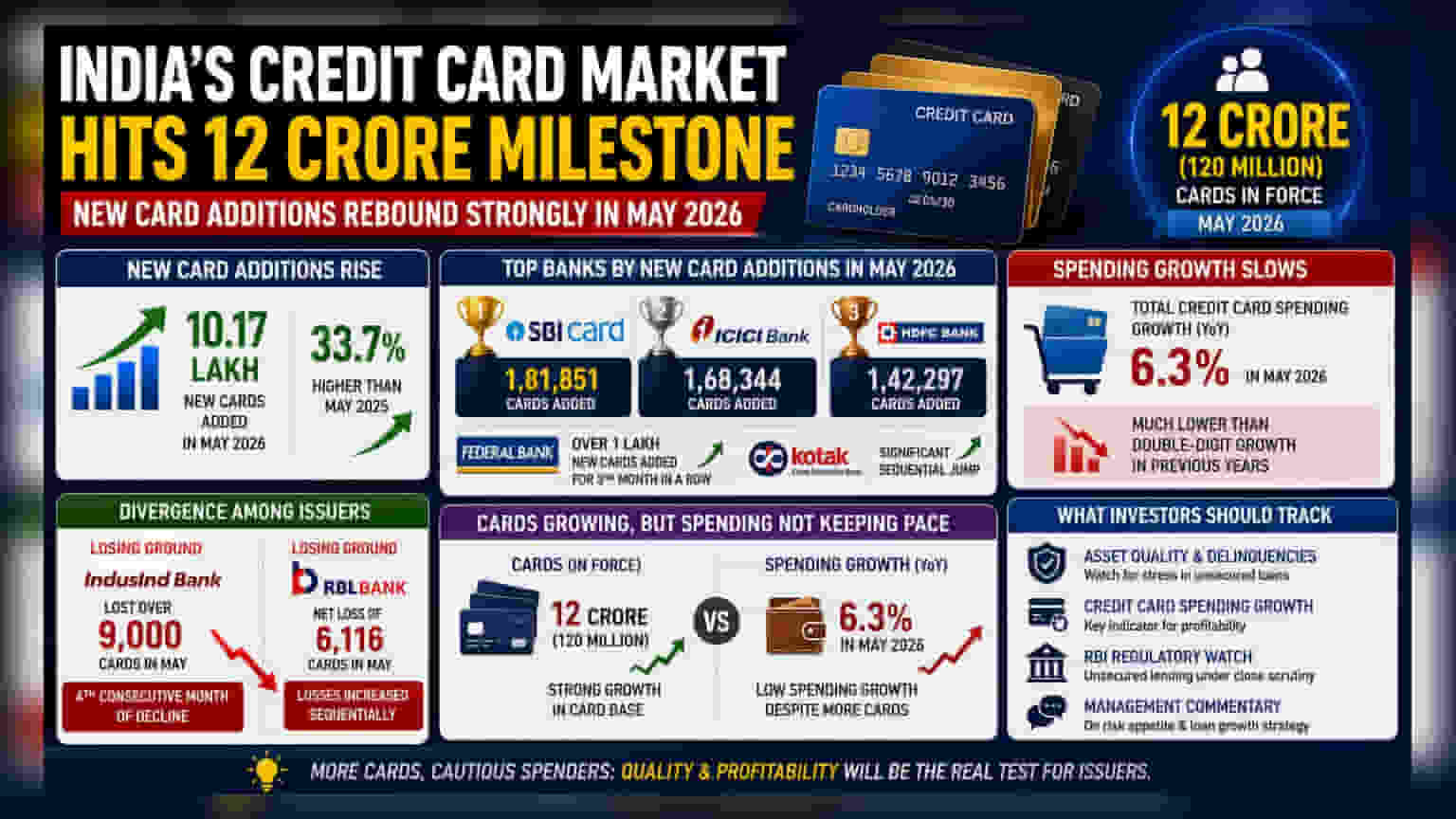
The Indian credit card industry reached 120 million cards in May 2026, with SBI Cards taking the top spot in new user acquisitions. While the number of cards in circulation is rising quickly, total consumer spending grew by a modest 6.3%, suggesting a shift in spending habits and a more cautious environment.
What Happened
In May 2026, the Indian credit card sector reached a milestone of 12 crore (120 million) cards in force. The data shows a strong rebound in new card additions, which rose to 10.17 lakh in May, a 33.7% increase compared to the same month last year. This recovery suggests that card issuers are aggressively pushing to grow their user base after a period of slower activity.
The Changing Leaderboard
State Bank of India Card and Payment Services (SBI Cards) stood out as the leader in new card additions, adding 1,81,851 cards in May. This performance placed it ahead of private sector giants ICICI Bank and HDFC Bank, which added 1,68,344 and 1,42,297 cards, respectively. Mid-tier players also showed notable activity; for instance, Federal Bank recorded over one lakh new card additions for the third month in a row, while Kotak Mahindra Bank saw a significant sequential jump.
The Spending Growth Slowdown
While the total number of cards is growing, actual spending by cardholders is not keeping pace. Total credit card spending in May rose by only 6.3% compared to May 2025. This rate is much lower than the double-digit growth seen in previous years. This gap between the number of cards being issued and the amount of money actually spent is a key indicator for investors. It suggests that while banks are successful at acquiring new customers, those customers are being more careful with their spending, or the new users have lower spending capacity than existing ones.
Divergence Among Issuers
Growth in the sector is not uniform. While some banks are adding users rapidly, others are struggling to keep their customer base. IndusInd Bank recorded a decline in its card base for the fourth consecutive month, losing over 9,000 cards in May. Similarly, RBL Bank saw its net card losses increase to 6,116. These trends show that the competition to retain and grow cardholders is intense, and smaller or mid-tier players face different operational pressures compared to the market leaders.
What Investors Should Track
Investors tracking this space should look beyond just the number of new cards issued. The critical monitorables include asset quality—specifically the level of bad loans or delinquencies—and the growth in credit card spending. The Reserve Bank of India has historically kept a close watch on unsecured lending, which includes credit cards. If spending growth remains low while the number of cards grows, it may pressure the profitability of issuers, as they still incur costs to acquire and maintain these users. Monitoring management commentary from these banks regarding their risk appetite and loan growth strategies will be essential in the coming quarters.