

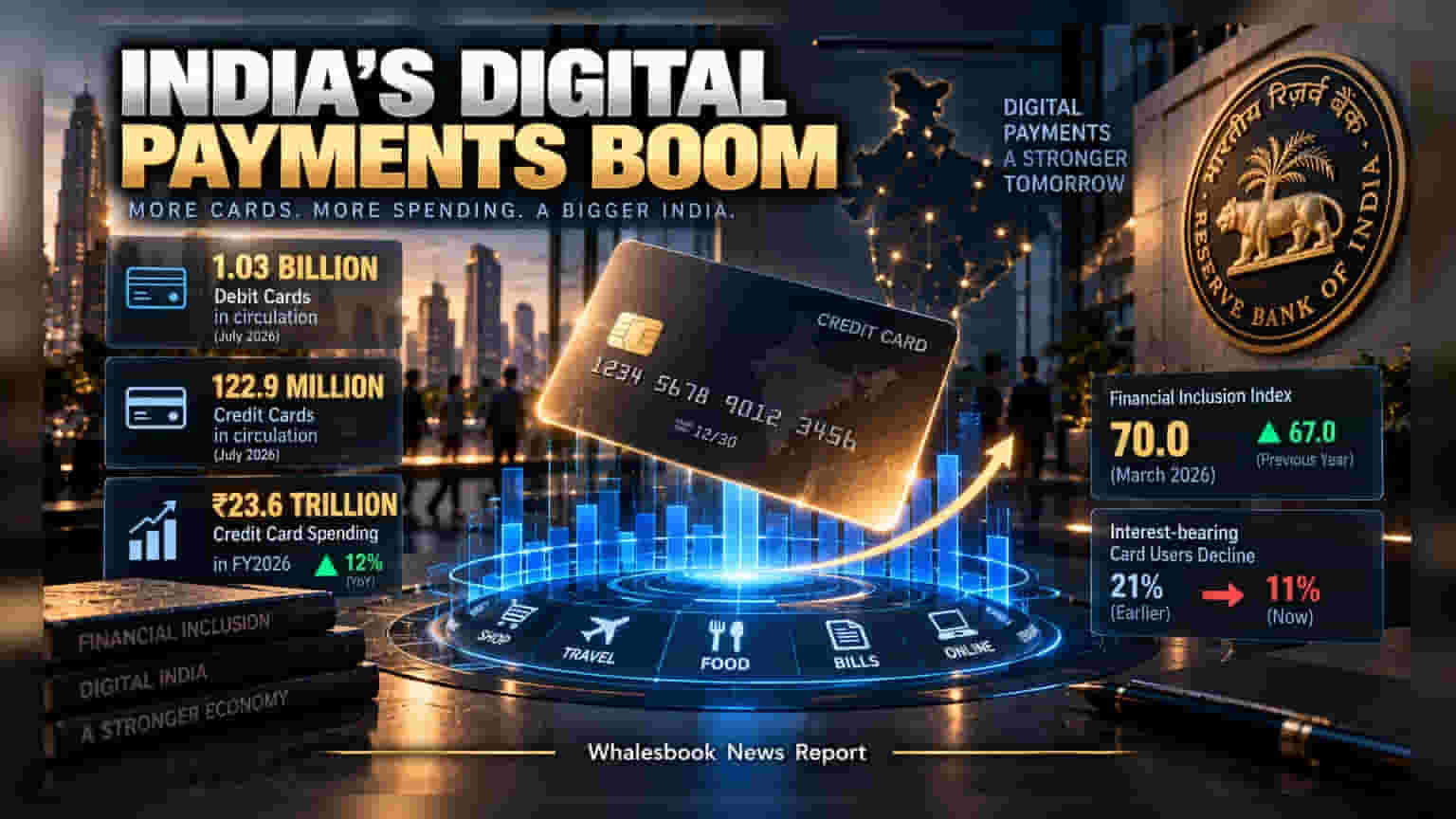
India’s credit card spending grew 12% to Rs 23.6 trillion in FY2026, supported by higher financial inclusion. While transaction volumes are rising, banks are facing profit margin pressure as fewer customers carry interest-bearing balances. Investors should track how credit card portfolios perform against these shifting income patterns.
India’s digital payment landscape has reached a new scale, with over 1.03 billion debit cards and 122.9 million credit cards in circulation as of July 2026. The Reserve Bank of India’s Financial Inclusion Index climbed to 70.0 in March 2026, up from 67.0 the prior year, illustrating that more Indians are participating in the formal financial system than ever before. This expansion has driven credit card spending to cross Rs 23.6 trillion in FY2026, marking a 12% increase over the previous year.
However, this growth in volume does not translate directly into higher profit for all lenders. Banks are currently navigating a squeeze on their profit margins, specifically within their credit card businesses. The proportion of credit card users who carry forward their balances—and thus pay interest to the bank—has dropped from 21% to 11%. As more consumers pay off their dues in full each month, the high-interest income that banks traditionally relied on from the credit segment is shrinking. This forces lenders to balance their aggressive push for new customers with the need to maintain profitability.
Another significant development occurred in August 2026, when Parliament passed the Taxation and Other Laws (Amendment) Bill. This legislation creates a framework that could allow for future Merchant Discount Rate (MDR) charges on specific UPI merchant transactions. While the government has not yet set any rates or timelines for such charges, the market is waiting to see how this might change the revenue model for digital payment providers and banks. Any implementation of these charges could shift how businesses and consumers interact with digital payment platforms.
Looking ahead, banks face the challenge of managing risk as they expand into the 'new-to-credit' population in rural areas. While these regions offer a large customer base, the lack of traditional credit history makes it difficult for lenders to assess risk accurately. Cybersecurity remains a constant area of concern as well; the rapid increase in transaction volume naturally brings higher exposure to fraud. Investors should monitor the upcoming quarterly bank results to see how credit card portfolios are performing and whether banks can offset the decline in interest-bearing balances through higher transaction volumes or improved operational efficiency.